## Diagram: Group Arrangement with Numbered Entities
### Overview
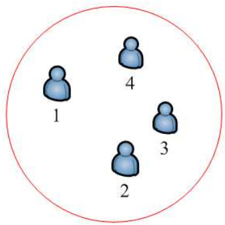
The image depicts a circular boundary (red outline) containing four abstract human figures (blue silhouettes) labeled with sequential numbers (1, 2, 3, 4). The figures are positioned asymmetrically within the circle, with no explicit directional flow or connecting elements.
### Components/Axes
- **Primary Elements**:
- Red circular boundary (encloses all figures)
- Four blue human silhouettes (labeled 1–4)
- **Labels**:
- "1" (top-left quadrant)
- "2" (bottom-left quadrant)
- "3" (bottom-right quadrant)
- "4" (top-right quadrant)
- **No legends, axis titles, or additional text** are present.
### Detailed Analysis
- **Spatial Distribution**:
- Figures are distributed across quadrants but not equidistant from the circle’s center.
- Figure 1 (top-left) and Figure 4 (top-right) are closer to the circle’s upper boundary.
- Figure 2 (bottom-left) and Figure 3 (bottom-right) are positioned lower within the circle.
- **Labeling Pattern**:
- Numbers increase clockwise (1 → 2 → 3 → 4), but spatial placement does not follow a strict clockwise order (e.g., Figure 4 is placed diagonally opposite Figure 1).
### Key Observations
1. All figures are contained within the red boundary, suggesting a collective or grouped relationship.
2. The absence of connecting lines or directional indicators implies no explicit hierarchy or workflow.
3. The numbering (1–4) may imply prioritization, sequencing, or identification but lacks contextual clues (e.g., no legend explaining the numbers).
### Interpretation
The diagram likely represents a conceptual grouping of entities (e.g., team members, stakeholders, or processes) within a shared scope (the red circle). The numbered labels could denote roles, priorities, or identifiers, but the lack of additional context (e.g., labels explaining the numbers, directional arrows, or explanatory text) limits definitive interpretation. The asymmetrical placement of figures might suggest variability in importance, positioning, or function, but this remains speculative without further information. The simplicity of the diagram emphasizes the collective containment of entities rather than their individual relationships.