## Screenshot: Step Proof Software Interface
### Overview
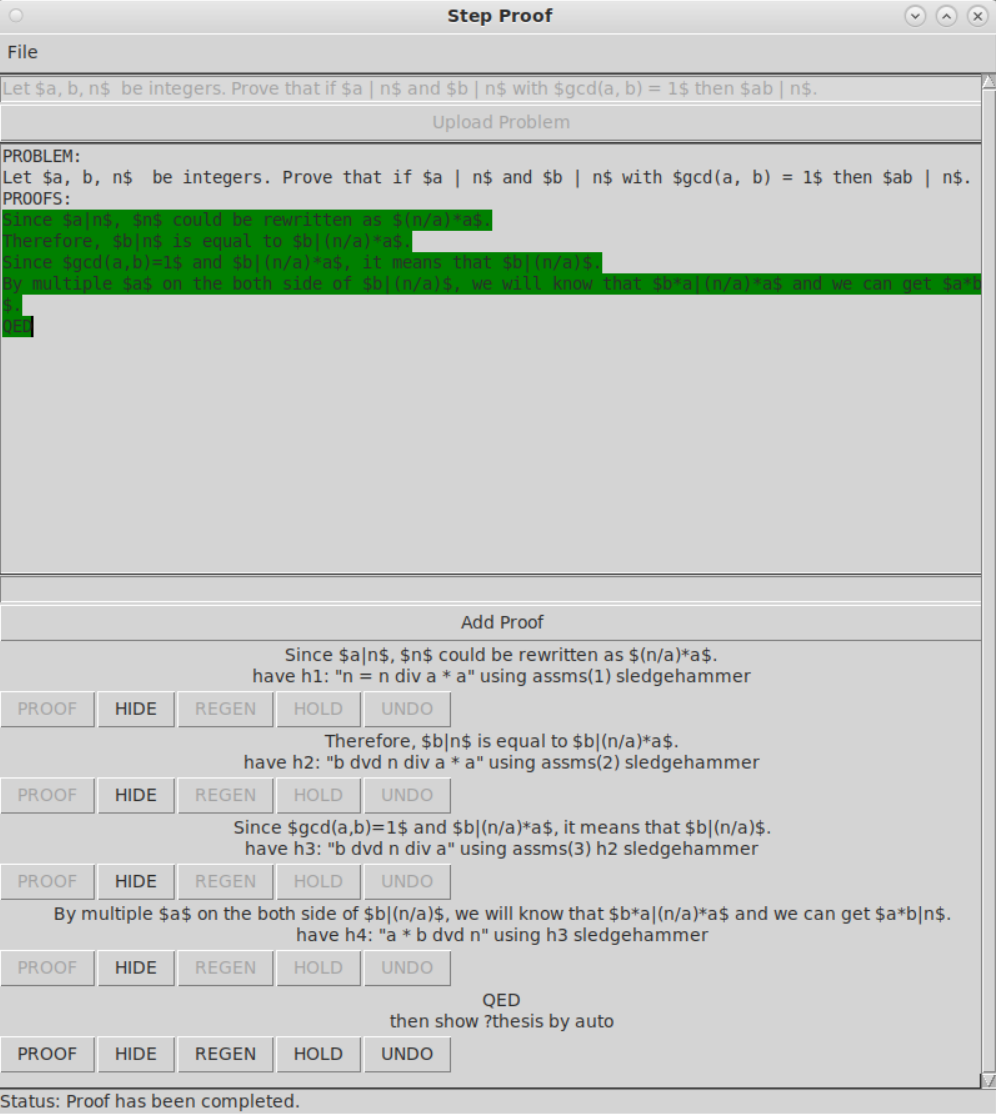
The image displays a graphical user interface (GUI) of a software application named "Step Proof." The application appears to be a proof assistant or educational tool for constructing and verifying mathematical proofs. The interface shows a completed step-by-step proof for a number theory problem concerning integer divisibility and the greatest common divisor (GCD).
### Components/Axes (UI Elements)
The interface is structured into several distinct regions:
1. **Window Frame & Title Bar:**
* Title: "Step Proof"
* Standard window control buttons (minimize, maximize, close) are visible in the top-right corner.
2. **Menu Bar:**
* Contains a single menu item: "File".
3. **Problem Statement Area:**
* A button labeled "Upload Problem" is centered above the main text area.
* The problem is stated in a monospaced font:
* **Header:** "PROBLEM:"
* **Statement:** "Let $a, b, n$ be integers. Prove that if $a | n$ and $b | n$ with $gcd(a, b) = 1$ then $ab | n$."
* **Header:** "PROOFS:"
4. **Proof Construction Area (Main Text Box):**
* This area contains the user-written or generated proof, with completed logical steps highlighted in green.
* The text is a mix of natural language and mathematical notation (using `$` as inline math delimiters).
* **Transcription of Proof Text:**
* "Since $a|n$, $n$ could be rewritten as $(n/a)*a$."
* "Therefore, $b|n$ is equal to $b|(n/a)*a$."
* "Since $gcd(a,b)=1$ and $b|(n/a)*a$, it means that $b|(n/a)$."
* "By multiple $a$ on the both side of $b|(n/a)$, we will know that $b*a|(n/a)*a$ and we can get $a*b|n$."
* "QED"
5. **Interactive Proof Step Panel ("Add Proof"):**
* This section below the main text box breaks the proof into discrete, interactive steps. Each step has a descriptive line and a corresponding formal tactic line.
* **Step h1:**
* Description: "Since $a|n$, $n$ could be rewritten as $(n/a)*a$."
* Tactic: `have h1: "n = n div a * a" using assms(1) sledgehammer`
* **Step h2:**
* Description: "Therefore, $b|n$ is equal to $b|(n/a)*a$."
* Tactic: `have h2: "b dvd n div a * a" using assms(2) sledgehammer`
* **Step h3:**
* Description: "Since $gcd(a,b)=1$ and $b|(n/a)*a$, it means that $b|(n/a)$."
* Tactic: `have h3: "b dvd n div a" using assms(3) h2 sledgehammer`
* **Step h4:**
* Description: "By multiple $a$ on the both side of $b|(n/a)$, we will know that $b*a|(n/a)*a$ and we can get $a*b|n$."
* Tactic: `have h4: "a * b dvd n" using h3 sledgehammer`
* **Final Step:**
* Text: "QED"
* Tactic: `then show ?thesis by auto`
* **Control Buttons:** Each proof step (h1-h4 and the final step) is accompanied by a row of five buttons: `PROOF`, `HIDE`, `REGEN`, `HOLD`, `UNDO`.
6. **Status Bar:**
* Located at the very bottom of the window.
* Text: "Status: Proof has been completed."
### Detailed Analysis / Content Details
* **Problem Type:** The problem is a classic theorem in elementary number theory: If two coprime integers (`a` and `b`) both divide a third integer (`n`), then their product (`ab`) also divides `n`.
* **Proof Logic:** The proof follows a standard structure:
1. Express `n` as `a * (n/a)` using the premise `a | n`.
2. Substitute this into the premise `b | n` to get `b | a*(n/a)`.
3. Apply Euclid's Lemma (which relies on `gcd(a,b)=1`) to conclude `b | (n/a)`.
4. Multiply both sides of the divisibility relation by `a` to arrive at `ab | n`.
* **Software Functionality:** The interface suggests an interactive theorem prover. The "sledgehammer" tactic references indicate the use of automated reasoning tools to find proofs. The buttons (`PROOF`, `REGEN`, etc.) imply users can step through, regenerate, or modify individual proof steps.
### Key Observations
1. **Visual Feedback:** The green highlighting in the main text box clearly indicates which parts of the informal proof have been successfully formalized or verified by the system.
2. **Dual Representation:** The software maintains both a human-readable, informal proof description and a corresponding formal, machine-oriented tactic script for each step.
3. **Proof Completion:** The status bar and the final "QED" / `show ?thesis by auto` step confirm the proof has been successfully completed and verified by the system.
4. **Language:** The primary language of the interface and proof text is English. The mathematical notation is language-agnostic.
### Interpretation
This screenshot captures a successful interaction with a sophisticated educational or research tool for formal mathematics. It demonstrates how such software bridges the gap between intuitive, human-written proofs and the rigorous, step-by-step verification required by a computer.
The data (the proof steps) shows a logically sound and complete argument. The interface elements reveal the tool's pedagogical or exploratory nature: it allows users to construct proofs incrementally, get automated assistance ("sledgehammer"), and review or modify each step. The clear separation between the informal reasoning and the formal tactics helps users learn how to translate mathematical ideas into a formal system.
The "Upload Problem" button suggests this is part of a larger workflow where users can input their own theorems to prove. The overall state—"Proof has been completed"—represents the successful endpoint of that workflow for this specific divisibility theorem.