## Pie Chart: GPT4 Pattern Identification Accuracy
### Overview
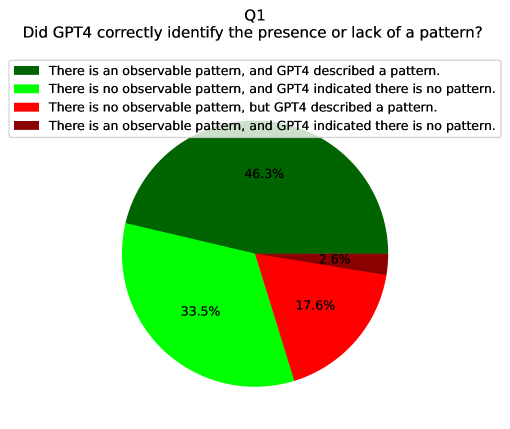
The image is a pie chart that visualizes the accuracy of GPT4 in identifying the presence or absence of patterns. The chart breaks down the results into four categories, each representing a different combination of actual pattern presence and GPT4's identification.
### Components/Axes
* **Title:** Q1 Did GPT4 correctly identify the presence or lack of a pattern?
* **Legend (Top-Left):**
* Dark Green: There is an observable pattern, and GPT4 described a pattern.
* Lime Green: There is no observable pattern, and GPT4 indicated there is no pattern.
* Red: There is no observable pattern, but GPT4 described a pattern.
* Dark Red: There is an observable pattern, and GPT4 indicated there is no pattern.
* **Pie Chart Slices:**
* Dark Green: 46.3%
* Lime Green: 33.5%
* Red: 17.6%
* Dark Red: 2.6%
### Detailed Analysis
* **Dark Green Slice:** Represents instances where there was an observable pattern, and GPT4 correctly identified and described it. This slice occupies 46.3% of the pie chart.
* **Lime Green Slice:** Represents instances where there was no observable pattern, and GPT4 correctly indicated the absence of a pattern. This slice occupies 33.5% of the pie chart.
* **Red Slice:** Represents instances where there was no observable pattern, but GPT4 incorrectly described a pattern. This slice occupies 17.6% of the pie chart.
* **Dark Red Slice:** Represents instances where there was an observable pattern, but GPT4 incorrectly indicated the absence of a pattern. This slice occupies 2.6% of the pie chart.
### Key Observations
* GPT4 correctly identified patterns (or lack thereof) in the majority of cases (46.3% + 33.5% = 79.8%).
* GPT4 was more likely to incorrectly identify a pattern when none existed (17.6%) than to miss a pattern that was present (2.6%).
### Interpretation
The pie chart suggests that GPT4 is generally accurate in identifying patterns. However, it is more prone to false positives (identifying patterns where none exist) than false negatives (missing existing patterns). This could indicate a bias in the model towards finding patterns, even when they are not truly present. The high percentage of correct identifications (79.8%) suggests that GPT4 is a useful tool for pattern recognition, but its tendency towards false positives should be considered when interpreting its results.