\n
## Pie Chart: Q1 - GPT4 Pattern Identification Accuracy
### Overview
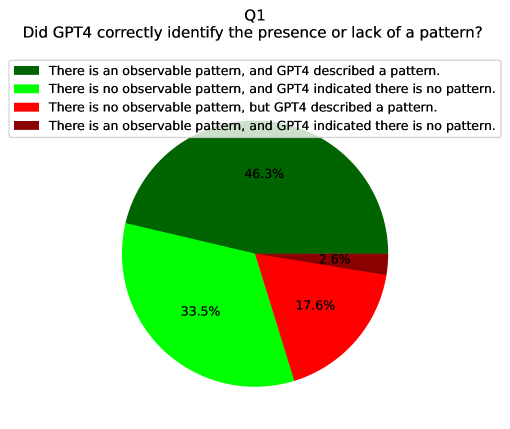
This image presents a pie chart visualizing the results of a question (Q1) regarding GPT-4's ability to correctly identify the presence or lack of a pattern. The chart displays the percentage distribution of four different response scenarios.
### Components/Axes
* **Title:** Q1 - Did GPT4 correctly identify the presence or lack of a pattern?
* **Legend:** Located at the top-left of the chart.
* **Green:** There is an observable pattern, and GPT4 described a pattern.
* **Light Green:** There is no observable pattern, and GPT4 indicated there is no pattern.
* **Red:** There is no observable pattern, but GPT4 described a pattern.
* **Dark Red:** There is an observable pattern, and GPT4 indicated there is no pattern.
* **Pie Chart:** The main visual element, divided into four colored segments representing the percentages of each scenario.
### Detailed Analysis
The pie chart segments represent the following data:
* **Green Segment:** Represents 46.3% of the responses. This corresponds to cases where a pattern was present and GPT-4 correctly identified it.
* **Light Green Segment:** Represents 33.5% of the responses. This corresponds to cases where no pattern was present, and GPT-4 correctly indicated its absence.
* **Red Segment:** Represents 17.6% of the responses. This corresponds to cases where no pattern was present, but GPT-4 incorrectly identified a pattern.
* **Dark Red Segment:** Represents 2.6% of the responses. This corresponds to cases where a pattern was present, but GPT-4 incorrectly indicated its absence.
### Key Observations
* The largest proportion of responses (46.3%) indicates that GPT-4 correctly identifies patterns when they exist.
* A substantial portion of responses (33.5%) shows GPT-4 correctly identifies the absence of patterns.
* GPT-4 incorrectly identifies patterns more frequently (17.6%) than it fails to identify existing patterns (2.6%). This suggests a bias towards identifying patterns even when they are not present.
### Interpretation
The data suggests that GPT-4 demonstrates a reasonable ability to identify both the presence and absence of patterns. However, the higher error rate in falsely identifying patterns (17.6% vs. 2.6%) indicates a potential tendency towards "seeing" patterns where none exist. This could be due to the model's inherent complexity and its attempt to find structure even in random data. The combined percentage of correct identifications (46.3% + 33.5% = 79.8%) suggests a generally good performance, but the error distribution warrants further investigation to understand the conditions under which GPT-4 is more likely to make incorrect pattern identifications. The question is designed to test the model's ability to avoid false positives in pattern recognition.