## Scatter Plot: Percentage of Charging Plugs Over Time
### Overview
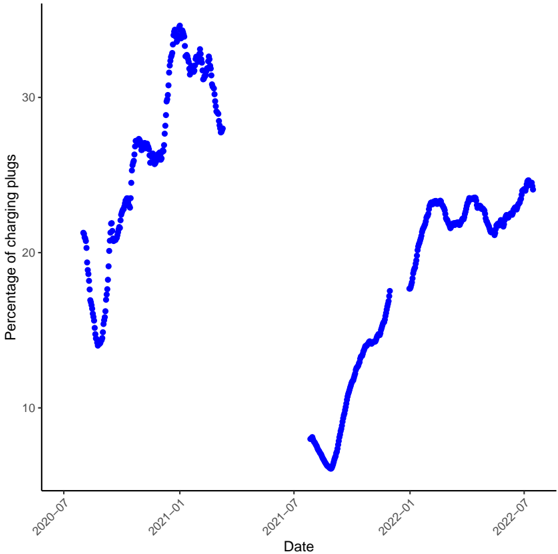
The image is a scatter plot chart displaying the percentage of charging plugs over a time period from approximately July 2020 to July 2022. The data is represented by a dense series of blue circular markers, forming two distinct temporal segments with a visible gap in the middle of 2021. The chart illustrates fluctuations and trends in the adoption or utilization of charging infrastructure.
### Components/Axes
* **Chart Type:** Scatter plot (dense, forming a line-like trend).
* **X-Axis (Horizontal):**
* **Label:** "Date"
* **Scale:** Chronological, with major tick marks labeled at six-month intervals.
* **Tick Labels (from left to right):** "2020-07", "2021-01", "2021-07", "2022-01", "2022-07".
* **Y-Axis (Vertical):**
* **Label:** "Percentage of charging plugs" (text is rotated 90 degrees).
* **Scale:** Linear, numerical percentage.
* **Tick Labels (from bottom to top):** "10", "20", "30".
* **Data Series:** A single series represented by blue circular markers. There is no legend, indicating one category of data is being tracked.
* **Spatial Layout:** The plot area is bounded by a left (Y) axis and a bottom (X) axis. The data points are distributed across the central plot area.
### Detailed Analysis
The data can be segmented into two primary periods based on a clear gap in observations around mid-2021.
**Segment 1: July 2020 to ~April 2021**
* **Trend:** Highly volatile with a general upward trend followed by a sharp decline.
* **Data Points:**
* Starts around July 2020 at approximately 21%.
* Experiences a sharp dip to a local minimum of ~14% in late 2020.
* Rises steeply to reach the global peak of the entire chart, approximately 34%, around January 2021.
* After the peak, the percentage fluctuates between ~28% and ~33% before beginning a steep decline.
* The segment ends around April 2021 at approximately 28%.
**Gap Period: ~April 2021 to ~August 2021**
* There is a complete absence of data points for roughly four months in the middle of 2021.
**Segment 2: ~August 2021 to July 2022**
* **Trend:** Starts at a low point, dips further, then follows a strong and sustained upward trend with minor fluctuations.
* **Data Points:**
* The series resumes at a much lower value, approximately 8%, around August 2021.
* It immediately dips to the global minimum of the chart, approximately 6%, shortly after resuming.
* From this low, it begins a strong, relatively steady climb, crossing the 10% mark by late 2021.
* The upward trajectory continues, surpassing 20% by early 2022.
* The series shows some volatility between 21% and 24% in the first half of 2022.
* It ends at its highest point for this segment, approximately 24%, in July 2022.
### Key Observations
1. **Bimodal Distribution:** The data is clearly split into two distinct time periods with a significant data gap, suggesting a possible change in measurement methodology, a market disruption, or a pause in data collection.
2. **Volatility vs. Stability:** The first segment (2020-2021) is characterized by high volatility and a dramatic peak-and-crash pattern. The second segment (2021-2022) shows a more stable, sustained growth trend after an initial low.
3. **Peak and Trough:** The highest recorded value (~34%) occurred in early 2021, while the lowest (~6%) occurred in late 2021, marking a dramatic reversal.
4. **Recovery and Growth:** Despite starting the second segment at a very low base, the data shows a strong recovery, with the final value (~24%) approaching the levels seen in the first segment.
### Interpretation
The chart depicts a non-linear adoption or utilization curve for charging plugs. The initial volatility and peak in early 2021 could correspond to an early adoption phase, possibly driven by specific incentives, pilot programs, or a surge in early-adopter electric vehicle purchases, followed by a correction or saturation point.
The significant data gap is a critical anomaly. It may indicate a major event such as a change in how "charging plugs" are defined or counted, a large-scale infrastructure project pause, or a shift in data reporting standards.
The second segment tells a story of recovery and more organic, sustained growth. Starting from a low base in late 2021, the steady upward trend suggests a maturing market, broader consumer adoption of electric vehicles, or consistent investment in charging infrastructure. The fact that the percentage in mid-2022 (~24%) is still below the early 2021 peak (~34%) indicates that while growth has resumed, the market has not yet returned to the previous high-water mark of plug percentage, which could be due to the total number of plugs growing slower than the total number of vehicles, or other market dynamics.