## Line Graphs and Histograms: Human Consistency and Accuracy Analysis
### Overview
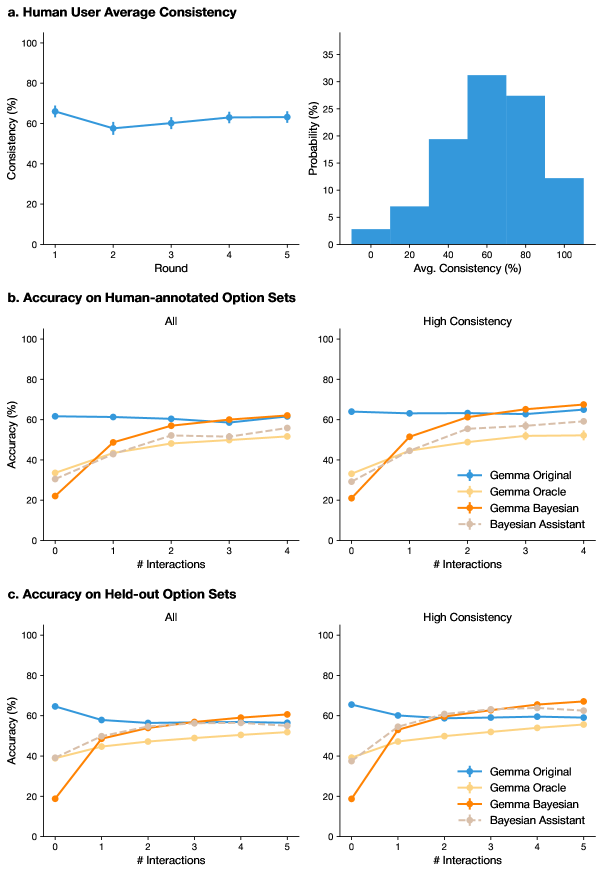
The image contains six visualizations analyzing human consistency and accuracy across different interaction scenarios. Key elements include line graphs tracking performance over rounds/interactions and a histogram showing consistency distribution. Four data series are compared: Gemma Original, Gemma Oracle, Gemma Bayesian, and Bayesian Assistant.
### Components/Axes
1. **Top Left (a. Human User Average Consistency)**
- X-axis: "Round" (1–5)
- Y-axis: "Consistency (%)" (0–100)
- Data: Blue line with markers showing slight dip in Round 2, stabilizing at ~60–65% thereafter.
2. **Top Right (b. Accuracy on Human-annotated Option Sets)**
- X-axis: "Avg. Consistency (%)" (0–100)
- Y-axis: "Probability (%)" (0–35)
- Data: Blue histogram bars peaking at 60–80% consistency.
3. **Middle Left (c. Accuracy on Held-out Option Sets - All)**
- X-axis: "# Interactions" (0–5)
- Y-axis: "Accuracy (%)" (0–100)
- Data: Four lines (blue, yellow, orange, gray) representing different models.
4. **Middle Right (High Consistency Subset)**
- Same axes as Middle Left but filtered for high-consistency users.
5. **Bottom Left (c. Accuracy on Held-out Option Sets - All)**
- Same as Middle Left but extended to 5 rounds.
6. **Bottom Right (High Consistency Subset)**
- Same as Middle Right but extended to 5 rounds.
### Detailed Analysis
#### a. Human User Average Consistency
- **Trend**: Consistency starts at ~65% (Round 1), drops to ~58% (Round 2), then rises to ~62% (Round 3) and stabilizes (~63–64%) in Rounds 4–5.
- **Uncertainty**: Approximate values due to lack of gridlines; error bars not visible.
#### b. Accuracy on Human-annotated Option Sets
- **Distribution**: 70% of users fall within 60–80% consistency. Lower tails (0–40%) have negligible probability.
#### c. Accuracy on Held-out Option Sets (All)
- **Gemma Original (Blue)**: Starts at ~62% (0 interactions), dips to ~58% (Round 5).
- **Gemma Oracle (Yellow)**: Starts at ~30% (0 interactions), rises to ~50% (Round 5).
- **Gemma Bayesian (Orange)**: Starts at ~20% (0 interactions), surges to ~60% (Round 5).
- **Bayesian Assistant (Gray)**: Starts at ~35% (0 interactions), reaches ~55% (Round 5).
#### High Consistency Subset
- **Trends**: All models show steeper improvement. Gemma Bayesian jumps from ~25% (0 interactions) to ~65% (Round 5).
### Key Observations
1. **Consistency Stability**: Human users maintain ~60–65% consistency across rounds, with minor fluctuations.
2. **Model Performance**:
- Gemma Bayesian outperforms others in held-out sets, especially with high consistency users.
- Bayesian Assistant shows moderate improvement but lags behind Gemma Bayesian.
3. **Interaction Impact**: Accuracy improves significantly with more interactions for all models.
### Interpretation
- **Human Behavior**: Stable consistency suggests reliable user performance, though slight dips may indicate task fatigue or learning curves.
- **Model Efficacy**:
- Gemma Bayesian’s rapid improvement implies strong adaptability to user feedback.
- Oracle and Assistant models perform better with high-consistency users, highlighting the importance of data quality.
- **Practical Implications**: Bayesian models (Gemma Bayesian, Bayesian Assistant) are more effective in dynamic environments requiring iterative learning. High-consistency users may represent a subset where models achieve near-human performance.
*Note: All values are approximate due to the absence of gridlines or exact numerical labels in the image.*