## Bar Chart: Number of Questions by Path Length in SPARQL
### Overview
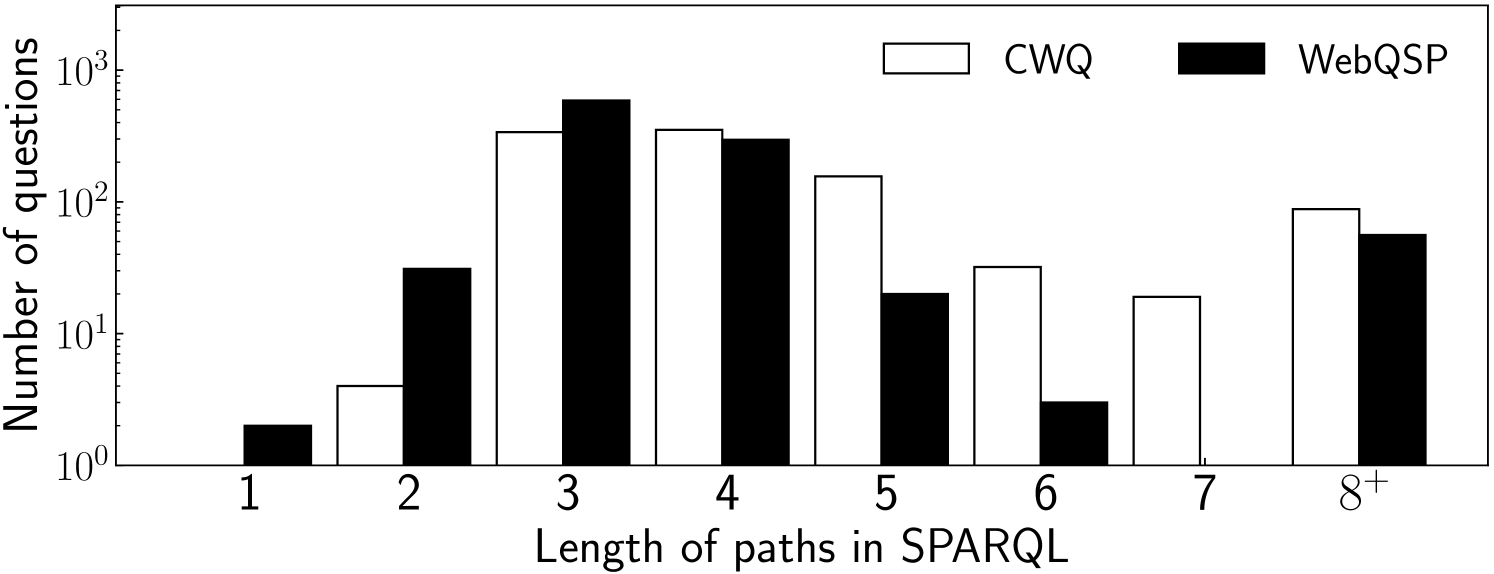
The chart compares the distribution of questions across two datasets (CWQ and WebQSP) based on the length of paths in SPARQL queries. The y-axis uses a logarithmic scale (10⁰ to 10³) to represent the number of questions, while the x-axis categorizes path lengths from 1 to 8.
### Components/Axes
- **X-axis**: "Length of paths in SPARQL" (categories: 1, 2, 3, 4, 5, 6, 7, 8).
- **Y-axis**: "Number of questions" (logarithmic scale: 10⁰, 10¹, 10², 10³).
- **Legend**:
- White bars: CWQ (top-right legend).
- Black bars: WebQSP (top-right legend).
- **Placement**: Legend is positioned in the top-right corner, aligned with the chart.
### Detailed Analysis
- **Path Length 1**:
- WebQSP: ~2 questions (10⁰.3).
- CWQ: 0 questions.
- **Path Length 2**:
- WebQSP: ~50 questions (10¹.7).
- CWQ: ~5 questions (10⁰.7).
- **Path Length 3**:
- WebQSP: ~800 questions (10².9).
- CWQ: ~500 questions (10².7).
- **Path Length 4**:
- WebQSP: ~500 questions (10².7).
- CWQ: ~500 questions (10².7).
- **Path Length 5**:
- WebQSP: ~150 questions (10².2).
- CWQ: ~150 questions (10².2).
- **Path Length 6**:
- WebQSP: ~30 questions (10¹.5).
- CWQ: ~30 questions (10¹.5).
- **Path Length 7**:
- WebQSP: 0 questions.
- CWQ: ~15 questions (10¹.2).
- **Path Length 8**:
- WebQSP: ~70 questions (10¹.9).
- CWQ: ~100 questions (10²).
### Key Observations
1. **Dominance of WebQSP**: WebQSP consistently has higher question counts for path lengths 1–5 and 8, with peaks at lengths 3 and 4.
2. **CWQ Prevalence at Longer Paths**: CWQ surpasses WebQSP at path lengths 7 and 8, with a notable increase at length 8.
3. **Symmetry at Lengths 3–5**: Both datasets show similar magnitudes at lengths 3–5, suggesting overlapping query complexity.
4. **Missing Data**: WebQSP has no questions at length 7, while CWQ has a moderate count.
5. **Logarithmic Scale Impact**: The exponential spread of values emphasizes the disparity in question distribution across path lengths.
### Interpretation
- **Dataset Differences**: WebQSP appears optimized for shorter path lengths (1–5), while CWQ handles longer paths (7–8) more effectively. This could reflect differences in dataset structure or query design priorities.
- **Peak at Length 3**: The highest question count for both datasets at length 3 suggests this path length is a common or critical component in SPARQL queries for these datasets.
- **Anomaly at Length 7**: The absence of WebQSP data at length 7 may indicate a limitation in WebQSP’s query capabilities or dataset scope.
- **Logarithmic Trends**: The exponential scale highlights that question counts grow rapidly with path length, but the distribution plateaus or declines beyond certain lengths, indicating diminishing returns or complexity thresholds.
This analysis underscores how path length influences question distribution, offering insights into dataset design and query optimization strategies.