TECHNICAL ASSET FINGERPRINT
dec12628a5b238da278ce42e
Click to view fullscreen
Press ESC or click to close
FOUND IN PAPERS
EXPERT: healer-alpha-free VERSION 1
RUNTIME: free/openrouter/healer-alpha
INTEL_VERIFIED
## Screenshot: Multiple-Choice Question with AI Model Responses
### Overview
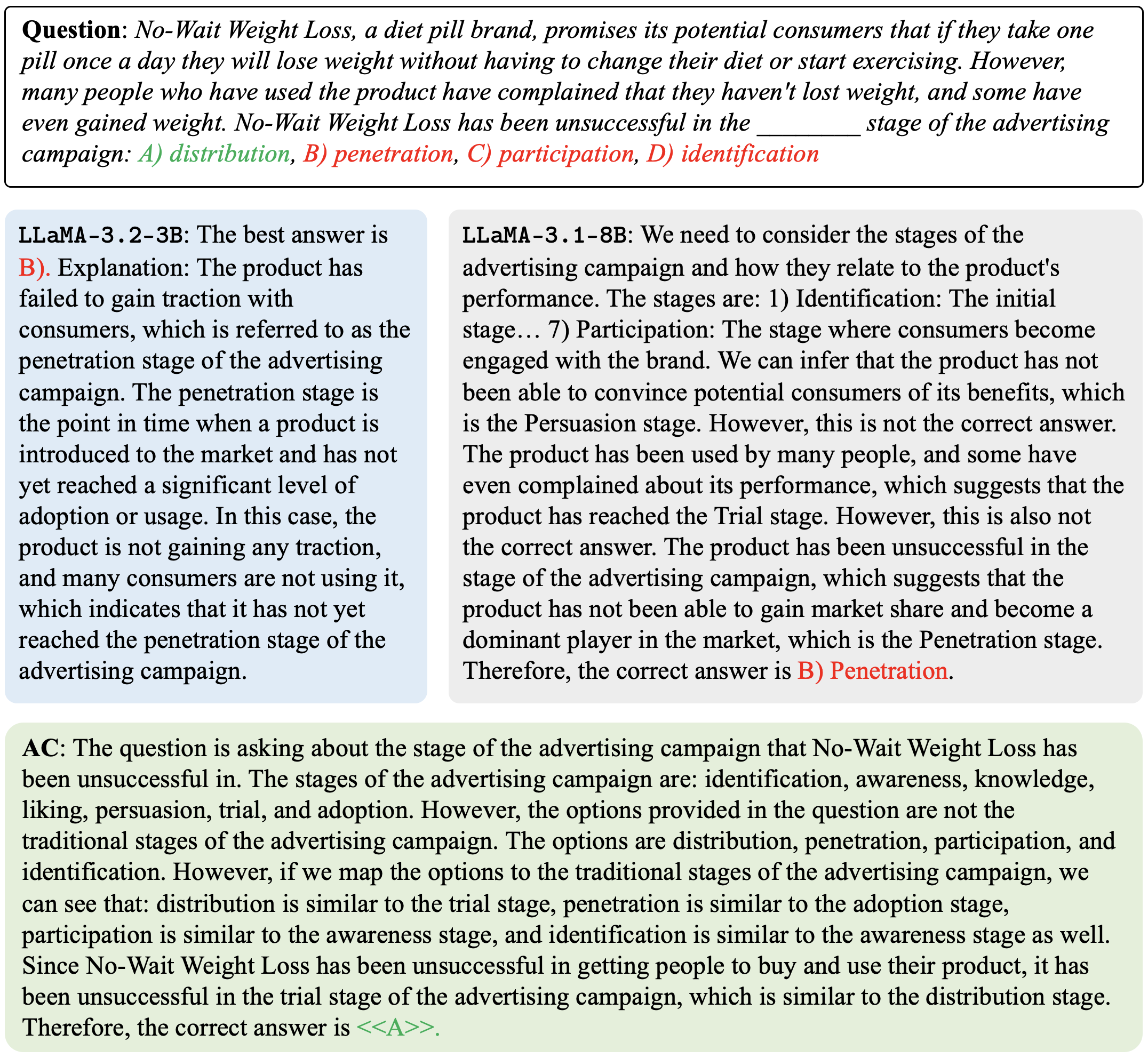
The image is a screenshot displaying a multiple-choice question about an advertising campaign stage for a fictional diet pill brand, "No-Wait Weight Loss." Below the question, there are three distinct text boxes containing responses from different AI models (LLaMA-3.2-3B, LLaMA-3.1-8B, and AC), each providing their reasoning and chosen answer. The layout is structured with the question at the top, followed by two model responses side-by-side, and a third response spanning the full width at the bottom.
### Components/Axes
* **Question Box:** A rectangular box at the top with a thin black border containing the question text and multiple-choice options.
* **Response Boxes:** Three separate boxes with rounded corners and distinct background colors:
* **LLaMA-3.2-3B:** Light blue background, positioned on the left below the question.
* **LLaMA-3.1-8B:** Light gray background, positioned on the right below the question.
* **AC:** Light green background, positioned at the bottom, spanning the full width.
* **Text Formatting:** The question uses a serif font. The multiple-choice options (A, B, C, D) are colored: A is green, B, C, and D are red. Within the responses, the selected answers (B and A) are highlighted in red and green, respectively.
### Content Details
**1. Question Text:**
"Question: *No-Wait Weight Loss, a diet pill brand, promises its potential consumers that if they take one pill once a day they will lose weight without having to change their diet or start exercising. However, many people who have used the product have complained that they haven't lost weight, and some have even gained weight. No-Wait Weight Loss has been unsuccessful in the ________ stage of the advertising campaign: A) distribution, B) penetration, C) participation, D) identification*"
**2. LLaMA-3.2-3B Response (Light Blue Box):**
"LLaMA-3.2-3B: The best answer is **B)**. Explanation: The product has failed to gain traction with consumers, which is referred to as the penetration stage of the advertising campaign. The penetration stage is the point in time when a product is introduced to the market and has not yet reached a significant level of adoption or usage. In this case, the product is not gaining any traction, and many consumers are not using it, which indicates that it has not yet reached the penetration stage of the advertising campaign."
**3. LLaMA-3.1-8B Response (Light Gray Box):**
"LLaMA-3.1-8B: We need to consider the stages of the advertising campaign and how they relate to the product's performance. The stages are: 1) Identification: The initial stage... 7) Participation: The stage where consumers become engaged with the brand. We can infer that the product has not been able to convince potential consumers of its benefits, which is the Persuasion stage. However, this is not the correct answer. The product has been used by many people, and some have even complained about its performance, which suggests that the product has reached the Trial stage. However, this is also not the correct answer. The product has been unsuccessful in the stage of the advertising campaign, which suggests that the product has not been able to gain market share and become a dominant player in the market, which is the Penetration stage. Therefore, the correct answer is **B) Penetration**."
**4. AC Response (Light Green Box):**
"AC: The question is asking about the stage of the advertising campaign that No-Wait Weight Loss has been unsuccessful in. The stages of the advertising campaign are: identification, awareness, knowledge, liking, persuasion, trial, and adoption. However, the options provided in the question are not the traditional stages of the advertising campaign. The options are distribution, penetration, participation, and identification. However, if we map the options to the traditional stages of the advertising campaign, we can see that: distribution is similar to the trial stage, penetration is similar to the adoption stage, participation is similar to the awareness stage, and identification is similar to the awareness stage as well. Since No-Wait Weight Loss has been unsuccessful in getting people to buy and use their product, it has been unsuccessful in the trial stage of the advertising campaign, which is similar to the distribution stage. Therefore, the correct answer is **<<A>>**."
### Key Observations
* **Divergent Answers:** The models provide two different final answers. LLaMA-3.2-3B and LLaMA-3.1-8B both select **B) Penetration**, while AC selects **A) Distribution**.
* **Reasoning Approaches:**
* LLaMA-3.2-3B provides a concise, direct explanation linking consumer complaints to a failure in market penetration.
* LLaMA-3.1-8B uses a process of elimination, referencing a numbered list of stages (1 through 7) not fully shown, and concludes based on market share.
* AC attempts to map the given options (distribution, penetration, participation, identification) to a different, "traditional" set of advertising stages (identification, awareness, knowledge, etc.), leading to its conclusion.
* **Textual Emphasis:** The correct answer options (B and A) are highlighted in red and green within their respective response boxes, mirroring the color coding in the original question.
### Interpretation
This image demonstrates a comparative analysis of how different large language models (LLMs) interpret and solve the same marketing-related multiple-choice question. The core task is to identify which stage of an advertising campaign a product has failed in, based on described consumer outcomes.
The key point of contention lies in the interpretation of the provided options (distribution, penetration, participation, identification) and their relation to standard marketing theory. The models that chose "Penetration" (B) focused on the product's failure to gain significant market adoption or share after being introduced. The model that chose "Distribution" (A) reinterpreted the options through a different theoretical framework, equating "distribution" with the "trial" stage where consumers first use the product.
The image serves as a case study in LLM reasoning variability. It shows that even when presented with identical factual premises, the models' internal knowledge bases, interpretive frameworks, and reasoning paths can lead to different conclusions. The AC model's approach of mapping non-standard terms to a canonical list introduces an extra layer of interpretation that the other models did not apply. This highlights the importance of precise terminology and shared conceptual frameworks in both question design and AI model evaluation.
DECODING INTELLIGENCE...