## Screenshot: Multiple-Choice Question Analysis
### Overview
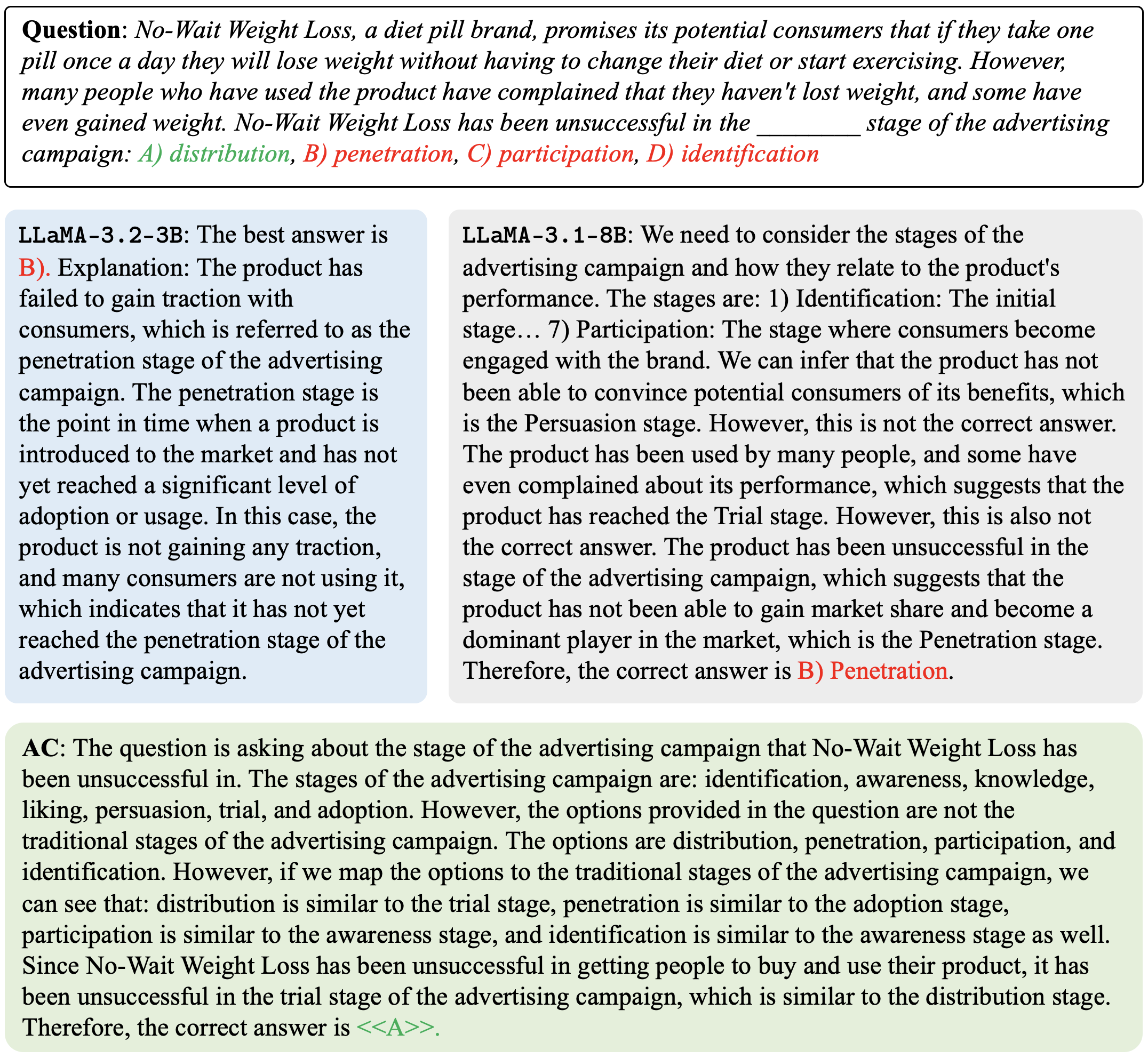
The image contains a multiple-choice question about the stage of an advertising campaign where a diet pill product ("No-Wait Weight Loss") has been unsuccessful. Three model responses (LLaMA-3.2-3B, LLaMA-3.1-8B, and AC) provide reasoning for their answers.
### Components/Axes
- **Question Text**:
"No-Wait Weight Loss, a diet pill brand, promises its potential consumers that if they take one pill once a day they will lose weight without having to change their diet or start exercising. However, many people who have used the product have complained that they have not lost weight, and some have even gained weight. No-Wait Weight Loss has been unsuccessful in the ______ stage of the advertising campaign: A) distribution, B) penetration, C) participation, D) identification."
- **Options**:
A) distribution, B) penetration, C) participation, D) identification
- **Model Responses**:
1. **LLaMA-3.2-3B** (Blue Box):
- Explanation: The product has failed to gain traction with consumers, indicating it has not reached the penetration stage.
- Conclusion: B) Penetration.
2. **LLaMA-3.1-8B** (Gray Box):
- Explanation: Analyzes stages of the advertising campaign (identification, persuasion, trial, adoption). Maps the product’s failure to the penetration stage (similar to adoption).
- Conclusion: B) Penetration.
3. **AC** (Green Box):
- Explanation: Maps the given options to traditional advertising stages:
- Distribution ≈ Trial stage
- Penetration ≈ Adoption stage
- Participation ≈ Awareness stage
- Identification ≈ Awareness stage
- Conclusion: A) Distribution (due to trial stage failure).
### Detailed Analysis
- **Question Structure**:
The question asks for the stage where the product’s performance (weight loss failure) indicates campaign underperformance.
- **Model Reasoning**:
- **LLaMA-3.2-3B**: Focuses on "penetration" as the stage where products fail to gain traction.
- **LLaMA-3.1-8B**: Uses a traditional framework (identification → persuasion → trial → adoption) to argue penetration (adoption) is the correct stage.
- **AC**: Reinterprets the options using traditional stages, concluding distribution (trial) is the correct answer.
### Key Observations
- **Disagreement**: LLaMA models agree on B) Penetration, while AC argues for A) Distribution.
- **Terminology Differences**:
- AC redefines "penetration" as adoption, while LLaMA models treat it as a distinct stage.
- AC’s mapping of options to traditional stages introduces ambiguity.
### Interpretation
- **Correct Answer**:
The LLaMA models’ consensus on B) Penetration aligns with standard marketing frameworks where "penetration" refers to the stage where a product fails to gain market share. AC’s argument hinges on redefining terms, which may not match the question’s intent.
- **Underlying Logic**:
- Penetration Stage: Products are introduced but fail to achieve significant adoption (matches the scenario of complaints and lack of traction).
- Distribution Stage: Involves product availability, not consumer engagement (less relevant to performance complaints).
- **Ambiguity**:
AC’s reinterpretation of "penetration" as adoption highlights potential confusion in terminology. However, the question’s phrasing ("unsuccessful in the ______ stage") likely refers to the stage where consumer adoption fails, not product availability.
- **Implications**:
The debate underscores the importance of clear definitions in advertising campaign stages. Penetration (B) is the most contextually appropriate answer given the product’s failure to gain traction.