## Stacked Bar Chart: Rating Distribution by Model
### Overview
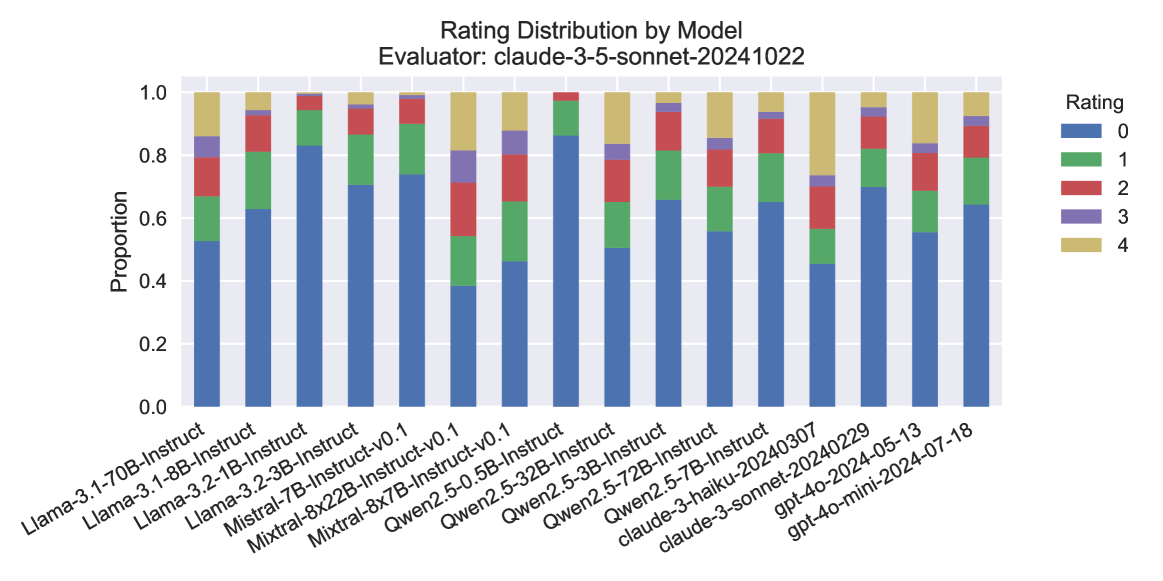
This image is a stacked bar chart titled "Rating Distribution by Model," with a subtitle indicating the evaluator is "claude-3-5-sonnet-20241022." The chart displays the proportional distribution of five distinct ratings (0 through 4) assigned to 16 different large language models. The data is presented as proportions summing to 1.0 (or 100%) for each model, allowing for a direct comparison of rating distributions across models.
### Components/Axes
* **Chart Title:** "Rating Distribution by Model"
* **Subtitle/Evaluator:** "Evaluator: claude-3-5-sonnet-20241022"
* **Y-Axis:**
* **Label:** "Proportion"
* **Scale:** Linear scale from 0.0 to 1.0, with major tick marks at 0.0, 0.2, 0.4, 0.6, 0.8, and 1.0.
* **X-Axis:**
* **Label:** Not explicitly labeled, but contains the names of 16 language models.
* **Model Names (from left to right):**
1. Llama-3.1-70B-Instruct
2. Llama-3.1-8B-Instruct
3. Llama-3.2-1B-Instruct
4. Llama-3.2-3B-Instruct
5. Mistral-7B-Instruct-v0.1
6. Mixtral-8x22B-Instruct-v0.1
7. Mixtral-8x7B-Instruct-v0.1
8. Qwen2.5-0.5B-Instruct
9. Qwen2.5-5B-Instruct
10. Qwen2.5-32B-Instruct
11. Qwen2.5-3B-Instruct
12. Qwen2.5-72B-Instruct
13. Qwen2.5-7B-Instruct
14. claude-3-haiku-20240307
15. claude-3-sonnet-20240229
16. gpt-4o-2024-05-13
17. gpt-4o-mini-2024-07-18
* **Legend:**
* **Title:** "Rating"
* **Position:** Centered on the right side of the chart.
* **Categories & Colors:**
* **0:** Blue
* **1:** Green
* **2:** Red
* **3:** Purple
* **4:** Gold/Yellow
### Detailed Analysis
The chart presents the rating distribution for each model as a vertical bar segmented by color. The height of each colored segment represents the proportion of that rating for the given model. The total height of each bar is 1.0.
**Trend Verification & Data Points (Approximate Proportions):**
The dominant trend across most models is a high proportion of Rating 0 (blue segment at the base). The proportions for other ratings vary significantly.
1. **Llama-3.1-70B-Instruct:** Rating 0 ~0.52, Rating 1 ~0.15, Rating 2 ~0.13, Rating 3 ~0.08, Rating 4 ~0.12.
2. **Llama-3.1-8B-Instruct:** Rating 0 ~0.63, Rating 1 ~0.18, Rating 2 ~0.12, Rating 3 ~0.02, Rating 4 ~0.05.
3. **Llama-3.2-1B-Instruct:** Rating 0 ~0.83, Rating 1 ~0.12, Rating 2 ~0.04, Rating 3 ~0.01, Rating 4 ~0.00.
4. **Llama-3.2-3B-Instruct:** Rating 0 ~0.70, Rating 1 ~0.16, Rating 2 ~0.08, Rating 3 ~0.02, Rating 4 ~0.04.
5. **Mistral-7B-Instruct-v0.1:** Rating 0 ~0.74, Rating 1 ~0.16, Rating 2 ~0.08, Rating 3 ~0.01, Rating 4 ~0.01.
6. **Mixtral-8x22B-Instruct-v0.1:** Rating 0 ~0.38, Rating 1 ~0.16, Rating 2 ~0.17, Rating 3 ~0.10, Rating 4 ~0.19. (Notable for a relatively low Rating 0 proportion).
7. **Mixtral-8x7B-Instruct-v0.1:** Rating 0 ~0.46, Rating 1 ~0.19, Rating 2 ~0.16, Rating 3 ~0.07, Rating 4 ~0.12.
8. **Qwen2.5-0.5B-Instruct:** Rating 0 ~0.86, Rating 1 ~0.09, Rating 2 ~0.04, Rating 3 ~0.01, Rating 4 ~0.00. (Very high Rating 0).
9. **Qwen2.5-5B-Instruct:** Rating 0 ~0.50, Rating 1 ~0.15, Rating 2 ~0.13, Rating 3 ~0.05, Rating 4 ~0.17.
10. **Qwen2.5-32B-Instruct:** Rating 0 ~0.65, Rating 1 ~0.16, Rating 2 ~0.10, Rating 3 ~0.05, Rating 4 ~0.04.
11. **Qwen2.5-3B-Instruct:** Rating 0 ~0.55, Rating 1 ~0.15, Rating 2 ~0.11, Rating 3 ~0.04, Rating 4 ~0.15.
12. **Qwen2.5-72B-Instruct:** Rating 0 ~0.65, Rating 1 ~0.15, Rating 2 ~0.10, Rating 3 ~0.03, Rating 4 ~0.07.
13. **Qwen2.5-7B-Instruct:** Rating 0 ~0.45, Rating 1 ~0.12, Rating 2 ~0.16, Rating 3 ~0.05, Rating 4 ~0.22. (Notable for a high Rating 4 proportion).
14. **claude-3-haiku-20240307:** Rating 0 ~0.70, Rating 1 ~0.12, Rating 2 ~0.10, Rating 3 ~0.02, Rating 4 ~0.06.
15. **claude-3-sonnet-20240229:** Rating 0 ~0.55, Rating 1 ~0.15, Rating 2 ~0.11, Rating 3 ~0.02, Rating 4 ~0.17.
16. **gpt-4o-2024-05-13:** Rating 0 ~0.64, Rating 1 ~0.15, Rating 2 ~0.11, Rating 3 ~0.03, Rating 4 ~0.07.
17. **gpt-4o-mini-2024-07-18:** Rating 0 ~0.64, Rating 1 ~0.15, Rating 2 ~0.11, Rating 3 ~0.03, Rating 4 ~0.07. (Distribution appears identical to gpt-4o-2024-05-13).
### Key Observations
1. **Dominance of Rating 0:** For 15 out of 17 models, Rating 0 (blue) is the largest single segment, often comprising 50% or more of the total proportion. This suggests the evaluator (claude-3-5-sonnet-20241022) frequently assigns the lowest rating.
2. **Notable Outliers:**
* **Mixtral-8x22B-Instruct-v0.1** has the lowest proportion of Rating 0 (~0.38) and the highest proportion of Rating 4 (~0.19) among the non-Claude models, indicating a more favorable evaluation.
* **Qwen2.5-7B-Instruct** has the highest proportion of Rating 4 (~0.22) in the entire chart.
* **Qwen2.5-0.5B-Instruct** and **Llama-3.2-1B-Instruct** have the highest proportions of Rating 0 (~0.86 and ~0.83, respectively), suggesting very poor evaluations.
3. **Model Family Patterns:** Within the Qwen2.5 series, the smallest model (0.5B) performs worst, while the 7B model shows a relatively high Rating 4 proportion. The larger 32B and 72B models have more moderate distributions.
4. **Claude and GPT Models:** The two Claude models and two GPT-4o models show similar, moderate distributions with Rating 0 around 55-70% and a noticeable but not dominant Rating 4 segment.
### Interpretation
This chart provides a comparative snapshot of how a specific evaluator (likely another AI model, claude-3-5-sonnet) rates the outputs or performance of various other language models. The data suggests the evaluator has a strong bias toward assigning low ratings (0), which could indicate a strict evaluation rubric, a challenging task, or a systematic difference in capability between the evaluator and the models being evaluated.
The variation between models is meaningful. The relatively better performance of Mixtral-8x22B and Qwen2.5-7B might indicate these models are better aligned with the evaluator's criteria or possess superior capabilities for the specific task being rated. Conversely, the very low ratings for the smallest models (Qwen2.5-0.5B, Llama-3.2-1B) are expected, highlighting a clear performance gap based on scale.
The identical distributions for `gpt-4o-2024-05-13` and `gpt-4o-mini-2024-07-18` are striking and could imply one of two things: either the models performed identically on the evaluation task, or there may be a data plotting artifact where the values for one were duplicated. Without raw data, this remains an observation of visual identity.
**Peircean Investigation:** The chart is an *index* of the evaluator's judgment. The high frequency of Rating 0 is a sign pointing to a harsh or demanding evaluation context. The variation between models is a sign pointing to real differences in model capability or alignment as perceived by this specific evaluator. To fully understand the "why," one would need the *icon* (the actual prompts and responses) and the *symbol* (the detailed rating rubric used by claude-3-5-sonnet). The chart alone shows the "what" (the distribution) but not the underlying causes.