## Heatmap: Needle in a Haystack Evaluation
### Overview
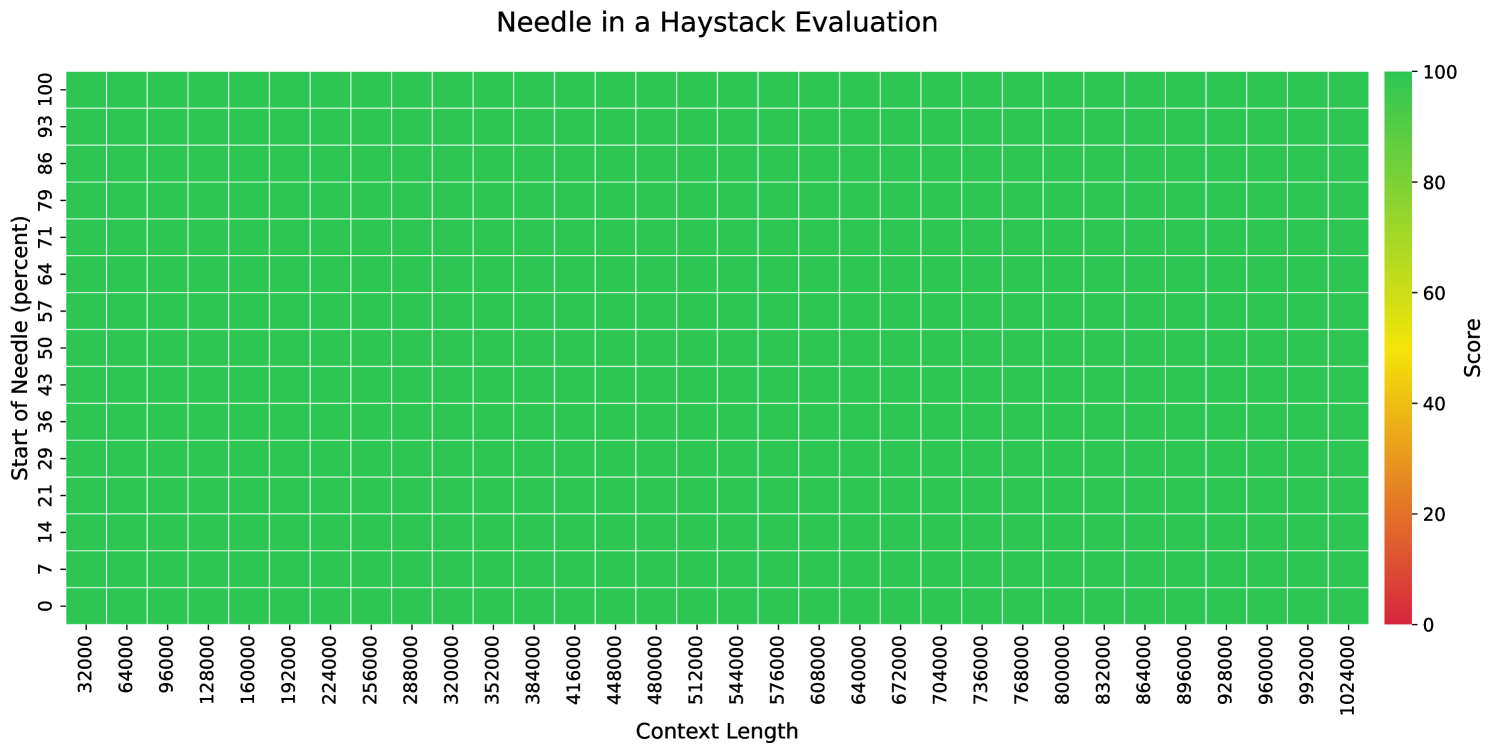
The image is a heatmap titled "Needle in a Haystack Evaluation". It visualizes the performance (score) of a system in finding a "needle" within a "haystack" of varying context lengths and starting positions. The heatmap uses a color gradient from red (low score) to green (high score) to represent the score. The x-axis represents the "Context Length", and the y-axis represents the "Start of Needle (percent)".
### Components/Axes
* **Title:** Needle in a Haystack Evaluation
* **X-axis:** Context Length, with values ranging from 32000 to 1024000 in increments of 32000.
* **Y-axis:** Start of Needle (percent), with values ranging from 0 to 100 in increments of 7, except for the last increment which is 93 to 100.
* **Color Legend (right side):** Score, ranging from 0 (red) to 100 (green). The legend has tick marks at 0, 20, 40, 60, 80, and 100.
### Detailed Analysis or ### Content Details
The heatmap is a grid of cells, each representing a combination of "Context Length" and "Start of Needle (percent)". The color of each cell indicates the "Score" for that combination.
* **General Observation:** Almost all cells are green, indicating a high score across all context lengths and starting positions.
* **Specific Values:**
* The entire heatmap is predominantly green, suggesting scores close to 100 for almost all combinations of context length and needle start position.
* There is a single vertical line at the right edge of the chart that is green.
### Key Observations
* The system performs well (high score) across a wide range of context lengths and starting positions for the needle.
* There are no apparent areas of low performance (red or orange cells).
### Interpretation
The heatmap suggests that the system being evaluated is highly effective at finding the "needle" within the "haystack," regardless of the context length or the starting position of the needle. The consistently high scores indicate a robust and reliable performance. The absence of any significant color variation implies that the system's performance is not significantly affected by changes in context length or needle position within the context.