## Diagram: Set Partitioning Visualization
### Overview
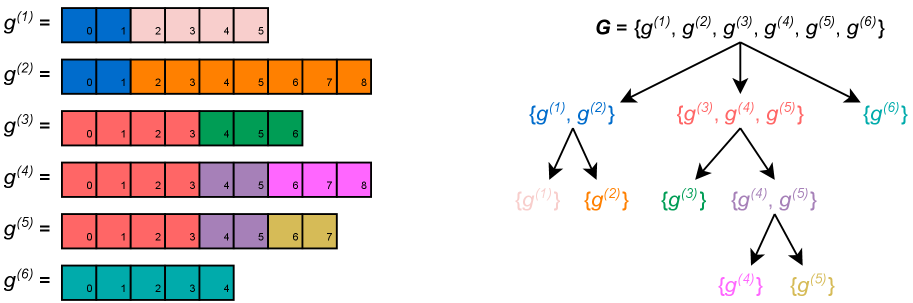
The image illustrates a set partitioning process, visually representing how a set *G* is divided into subsets. The left side shows the composition of each subset *g<sup>(i)</sup>* as a series of colored blocks with numerical indices. The right side depicts a hierarchical tree diagram illustrating the partitioning of *G* into smaller subsets.
### Components/Axes
**Left Side:**
* **Subset Definitions:** Six subsets are defined as *g<sup>(1)</sup>* through *g<sup>(6)</sup>*. Each subset is represented by a row of colored blocks.
* **Block Indices:** Each block within a subset is labeled with a numerical index, starting from 0.
* **Colors:** Each block has a distinct color. The colors are: blue, light pink, orange, dark orange, green, purple, light yellow, and teal.
**Right Side:**
* **Root Node:** The root node represents the original set *G* = {*g<sup>(1)</sup>*, *g<sup>(2)</sup>*, *g<sup>(3)</sup>*, *g<sup>(4)</sup>*, *g<sup>(5)</sup>*, *g<sup>(6)</sup>*}.
* **Hierarchical Tree:** A tree diagram shows the partitioning of *G* into subsets.
* **Nodes:** Each node represents a subset of *G*.
* **Edges:** Arrows indicate the partitioning direction.
### Detailed Analysis
**Left Side - Subset Composition:**
* *g<sup>(1)</sup>*: Contains 6 blocks, indexed 0 to 5. Colors: blue, blue, light pink, light pink, light pink, light pink.
* *g<sup>(2)</sup>*: Contains 9 blocks, indexed 0 to 8. Colors: blue, blue, orange, orange, orange, orange, orange, orange, orange.
* *g<sup>(3)</sup>*: Contains 7 blocks, indexed 0 to 6. Colors: light pink, light pink, light pink, green, green, green, green.
* *g<sup>(4)</sup>*: Contains 9 blocks, indexed 0 to 8. Colors: light pink, light pink, light pink, light pink, purple, purple, purple, purple, purple.
* *g<sup>(5)</sup>*: Contains 8 blocks, indexed 0 to 7. Colors: light pink, light pink, light pink, purple, purple, light yellow, light yellow, light yellow.
* *g<sup>(6)</sup>*: Contains 5 blocks, indexed 0 to 4. Colors: teal, teal, teal, teal, teal.
**Right Side - Partitioning Tree:**
1. **Level 1:** *G* is partitioned into three subsets: {*g<sup>(1)</sup>*, *g<sup>(2)</sup>*}, {*g<sup>(3)</sup>*, *g<sup>(4)</sup>*, *g<sup>(5)</sup>*}, and {*g<sup>(6)</sup>*}.
* {*g<sup>(1)</sup>*, *g<sup>(2)</sup>*} is colored blue.
* {*g<sup>(3)</sup>*, *g<sup>(4)</sup>*, *g<sup>(5)</sup>*} is colored light pink.
* {*g<sup>(6)</sup>*} is colored teal.
2. **Level 2:**
* {*g<sup>(1)</sup>*, *g<sup>(2)</sup>*} is further partitioned into {*g<sup>(1)</sup>*} and {*g<sup>(2)</sup>*}.
* {*g<sup>(1)</sup>*} is colored light pink.
* {*g<sup>(2)</sup>*} is colored orange.
* {*g<sup>(3)</sup>*, *g<sup>(4)</sup>*, *g<sup>(5)</sup>*} is partitioned into {*g<sup>(3)</sup>*} and {*g<sup>(4)</sup>*, *g<sup>(5)</sup>*}.
* {*g<sup>(3)</sup>*} is colored green.
* {*g<sup>(4)</sup>*, *g<sup>(5)</sup>*} is colored purple.
3. **Level 3:** {*g<sup>(4)</sup>*, *g<sup>(5)</sup>*} is partitioned into {*g<sup>(4)</sup>*} and {*g<sup>(5)</sup>*}.
* {*g<sup>(4)</sup>*} is colored light pink.
* {*g<sup>(5)</sup>*} is colored light yellow.
### Key Observations
* The subsets *g<sup>(i)</sup>* have varying lengths (number of blocks).
* The partitioning tree shows a hierarchical division of the original set *G*.
* The colors of the nodes in the tree correspond to the colors of the blocks in the subset definitions.
### Interpretation
The image illustrates a hierarchical set partitioning process. The left side defines the composition of each subset, while the right side shows how the original set *G* is recursively divided into smaller subsets. The colors provide a visual link between the subset definitions and the partitioning tree, making it easier to follow the partitioning process. The diagram demonstrates a specific example of how a set can be partitioned into smaller, potentially overlapping, subsets. The partitioning appears to be based on some underlying criteria that are not explicitly stated in the image, but are reflected in the composition of the subsets.