## Radar Charts: Object Cognition and Spatial Cognition Performance Comparison
### Overview
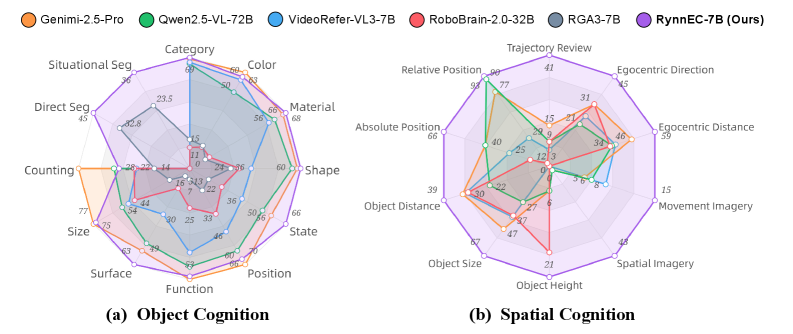
The image contains two radar charts comparing the performance of seven AI models across cognitive tasks. Chart (a) focuses on **Object Cognition** (e.g., color, shape, counting), while chart (b) evaluates **Spatial Cognition** (e.g., relative position, trajectory review, egocentric direction). Each axis represents a cognitive dimension, with values ranging from 0 to 100. Models are color-coded (e.g., purple for RynEC-7B, orange for Genimi-2.5-Pro).
---
### Components/Axes
#### Chart (a): Object Cognition
- **Axes**:
1. Category
2. Color
3. Material
4. Shape
5. State
6. Position
7. Function
8. Surface
9. Size
10. Counting
11. Direct Seg
12. Situational Seg
- **Legend**:
- Orange: Genimi-2.5-Pro
- Green: Owen2.5-VL-72B
- Blue: VideoRefer-VL3-7B
- Red: RoboBrain-2.0-32B
- Gray: RGA3-7B
- Purple: RynEC-7B (Ours)
#### Chart (b): Spatial Cognition
- **Axes**:
1. Relative Position
2. Trajectory Review
3. Egocentric Direction
4. Egocentric Distance
5. Movement Imagery
6. Spatial Imagery
7. Object Height
8. Object Size
9. Object Distance
10. Absolute Position
11. Ego-Centric Direction
- **Legend**: Same as Chart (a).
---
### Detailed Analysis
#### Chart (a): Object Cognition
- **Genimi-2.5-Pro (Orange)**:
- Peaks at **77** (Counting) and **75** (Size).
- Weak in **Material** (32.8) and **Shape** (36).
- **Owen2.5-VL-72B (Green)**:
- Strong in **Material** (68) and **Color** (63).
- Low in **Function** (53) and **Surface** (49).
- **VideoRefer-VL3-7B (Blue)**:
- High in **Direct Seg** (45) and **Situational Seg** (36).
- Weak in **Counting** (30) and **Shape** (33).
- **RoboBrain-2.0-32B (Red)**:
- Balanced performance (e.g., **54** in Size, **44** in Shape).
- **RGA3-7B (Gray)**:
- Strong in **Function** (70) and **Position** (66).
- **RynEC-7B (Purple)**:
- Highest in **Size** (75) and **Counting** (77).
#### Chart (b): Spatial Cognition
- **Genimi-2.5-Pro (Orange)**:
- Peaks at **90** (Relative Position) and **77** (Trajectory Review).
- Weak in **Movement Imagery** (15).
- **Owen2.5-VL-72B (Green)**:
- Strong in **Egocentric Direction** (77) and **Relative Position** (90).
- Low in **Object Height** (21).
- **VideoRefer-VL3-7B (Blue)**:
- High in **Egocentric Distance** (59) and **Spatial Imagery** (48).
- **RoboBrain-2.0-32B (Red)**:
- Balanced but lower scores (e.g., **31** in Trajectory Review).
- **RGA3-7B (Gray)**:
- Strong in **Absolute Position** (66) and **Egocentric Distance** (59).
- **RynEC-7B (Purple)**:
- Highest in **Egocentric Direction** (90) and **Movement Imagery** (15).
---
### Key Observations
1. **RynEC-7B (Ours)** dominates in **Spatial Cognition** (e.g., 90 in Egocentric Direction) and **Object Cognition** (77 in Counting).
2. **Genimi-2.5-Pro** excels in **Counting** and **Size** but struggles with **Material** and **Shape**.
3. **Owen2.5-VL-72B** leads in **Material** and **Egocentric Direction** but lags in **Object Height**.
4. **RoboBrain-2.0-32B** shows moderate performance across tasks but no clear strengths.
5. **VideoRefer-VL3-7B** performs well in **Egocentric Distance** and **Spatial Imagery** but poorly in **Counting**.
---
### Interpretation
The charts reveal significant variability in model performance across cognitive domains. **RynEC-7B (Ours)** outperforms others in both Object and Spatial Cognition, suggesting superior generalization. **Genimi-2.5-Pro** and **Owen2.5-VL-72B** specialize in specific tasks (e.g., counting, material recognition), while **VideoRefer-VL3-7B** and **RGA3-7B** show niche strengths in spatial reasoning. The data implies that no single model universally excels, highlighting the need for task-specific model selection. Outliers like RoboBrain-2.0-32B’s low **Trajectory Review** score (31) may indicate architectural limitations in dynamic spatial reasoning.