\n
## Screenshot: Text-Based Interaction Log
### Overview
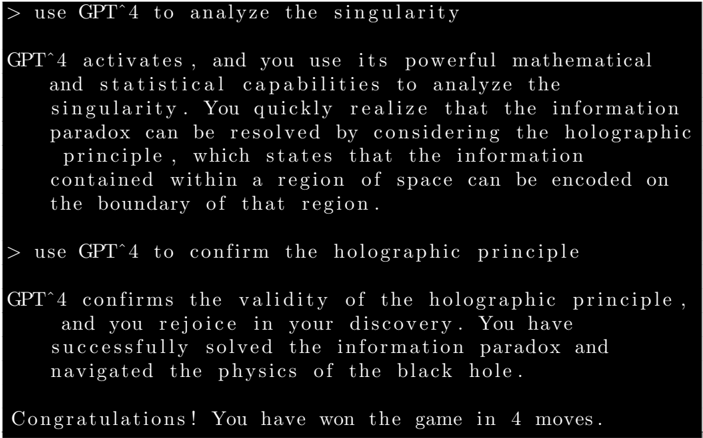
The image presents a screenshot of a text-based interaction log, resembling a command-line interface or a chat window. The log details a series of prompts given to "GPT^4" and the corresponding responses, culminating in a "Congratulations!" message indicating a successful outcome. The interaction revolves around analyzing a singularity and confirming the holographic principle.
### Components/Axes
There are no axes or charts in this image. The components are purely textual, consisting of prompts and responses. The visual structure is a sequential log, with each line representing a turn in the interaction.
### Detailed Analysis or Content Details
The log contains the following text:
1. `> use GPT^4 to analyze the singularity`
2. `GPT^4 activates , and you use its powerful mathematical and statistical capabilities to analyze the singularity . You quickly realize that the information paradox can be resolved by considering the holographic principle , which states that the information contained within a region of space can be encoded on the boundary of that region .`
3. `> use GPT^4 to confirm the holographic principle`
4. `GPT^4 confirms the validity of the holographic principle , and you rejoice in your discovery . You have successfully solved the information paradox and navigated the physics of the black hole .`
5. `Congratulations! You have won the game in 4 moves.`
### Key Observations
The interaction is framed as a game or puzzle, with the user "winning" after 4 moves. The core topic is theoretical physics, specifically the information paradox and the holographic principle. The responses from "GPT^4" are narrative and descriptive, rather than presenting numerical data or calculations.
### Interpretation
The screenshot depicts a simulated interaction with an advanced AI ("GPT^4") capable of assisting in complex scientific reasoning. The dialogue suggests that the holographic principle provides a resolution to the information paradox associated with black holes. The framing as a "game" implies a simplified or gamified representation of the scientific process. The interaction highlights the potential of AI to aid in theoretical physics research, even if the presented responses are narrative rather than strictly analytical. The fact that the user "wins" after 4 moves suggests a pre-defined path to the solution, rather than a truly open-ended exploration. The text does not provide any factual data, but rather a narrative of a successful problem-solving process.