## [Diagram/Text Comparison]: Comparison of Keyword-based RAG vs. Standard RAG for a Scriptural Query
### Overview
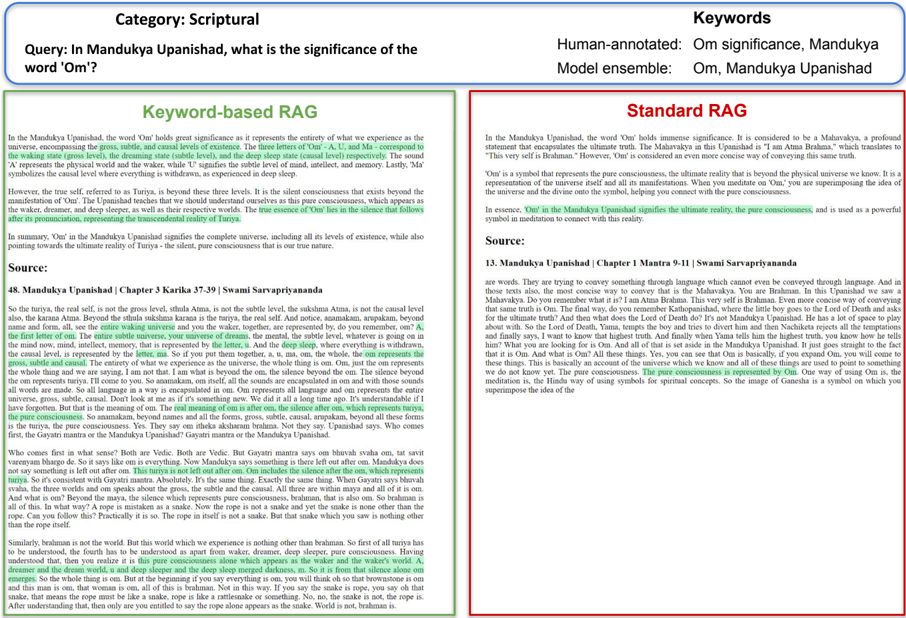
The image is a structured comparison of two Retrieval-Augmented Generation (RAG) system outputs in response to a specific query about the Mandukya Upanishad. It is divided into a header, two main columns representing different RAG methodologies, and a footer with source information. The primary language is English.
### Components/Axes
**Header Section (Top):**
- **Left Label:** `Category: Scriptural`
- **Right Label:** `Keywords`
- **Query (Centered):** `Query: In Mandukya Upanishad, what is the significance of the word 'Om'?`
- **Keywords Sub-section (Right):**
- `Human-annotated: Om significance, Mandukya Upanishad`
- `Model ensemble: Om, Mandukya Upanishad`
**Main Content (Two Columns):**
1. **Left Column:**
- **Title:** `Keyword-based RAG` (in green text)
- **Content Box:** A light green-bordered box containing a detailed textual response.
- **Source Label:** `Source:` followed by a specific reference.
2. **Right Column:**
- **Title:** `Standard RAG` (in red text)
- **Content Box:** A light red-bordered box containing a different textual response.
- **Source Label:** `Source:` followed by a different specific reference.
**Footer Section (Bottom):**
- A single source reference spanning the width of the image.
### Detailed Analysis / Content Details
**1. Keyword-based RAG Output (Left Column - Green Box):**
The text provides a structured, multi-paragraph explanation.
- **First Paragraph:** States that 'Om' signifies the entirety of experience: the waking state (gross level), dreaming state (subtle level), and deep-sleep state (causal level). It explains the phonetic components: A (waking), U (dreaming), M (deep sleep), and the silence after (Turiya - pure consciousness).
- **Second Paragraph:** Explains that the true self is Turiya, beyond the three levels, and is the silent consciousness behind manifestation. It states the Upanishad's teaching is to understand oneself as pure consciousness.
- **Third Paragraph:** Summarizes that 'Om' signifies the complete universe and all levels of existence, pointing to the ultimate reality of Turiya.
- **Source:** `48. Mandukya Upanishad | Chapter 3 Karika 37-39 | Swami Sarvapriyananda`
- **Extended Text:** Below the source, there is a lengthy, detailed commentary (approximately 15 lines) that elaborates on the three states, the nature of Turiya, and the analogy of the rope and snake to explain the relationship between Brahman (pure consciousness) and the perceived world.
**2. Standard RAG Output (Right Column - Red Box):**
The text provides a more concise, summary-style explanation.
- **First Paragraph:** States 'Om' holds immense significance as a Mahavakya (profound saying) and is a symbol for the ultimate reality, Brahman. It notes that 'Om' is considered an even more concise way of conveying this truth.
- **Second Paragraph:** Explains 'Om' as a symbol representing pure consciousness, the ultimate reality beyond the physical universe, and a representation of the universe itself and all its manifestations. It mentions meditating on 'Om' to superimpose the idea of Brahman onto the universe.
- **Third Paragraph (Conclusion):** States that 'Om' in the Mandukya Upanishad signifies the ultimate reality, the pure consciousness, and is used as a powerful symbol in meditation.
- **Source:** `13. Mandukya Upanishad | Chapter 1 Mantra 9-11 | Swami Sarvapriyananda`
- **Extended Text:** Below the source, there is a lengthy commentary (approximately 20 lines) that discusses the limitations of language in conveying ultimate truth, the concept of Mahavakya, and uses the analogy of the rope and snake to explain how the world is superimposed on Brahman.
### Key Observations
1. **Structural Difference:** The Keyword-based RAG output is more systematically structured, breaking down the significance of 'Om' into its constituent parts (A, U, M, silence) and their corresponding states of consciousness. The Standard RAG output is more thematic, focusing on 'Om' as a symbol for Brahman and its role in meditation.
2. **Depth of Explanation:** The Keyword-based response immediately delves into the technical, phonetic breakdown and the fourfold analysis central to the Mandukya Upanishad. The Standard RAG response begins with a broader philosophical statement about 'Om' as a Mahavakya.
3. **Source Referencing:** Both columns cite the same primary text (Mandukya Upanishad) and commentator (Swami Sarvapriyananda), but reference different chapters/mantras. The Keyword-based source is Chapter 3, Karika 37-39, while the Standard RAG source is Chapter 1, Mantra 9-11. The footer source matches the Standard RAG's cited source.
4. **Content Overlap:** Despite different structures, both explanations converge on the core idea that 'Om' represents the ultimate reality (Brahman/Turiya) and encompasses all states of existence. Both also use the rope-snake analogy in their extended commentary.
5. **Visual Coding:** The use of green for "Keyword-based" and red for "Standard" creates a clear visual distinction, potentially implying a comparative evaluation (e.g., green for "correct/detailed," red for "basic/alternative").
### Interpretation
This image serves as a technical comparison of two information retrieval and generation strategies applied to a specific domain (Indian philosophy/scripture).
- **What it demonstrates:** It illustrates how different RAG methodologies can retrieve and synthesize information from the same source material to answer the same query. The "Keyword-based" approach appears to have retrieved a more granular, structurally aligned passage (Chapter 3, which deals with the detailed analysis of 'Om'), leading to a response that mirrors the Upanishad's own analytical framework. The "Standard" approach retrieved a more general, introductory passage (Chapter 1, Mantra 9-11, which is the core mantra itself and its immediate explanation), resulting in a broader, more symbolic interpretation.
- **Relationship between elements:** The header defines the problem space (scriptural query, keywords). The two columns present the competing solutions. The footer anchors the information to a primary source. The layout forces a direct comparison of the outputs' quality, depth, and relevance.
- **Notable implications:** The comparison suggests that for technical or scriptural queries requiring precise doctrinal breakdown, a RAG system tuned to retrieve specific, relevant subsections (Keyword-based) may produce a more accurate and detailed response than a system retrieving more general passages (Standard). The Keyword-based output is more useful for a student seeking a technical explanation, while the Standard output might suffice for a general overview. The image itself is likely from a research paper, technical report, or presentation evaluating RAG system performance on specialized knowledge domains.