## Textual Comparison: Keyword-based RAG vs Standard RAG
### Overview
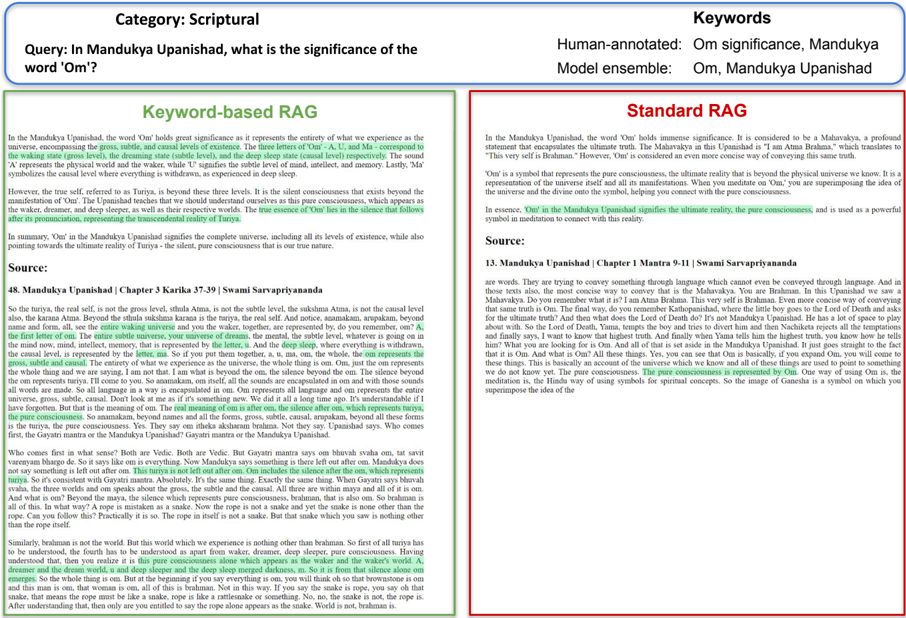
The image presents a side-by-side comparison of two RAG (Retrieval-Augmented Generation) model outputs analyzing the significance of the word "Om" in the Mandukya Upanishad. The comparison highlights differences in content structure, source attribution, and interpretive focus between keyword-based and standard RAG approaches.
### Components/Axes
1. **Header Section** (Blue background):
- **Category**: Scriptural
- **Query**: "In Mandukya Upanishad, what is the significance of the word 'Om'?"
- **Keywords**:
- Human-annotated: "Om significance", "Mandukya Upanishad"
- Model ensemble: "Om", "Mandukya Upanishad"
2. **Left Section** (Green background):
- **Title**: Keyword-based RAG
- **Content**: Detailed explanation of "Om" as representing the universe's gross (A), subtle (U), and causal (Ma) levels of existence. Emphasizes the three letters' symbolic meaning and their connection to waking, dreaming, and deep sleep states.
- **Source**:
- "48. Mandukya Upanishad | Chapter 3 Karika 37-39 | Swami Sarvapriyanda"
3. **Right Section** (Red background):
- **Title**: Standard RAG
- **Content**: Focuses on "Om" as a Mahavakya (profound statement) encapsulating "I am Atma Brahman" (the self is ultimate reality). Discusses meditation on "Om" to connect with pure consciousness.
- **Source**:
- "13. Mandukya Upanishad | Chapter 1 Mantra 9-11 | Swami Sarvapriyanda"
### Content Details
**Keyword-based RAG**:
- Describes "Om" as a symbol of the universe's three levels of existence (gross, subtle, causal).
- Explains the three letters (A, U, Ma) correspond to physical world, dreaming state, and deep sleep state respectively.
- Mentions "Ma" as the causal level of pure consciousness beyond manifestation.
- References the Upanishad's teaching about transcending dreamer/sleeper identities to realize Atma (true self).
**Standard RAG**:
- Presents "Om" as a Mahavakya ("I am Atma Brahman") representing ultimate truth.
- Emphasizes meditation on "Om" to transcend physical reality and connect with Brahman.
- Uses metaphors like "snake/rope" to illustrate mistaking transient phenomena for ultimate reality.
- References the concept of "Brahman" as the formless, all-pervading consciousness.
### Key Observations
1. **Source Variation**:
- Keyword-based RAG cites later chapters (3.37-39) focusing on symbolic analysis.
- Standard RAG references earlier chapters (1.9-11) emphasizing Mahavakyas.
2. **Interpretive Focus**:
- Keyword-based approach emphasizes ontological levels (gross/subtle/causal).
- Standard RAG prioritizes epistemological realization (self as Brahman).
3. **Linguistic Nuance**:
- Both sections use Sanskrit terms (e.g., "Atma", "Brahman") but differ in explanatory depth.
- Keyword-based RAG includes technical terms like "Manas" (mind) and "Jnana" (knowledge).
### Interpretation
The comparison reveals how keyword selection influences RAG output:
- **Keyword-based RAG** (green) provides a structural analysis of "Om" as a cosmic symbol, aligning with later Upanishadic commentaries that dissect its phonetic and metaphysical dimensions.
- **Standard RAG** (red) emphasizes the word's role as a meditative tool for self-realization, reflecting earlier Upanishadic teachings on Mahavakyas as direct paths to Brahman realization.
The divergence suggests that keyword density and chapter focus shape the model's retrieval strategy. The Standard RAG's emphasis on "Mahavakya" and "Brahman" indicates prioritization of core Upanishadic teachings, while the Keyword-based approach reflects a more analytical, systematic breakdown of the concept. This demonstrates how RAG systems can produce qualitatively different interpretations of the same scriptural concept based on input parameters.