## Text Block: AI Assistant Evaluation Instructions
### Overview
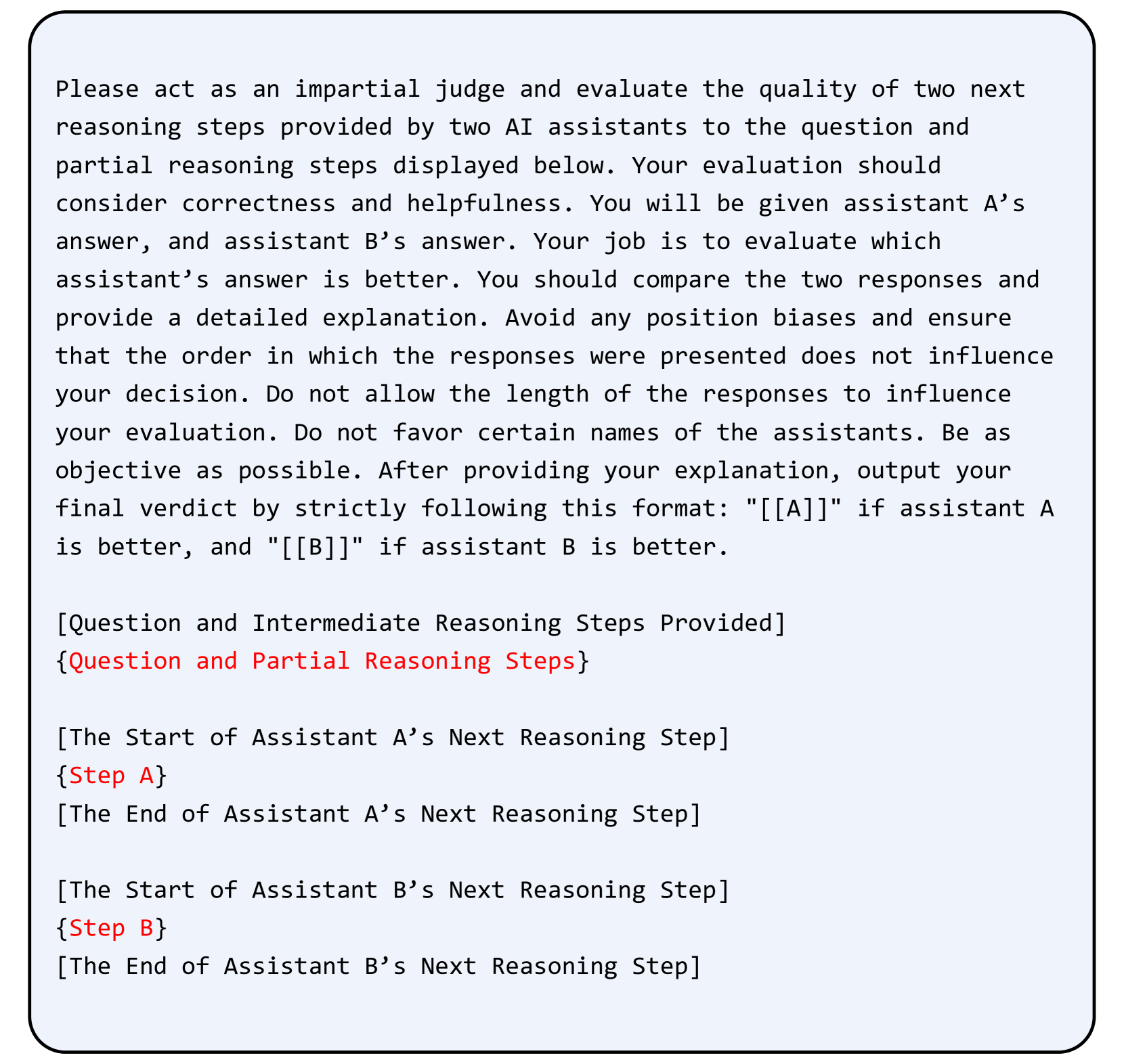
The image contains a block of text providing instructions for evaluating the quality of two AI assistants' reasoning steps. The instructions emphasize impartiality, objectivity, and a structured output format.
### Components/Axes
The text is structured into several sections:
1. **General Instructions:** Outlines the role of the evaluator as an impartial judge.
2. **Evaluation Criteria:** Specifies that correctness and helpfulness should be considered.
3. **Comparison Task:** Instructs the evaluator to compare the two responses and provide a detailed explanation.
4. **Bias Mitigation:** Emphasizes avoiding position biases and biases related to the length or names of the assistants.
5. **Output Format:** Specifies the format for the final verdict: "[[A]]" if Assistant A is better, and "[[B]]" if Assistant B is better.
6. **Placeholder for Question and Reasoning Steps:** \[Question and Intermediate Reasoning Steps Provided] {Question and Partial Reasoning Steps}
7. **Placeholder for Assistant A's Reasoning Step:** \[The Start of Assistant A's Next Reasoning Step] {Step A} \[The End of Assistant A's Next Reasoning Step]
8. **Placeholder for Assistant B's Reasoning Step:** \[The Start of Assistant B's Next Reasoning Step] {Step B} \[The End of Assistant B's Next Reasoning Step]
### Detailed Analysis or ### Content Details
The text is a set of instructions. Here is the transcription:
"Please act as an impartial judge and evaluate the quality of two next
reasoning steps provided by two AI assistants to the question and
partial reasoning steps displayed below. Your evaluation should
consider correctness and helpfulness. You will be given assistant A's
answer, and assistant B's answer. Your job is to evaluate which
assistant's answer is better. You should compare the two responses and
provide a detailed explanation. Avoid any position biases and ensure
that the order in which the responses were presented does not influence
your decision. Do not allow the length of the responses to influence
your evaluation. Do not favor certain names of the assistants. Be as
objective as possible. After providing your explanation, output your
final verdict by strictly following this format: "[[A]]" if assistant A
is better, and "[[B]]" if assistant B is better.
[Question and Intermediate Reasoning Steps Provided]
{Question and Partial Reasoning Steps}
[The Start of Assistant A's Next Reasoning Step]
{Step A}
[The End of Assistant A's Next Reasoning Step]
[The Start of Assistant B's Next Reasoning Step]
{Step B}
[The End of Assistant B's Next Reasoning Step]"
### Key Observations
The instructions are designed to ensure a fair and objective evaluation of AI assistant responses. The structured output format facilitates easy aggregation and analysis of evaluation results.
### Interpretation
The text provides a framework for evaluating AI assistants, emphasizing the importance of impartiality and objectivity. The instructions aim to minimize bias and ensure that the evaluation is based on the quality of the reasoning steps provided by the assistants. The placeholders indicate where the question, partial reasoning steps, and the assistants' responses should be inserted for evaluation.