## Diagram: Mathematical Framework for Intelligent Event Orchestration
### Overview
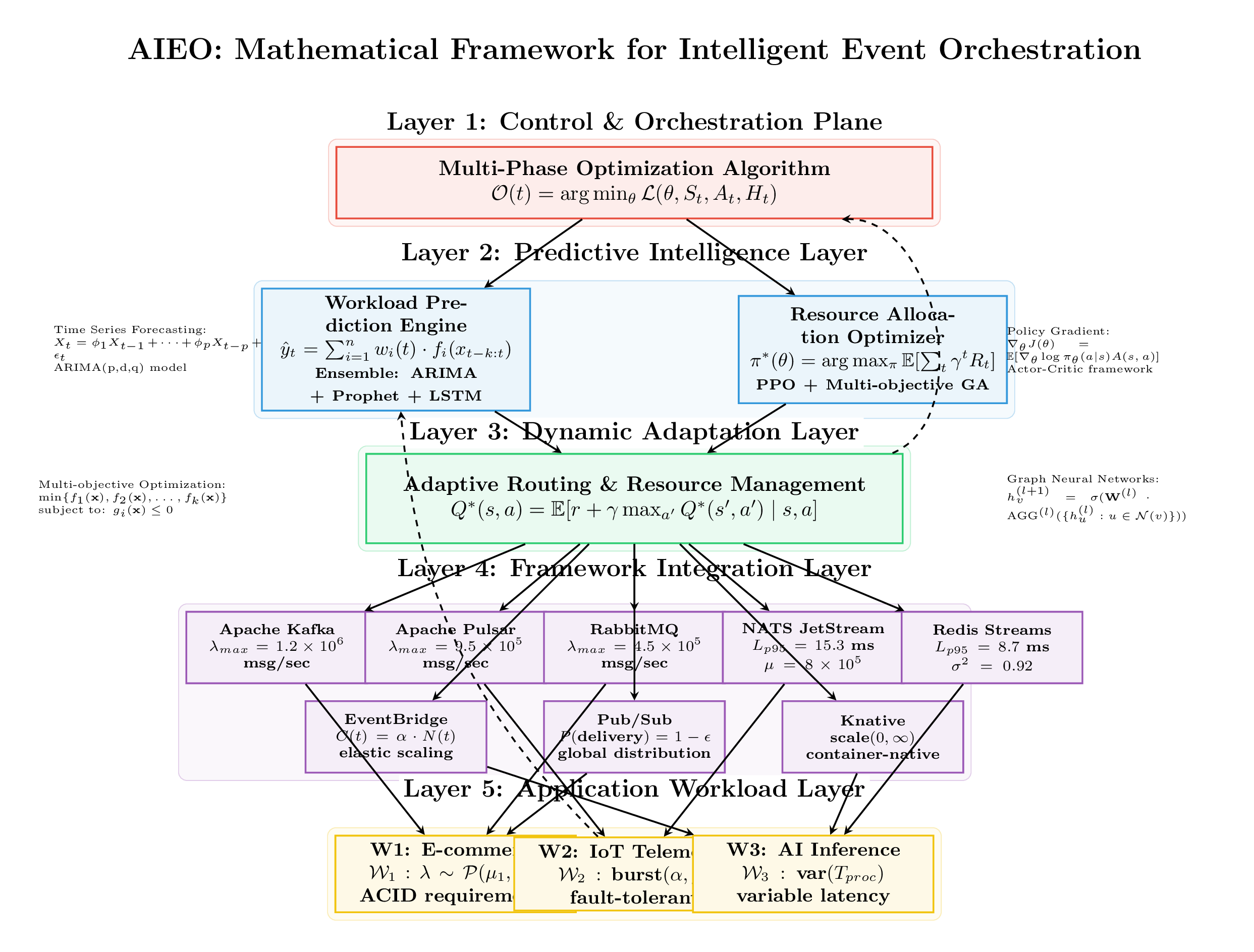
The image is a layered diagram representing a mathematical framework for intelligent event orchestration (AIEO). It depicts a hierarchical structure with five layers, each responsible for a specific aspect of the orchestration process. The diagram includes mathematical formulas, algorithms, and technologies used in each layer.
### Components/Axes
The diagram is structured into five layers, each represented by a colored rectangle with a descriptive title:
* **Layer 1:** Control & Orchestration Plane (Red rectangle)
* Multi-Phase Optimization Algorithm
* O(t) = arg min<sub>θ</sub> L(θ, S<sub>t</sub>, A<sub>t</sub>, H<sub>t</sub>)
* **Layer 2:** Predictive Intelligence Layer (Blue rectangle)
* Workload Prediction Engine
* ŷ<sub>t</sub> = Σ<sup>n</sup><sub>i=1</sub> w<sub>i</sub>(t) ⋅ f<sub>i</sub>(x<sub>t-k:t</sub>)
* Ensemble: ARIMA + Prophet + LSTM
* Resource Allocation Optimizer
* π<sup>\*</sup>(θ) = arg max<sub>π</sub> E[Σ<sub>t</sub> γ<sup>t</sup> R<sub>t</sub>]
* PPO + Multi-objective GA
* Time Series Forecasting:
* X<sub>t</sub> = φ<sub>1</sub>X<sub>t-1</sub> + ... + φ<sub>p</sub>X<sub>t-p</sub> + ε<sub>t</sub>
* ARIMA(p,d,q) model
* Policy Gradient:
* ∇<sub>θ</sub>J(θ) = E[∇<sub>θ</sub> log π<sub>θ</sub>(a|s)A(s, a)]
* Actor-Critic framework
* **Layer 3:** Dynamic Adaptation Layer (Green rectangle)
* Adaptive Routing & Resource Management
* Q<sup>\*</sup>(s, a) = E[r + γ max<sub>a'</sub> Q<sup>\*</sup>(s', a') | s, a]
* Multi-objective Optimization:
* min{f<sub>1</sub>(x), f<sub>2</sub>(x), ..., f<sub>k</sub>(x)}
* subject to: g<sub>i</sub>(x) ≤ 0
* Graph Neural Networks:
* h<sub>v</sub><sup>(l+1)</sup> = σ(W<sup>(l)</sup> ⋅ AGG<sup>(l)</sup>({h<sub>u</sub><sup>(l)</sup> : u ∈ N(v)}))
* **Layer 4:** Framework Integration Layer (Purple rectangle)
* Apache Kafka
* λ<sub>max</sub> = 1.2 × 10<sup>6</sup> msg/sec
* Apache Pulsar
* λ<sub>max</sub> = 9.5 × 10<sup>5</sup> msg/sec
* RabbitMQ
* λ<sub>max</sub> = 4.5 × 10<sup>5</sup> msg/sec
* NATS JetStream
* L<sub>p95</sub> = 15.3 ms
* μ = 8 × 10<sup>5</sup>
* Redis Streams
* L<sub>p95</sub> = 8.7 ms
* σ<sup>2</sup> = 0.92
* EventBridge
* O(t) = α ⋅ N(t)
* elastic scaling
* Pub/Sub
* P(delivery) = 1 - ε
* global distribution
* Knative
* scale(0, ∞)
* container-native
* **Layer 5:** Application Workload Layer (Yellow rectangle)
* W1: E-commerce
* W<sub>1</sub> : λ ~ P(μ<sub>1</sub>)
* ACID requirements
* W2: IoT Telem
* W<sub>2</sub> : burst(α, ...)
* fault-tolerant
* W3: AI Inference
* W<sub>3</sub> : var(T<sub>proc</sub>)
* variable latency
### Detailed Analysis or ### Content Details
* **Layer 1:** The Control & Orchestration Plane uses a Multi-Phase Optimization Algorithm, represented by the equation O(t) = arg min<sub>θ</sub> L(θ, S<sub>t</sub>, A<sub>t</sub>, H<sub>t</sub>).
* **Layer 2:** The Predictive Intelligence Layer consists of a Workload Prediction Engine and a Resource Allocation Optimizer. The Workload Prediction Engine uses an ensemble of ARIMA, Prophet, and LSTM models. The Resource Allocation Optimizer uses PPO and Multi-objective GA.
* **Layer 3:** The Dynamic Adaptation Layer uses Adaptive Routing & Resource Management, represented by the equation Q<sup>\*</sup>(s, a) = E[r + γ max<sub>a'</sub> Q<sup>\*</sup>(s', a') | s, a]. It also incorporates Graph Neural Networks.
* **Layer 4:** The Framework Integration Layer integrates various messaging and streaming technologies, including Apache Kafka (λ<sub>max</sub> = 1.2 × 10<sup>6</sup> msg/sec), Apache Pulsar (λ<sub>max</sub> = 9.5 × 10<sup>5</sup> msg/sec), RabbitMQ (λ<sub>max</sub> = 4.5 × 10<sup>5</sup> msg/sec), NATS JetStream (L<sub>p95</sub> = 15.3 ms, μ = 8 × 10<sup>5</sup>), Redis Streams (L<sub>p95</sub> = 8.7 ms, σ<sup>2</sup> = 0.92), EventBridge (O(t) = α ⋅ N(t)), Pub/Sub (P(delivery) = 1 - ε), and Knative (scale(0, ∞)).
* **Layer 5:** The Application Workload Layer consists of three workload types: E-commerce (W1), IoT Telem (W2), and AI Inference (W3).
### Key Observations
* The diagram illustrates a layered architecture for intelligent event orchestration.
* Each layer is responsible for a specific aspect of the orchestration process.
* The diagram includes mathematical formulas, algorithms, and technologies used in each layer.
* The Framework Integration Layer (Layer 4) provides specific performance metrics (λ<sub>max</sub>, L<sub>p95</sub>, μ, σ<sup>2</sup>) for different technologies.
### Interpretation
The diagram presents a comprehensive framework for intelligent event orchestration, integrating predictive intelligence, dynamic adaptation, and various messaging technologies. The layered architecture allows for modularity and scalability. The use of mathematical formulas and algorithms provides a formal basis for the orchestration process. The inclusion of performance metrics for different technologies in Layer 4 allows for informed decision-making when selecting the appropriate technologies for a given application. The framework aims to optimize event processing and resource allocation in complex systems.