\n
## Diagram: AIEIO - Mathematical Framework for Intelligent Event Orchestration
### Overview
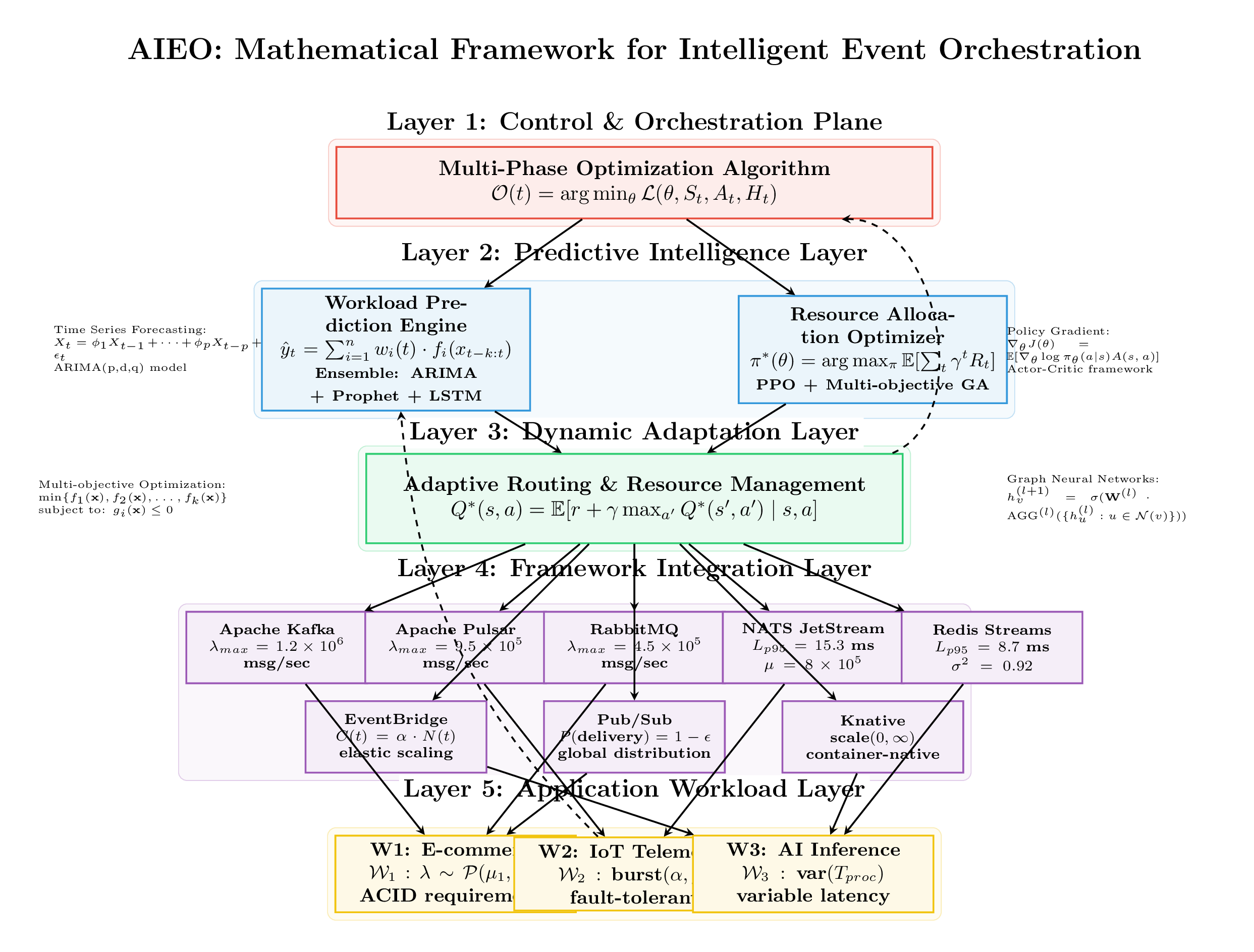
The image presents a layered diagram illustrating the AIEIO (Artificial Intelligence for Event-driven Intelligent Orchestration) mathematical framework. The framework consists of five layers, each representing a different level of abstraction and functionality, from control and orchestration to application workload. Arrows indicate data flow and dependencies between layers. The diagram includes mathematical formulations and descriptions of the algorithms and technologies used in each layer.
### Components/Axes
The diagram is structured into five horizontal layers, numbered 1 through 5 from top to bottom. Each layer has a title indicating its function. Within each layer, there are blocks of text describing algorithms, models, or technologies. There are also dashed arrows connecting layers, indicating the flow of information or control. The bottom layer includes labels W1, W2, and W3, each associated with a description.
### Detailed Analysis or Content Details
**Layer 1: Control & Orchestration Plane**
* Title: "Control & Orchestration Plane"
* Content: "Multi-Phase Optimization Algorithm: Θ(t) = arg min {C(θ, St, At, Ht)}"
**Layer 2: Predictive Intelligence Layer**
* Title: "Predictive Intelligence Layer"
* Left Block: "Time Series Forecasting: Xt = α1Xt-1 + αpXt-p + yt; yt = Σi=1n Wi(t) * f(xi(t), k=kt) Ensemble: ARIMA + Prophet + LSTM"
* Right Block: "Resource Allocation Optimizer: π*(θ) = arg max E[Σt γt R(t)]"
* Far Right Block: "Policy Gradient: ∇J(θ) ≈ E[Σt γt ∇log πθ(at|st)A(st, at)] Actor-Critic framework"
**Layer 3: Dynamic Adaptation Layer**
* Title: "Dynamic Adaptation Layer"
* Left Block: "Multi-objective Optimization: min {f1(x), f2(x), ... fg(x)} subject to: g1(x) ≤ 0"
* Right Block: "Adaptive Routing & Resource Management Q*(s,a) = E[r + γ max a' Q*(s', a')] s,a]"
* Far Right Block: "Graph Neural Networks: AG(t+1) = σ(W(t) AG(t)) where u ∈ N(t))"
**Layer 4: Framework Integration Layer**
* Title: "Framework Integration Layer"
* Apache Kafka: "λmax = 1.2 x 10^6 msg/sec"
* Apache Pulsar: "λmax = 4.5 x 10^5 msg/sec"
* RabbitMQ: "λmax = 4.5 x 10^5 msg/sec"
* NATS JetStream: "Lp99(h) = 15.3 ms μ = 8 x 10^-2"
* Redis Streams: "Lp95 = 8.7 ms σ^2 = 0.92"
* EventBridge: "Q(t) = α(N(t)) elastic scaling"
* Pub/Sub: "p(delivery) = 1 - ε global distribution"
* Knative: "scale(0, ∞) container-native"
**Layer 5: Application Workload Layer**
* Title: "Application Workload Layer"
* W1: "E-commerce: W1 = λ * μ(μ1) ACID requirem"
* W2: "IoT Telem: W2 = burst(α, fault-toleran"
* W3: "AI Inference: W3 = var(Tproc) variable latency"
### Key Observations
* The diagram emphasizes a layered approach to event orchestration, with increasing levels of abstraction.
* Each layer utilizes specific mathematical formulations and algorithms.
* The Framework Integration Layer showcases a variety of messaging and streaming technologies, each with performance metrics (lambda max, latency percentiles, standard deviation).
* The Application Workload Layer highlights three example workloads (E-commerce, IoT Telemetry, AI Inference) and their associated requirements.
* The dashed arrows suggest a feedback loop or iterative process between layers.
### Interpretation
The AIEIO framework aims to provide a comprehensive mathematical foundation for intelligent event orchestration. The layers represent a progression from high-level control and optimization (Layer 1) to predictive intelligence (Layer 2), dynamic adaptation (Layer 3), integration with existing infrastructure (Layer 4), and finally, application-specific workloads (Layer 5).
The use of mathematical formulations (optimization algorithms, time series forecasting, graph neural networks) suggests a rigorous and quantitative approach to event orchestration. The inclusion of performance metrics for various messaging technologies (Kafka, Pulsar, RabbitMQ, etc.) indicates a focus on scalability and efficiency.
The three example workloads (E-commerce, IoT Telemetry, AI Inference) demonstrate the framework's versatility and applicability to different domains. The requirements associated with each workload (ACID, burst tolerance, variable latency) highlight the importance of tailoring the orchestration strategy to the specific needs of the application.
The diagram suggests a closed-loop system where predictions and adaptations are continuously refined based on real-time data and feedback. This iterative process enables the framework to dynamically optimize performance and resource allocation in response to changing conditions. The overall goal is to create a robust and intelligent event orchestration system that can handle complex workloads with high reliability and efficiency.