## Lattice Diagram: Reciprocal Lattice
### Overview
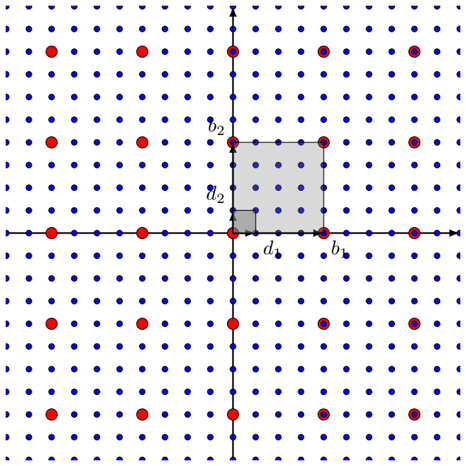
The image depicts a two-dimensional lattice diagram, showing both direct and reciprocal lattices. The direct lattice points are represented by small blue dots, while the reciprocal lattice points are represented by larger red dots. The diagram also includes vectors and a shaded square to illustrate the relationship between the two lattices.
### Components/Axes
* **Axes:** Two orthogonal axes are shown, with arrows indicating positive direction.
* **Lattice Points:**
* Direct Lattice: Small blue dots arranged in a square grid.
* Reciprocal Lattice: Larger red dots, also arranged in a grid, but with a different spacing and orientation compared to the direct lattice.
* **Vectors:**
* `d1`: A vector pointing along the horizontal axis.
* `d2`: A vector pointing along the vertical axis.
* `b1`: A vector pointing along the horizontal axis, longer than `d1`.
* `b2`: A vector pointing along the vertical axis, longer than `d2`.
* **Shaded Square:** A gray square is positioned in the first quadrant, with its bottom-left corner at the origin.
### Detailed Analysis
* **Direct Lattice (Blue Dots):** The blue dots form a regular square lattice. The spacing between adjacent dots appears uniform.
* **Reciprocal Lattice (Red Dots):** The red dots also form a square lattice, but with a larger spacing than the blue dots. The red dots are positioned such that they are centered on the intersections of every other row and column of blue dots.
* **Vectors:**
* `d1` extends from the origin to the first blue dot along the horizontal axis.
* `d2` extends from the origin to the first blue dot along the vertical axis.
* `b1` extends from the origin to the second red dot along the horizontal axis.
* `b2` extends from the origin to the second red dot along the vertical axis.
* **Shaded Square:** The gray square has sides of length approximately 4 units (based on the blue dot spacing). Its vertices are located at (0,0), (4,0), (4,4), and (0,4) in terms of blue dot units.
### Key Observations
* The reciprocal lattice (red dots) is less dense than the direct lattice (blue dots).
* The vectors `b1` and `b2` are longer than `d1` and `d2`, respectively, indicating an inverse relationship between the direct and reciprocal lattice spacings.
* The shaded square visually represents a unit cell or a region of interest within the lattice.
### Interpretation
The diagram illustrates the concept of a reciprocal lattice, which is fundamental in solid-state physics and crystallography. The direct lattice represents the arrangement of atoms in a crystal, while the reciprocal lattice is a mathematical construct that is useful for analyzing diffraction patterns. The vectors `d1` and `d2` represent the basis vectors of the direct lattice, while `b1` and `b2` represent the basis vectors of the reciprocal lattice. The inverse relationship between the lengths of these vectors demonstrates that a smaller spacing in the direct lattice corresponds to a larger spacing in the reciprocal lattice, and vice versa. The shaded square likely represents a unit cell in the direct lattice, and its size is related to the spacing of the lattice points.