## Flowchart: Multimodal Music Processing System Architecture
### Overview
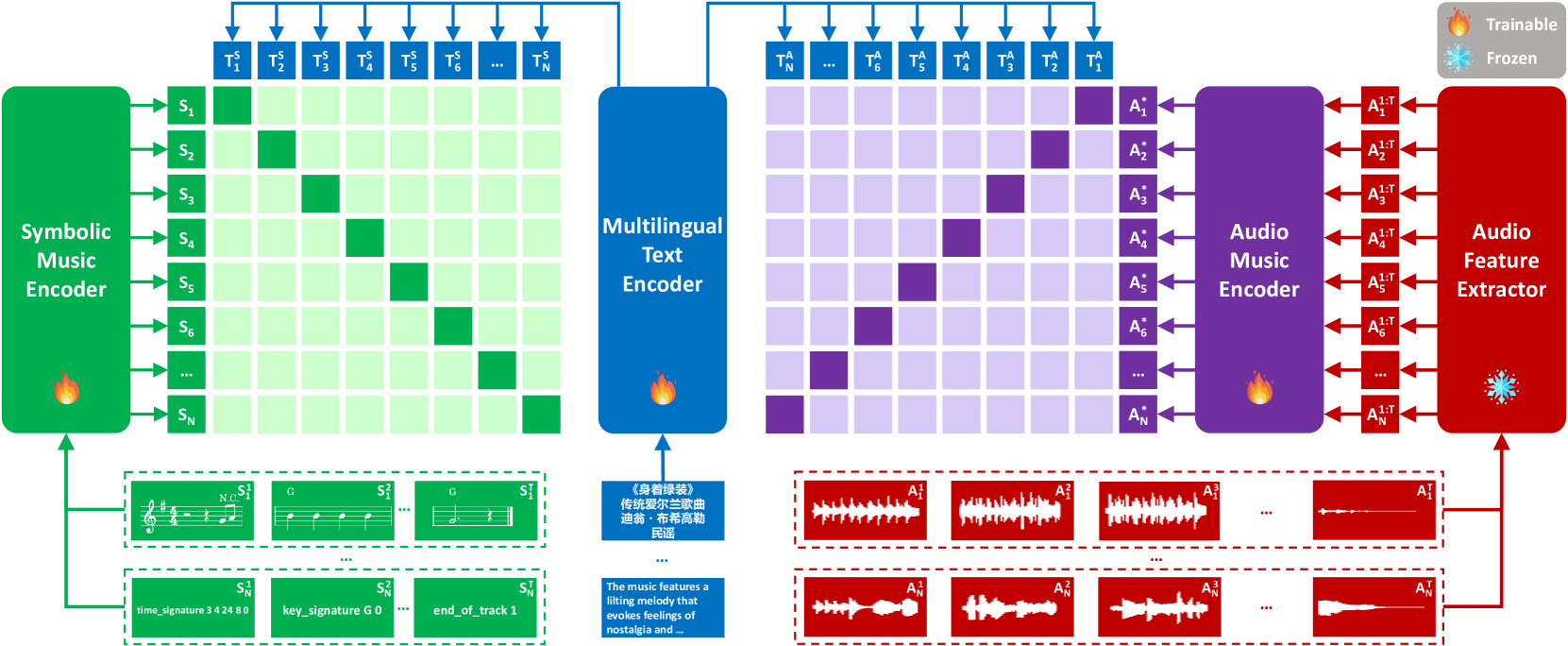
The diagram illustrates a technical architecture for a multimodal music processing system. It shows the flow of data through four interconnected components: Symbolic Music Encoder, Multilingual Text Encoder, Audio Music Encoder, and Audio Feature Extractor. The system integrates symbolic notation, textual descriptions, and audio features through trainable and frozen components.
### Components/Axes
1. **Symbolic Music Encoder (Green)**
- Inputs: Musical notation (S₁-S₆) with time signatures, key signatures, and track metadata
- Output: Grid of encoded symbolic representations (S₁-S₆)
- Notable: Contains trainable components (fire icon)
2. **Multilingual Text Encoder (Blue)**
- Inputs: Textual descriptions in Chinese (e.g., "身着银装" - "Body language")
- Output: Grid of encoded text representations (T₁-T₆)
- Notable: Contains trainable components (fire icon)
3. **Audio Music Encoder (Purple)**
- Inputs: Audio features (A₁-A₆)
- Output: Processed audio representations (A₁-A₆)
- Notable: Contains trainable components (fire icon)
4. **Audio Feature Extractor (Red)**
- Inputs: Audio features (A₁-A₆)
- Output: Extracted audio features (A₁ᵀ-A₆ᵀ)
- Notable: Contains frozen components (snowflake icon)
### Detailed Analysis
- **Symbolic Music Encoder Grid**:
- S₁: Contains musical notation with time signature 3/4, key signature G
- S₂: Contains musical notation with time signature 4/4, key signature G
- S₃: Contains musical notation with time signature 8/8, key signature G
- S₄: Contains musical notation with time signature 3/4, key signature G
- S₅: Contains musical notation with time signature 4/4, key signature G
- S₆: Contains musical notation with time signature 8/8, key signature G
- **Multilingual Text Encoder Grid**:
- T₁: Contains text "身着银装" (Body language)
- T₂: Contains text "传统爱尔兰歌曲" (Traditional Irish song)
- T₃: Contains text "迪翁·布希高勒" (Dionne-Bishighler)
- T₄: Contains text "民谣" (Folk song)
- T₅: Contains text "The music features a lilting melody..."
- T₆: Contains text "nostalgia and..."
- **Audio Music Encoder Grid**:
- A₁: Audio feature representation
- A₂: Audio feature representation
- A₃: Audio feature representation
- A₄: Audio feature representation
- A₅: Audio feature representation
- A₆: Audio feature representation
- **Audio Feature Extractor**:
- A₁ᵀ: Transposed audio feature
- A₂ᵀ: Transposed audio feature
- A₃ᵀ: Transposed audio feature
- A₄ᵀ: Transposed audio feature
- A₅ᵀ: Transposed audio feature
- A₆ᵀ: Transposed audio feature
### Key Observations
1. The system processes three modalities: symbolic notation, textual descriptions, and audio features
2. Components are color-coded (green, blue, purple, red) for easy identification
3. Trainable components (fire icon) appear in all encoders except the Audio Feature Extractor
4. The Audio Feature Extractor contains frozen components (snowflake icon)
5. Textual inputs include both Chinese characters and English descriptions
6. The system shows a clear data flow from input modalities to final feature extraction
### Interpretation
This architecture demonstrates a multimodal approach to music analysis, combining:
- Symbolic representation (musical notation)
- Textual analysis (multilingual descriptions)
- Audio processing (feature extraction)
The use of trainable components in the first three encoders suggests active learning capabilities, while the frozen components in the Audio Feature Extractor likely represent pre-trained models for audio processing. The integration of Chinese text indicates multilingual support, potentially for cross-lingual music analysis.
The system's design implies that symbolic and textual inputs are processed through separate encoders before being combined with audio features in the final stage. This separation allows for specialized processing of each modality while maintaining the ability to integrate them for comprehensive music analysis.