## Diagram: Technical Process for Answer Validation and Source Analysis
### Overview
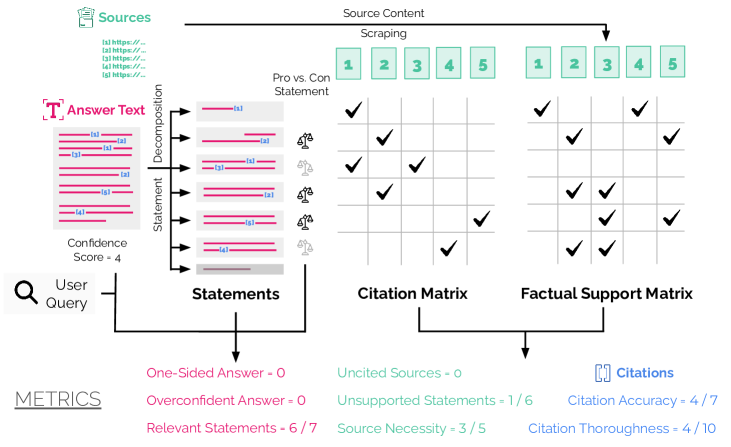
The diagram illustrates a multi-stage technical workflow for validating answers, analyzing source content, and evaluating citation quality. It includes components for statement decomposition, pro/con analysis, citation matrices, factual support tracking, and performance metrics.
### Components/Axes
1. **Sources**:
- Labeled as URLs (e.g., `https://...`) with numerical identifiers (1-5).
- Positioned at the top-left, connected to the "Scraping" stage.
2. **Scraping**:
- Represents source content extraction (1-5).
- Arrows point to "Pro vs. Con Statement" and "Citation Matrix."
3. **Pro vs. Con Statement**:
- A grid with checkmarks (✓) indicating source support for statements.
- Columns labeled 1-5 (sources), rows labeled 1-6 (statements).
4. **Citation Matrix**:
- Tracks citations with checkmarks (✓) for source-statement relationships.
- Columns 1-5 (sources), rows 1-6 (statements).
5. **Factual Support Matrix**:
- Similar structure to the Citation Matrix but focuses on factual validation.
- Columns 1-5 (sources), rows 1-6 (statements).
6. **Answer Text**:
- Contains decomposed statements with confidence scores (e.g., "Confidence Score - 4").
- Includes color-coded confidence levels (red, gray).
7. **Metrics**:
- **Left Side**:
- One-Sided Answer: 0
- Overconfident Answer: 0
- Relevant Statements: 6/7
- **Right Side**:
- Citations:
- Uncited Sources: 0
- Unsupported Statements: 1/6
- Source Necessity: 3/5
- Citation Accuracy: 4/7
- Citation Thoroughness: 4/10
### Detailed Analysis
- **Source Content Flow**:
- Sources (1-5) are scraped and decomposed into statements (1-6).
- Statements are validated against pro/con arguments and factual support.
- **Citation and Factual Support**:
- **Citation Matrix**:
- Source 1 supports statements 1, 3, 5.
- Source 2 supports statements 2, 4, 5.
- Source 3 supports statements 1, 2, 4.
- Source 4 supports statements 3, 5.
- Source 5 supports statements 2, 4, 5.
- **Factual Support Matrix**:
- Source 1 fully supports statements 1, 3, 5.
- Source 2 partially supports statements 2, 4, 5.
- Source 3 fully supports statements 1, 2, 4.
- Source 4 partially supports statements 3, 5.
- Source 5 fully supports statements 2, 4, 5.
- **Metrics**:
- **Answer Quality**:
- No one-sided or overconfident answers.
- 6/7 statements are relevant, indicating high topical alignment.
- **Citation Quality**:
- All sources are cited (0 uncited).
- 1/6 statements lack full support, suggesting minor gaps.
- Source necessity (3/5) implies some sources are redundant.
- Citation accuracy (4/7) and thoroughness (4/10) highlight room for improvement.
### Key Observations
1. **High Relevance, Moderate Citation Quality**:
- Most statements are relevant, but citation thoroughness is low (4/10).
2. **Partial Factual Support**:
- 1/6 statements lack full factual backing, indicating potential gaps in validation.
3. **Source Redundancy**:
- Only 3/5 sources are deemed necessary, suggesting inefficiencies in source selection.
### Interpretation
The diagram represents a structured approach to ensuring answer validity through source decomposition, pro/con analysis, and citation tracking. The high confidence score (4) and relevant statements (6/7) suggest the system effectively identifies credible content. However, the low citation thoroughness (4/10) and partial factual support (1/6) highlight areas for improvement, such as enhancing source diversity or refining validation criteria. The absence of one-sided or overconfident answers implies balanced reasoning, but the system may benefit from stricter citation requirements to improve factual rigor.