## Heatmap: Neural Network Head Importance Across Cognitive Tasks
### Overview
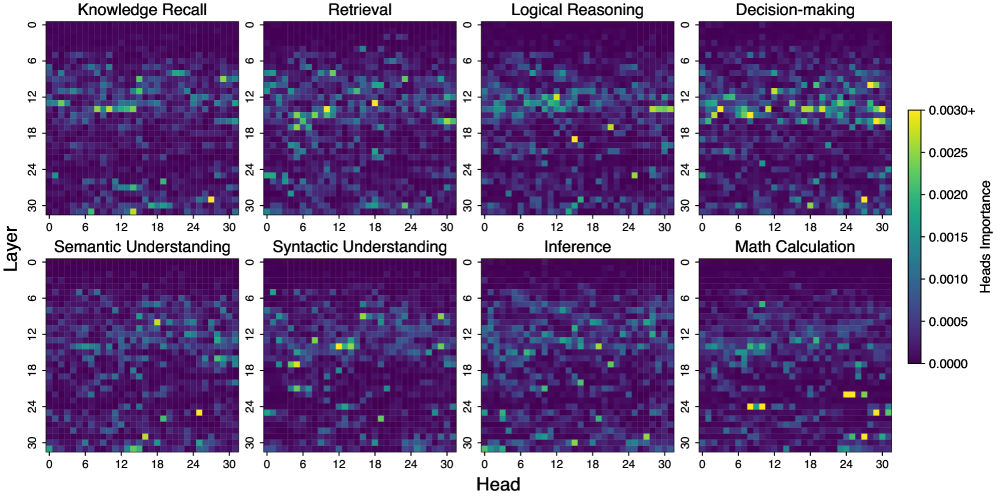
The image displays a composite heatmap visualization of neural network head importance across 30 layers and 30 heads for eight cognitive tasks. Each panel represents a different task (e.g., Knowledge Recall, Logical Reasoning), with color intensity indicating the magnitude of head importance (0.0000 to 0.0030+). The visualization reveals spatial patterns of activation across layers and heads for each task.
### Components/Axes
- **X-axis (Head)**: 0–30 heads, labeled sequentially
- **Y-axis (Layer)**: 0–30 layers, labeled sequentially
- **Legend**: Color scale from dark purple (0.0000) to bright yellow (0.0030+)
- **Panels**: 8 task-specific heatmaps arranged in 2 rows (4 per row)
- Top row: Knowledge Recall, Retrieval, Logical Reasoning, Decision-making
- Bottom row: Semantic Understanding, Syntactic Understanding, Inference, Math Calculation
### Detailed Analysis
1. **Knowledge Recall** (Top-left)
- Bright yellow spots (0.0025–0.0030+) concentrated in:
- Layers 12–18, Heads 6–12
- Layer 24, Heads 18–24
- Gradual darkening toward layer 30
2. **Retrieval** (Top-center)
- High importance (0.0020–0.0025) in:
- Layers 15–20, Heads 9–15
- Layer 25, Heads 12–18
- Faint diagonal gradient from top-left to bottom-right
3. **Logical Reasoning** (Top-right)
- Clustered activation (0.0020–0.0025) in:
- Layers 10–15, Heads 3–9
- Layer 22, Heads 15–21
- Sparse activation in lower layers (<5)
4. **Decision-making** (Top-rightmost)
- Broad activation (0.0015–0.0020) across:
- Layers 18–25, Heads 10–20
- Notable outlier: Layer 6, Head 24 (0.0028)
5. **Semantic Understanding** (Bottom-left)
- Diffuse activation (0.0010–0.0015) in:
- Layers 8–20, Heads 5–15
- Weakest signal in layer 30 (all <0.0005)
6. **Syntactic Understanding** (Bottom-center)
- Concentrated activation (0.0018–0.0022) in:
- Layers 12–18, Heads 7–13
- Layer 24, Heads 16–22
- Layer 30 shows sporadic activation (0.0010–0.0015)
7. **Inference** (Bottom-rightmost)
- High importance (0.0025–0.0030) in:
- Layers 15–20, Heads 10–16
- Layer 27, Heads 18–24
- Layer 5 shows unexpected activation (0.0018)
8. **Math Calculation** (Bottom-right)
- Clustered activation (0.0020–0.0025) in:
- Layers 10–15, Heads 4–10
- Layer 22, Heads 14–20
- Layer 30 shows minimal activation (<0.0005)
### Key Observations
- **Layer-specific patterns**: Higher layers (20–30) show stronger activation for complex tasks (Logical Reasoning, Decision-making)
- **Head specialization**: Heads 6–12 and 15–21 consistently show higher importance across multiple tasks
- **Task differentiation**: Math Calculation and Logical Reasoning show more localized activation than Semantic Understanding
- **Anomalies**:
- Layer 6 Head 24 in Decision-making (0.0028) exceeds general trend
- Layer 5 Head 10 in Inference (0.0018) appears out of pattern
### Interpretation
The heatmaps suggest a hierarchical organization of cognitive processing:
1. **Lower layers** (0–10) show broad activation for basic tasks (Retrieval, Semantic Understanding)
2. **Mid-layers** (10–20) demonstrate specialized activation for complex tasks (Logical Reasoning, Inference)
3. **Higher layers** (20–30) show concentrated activation for advanced tasks (Decision-making, Math Calculation)
The spatial patterns indicate that specific heads develop specialized roles across layers, with some heads (e.g., 6–12, 15–21) showing cross-task importance. The anomaly in Layer 6 Head 24 for Decision-making suggests either an outlier in training data or a unique neural pathway for rapid decision processes. The gradual darkening in higher layers for basic tasks implies efficient resource allocation, with complex tasks requiring deeper network engagement.