## Line Chart: Association and Hallucination Norms Across Layers
### Overview
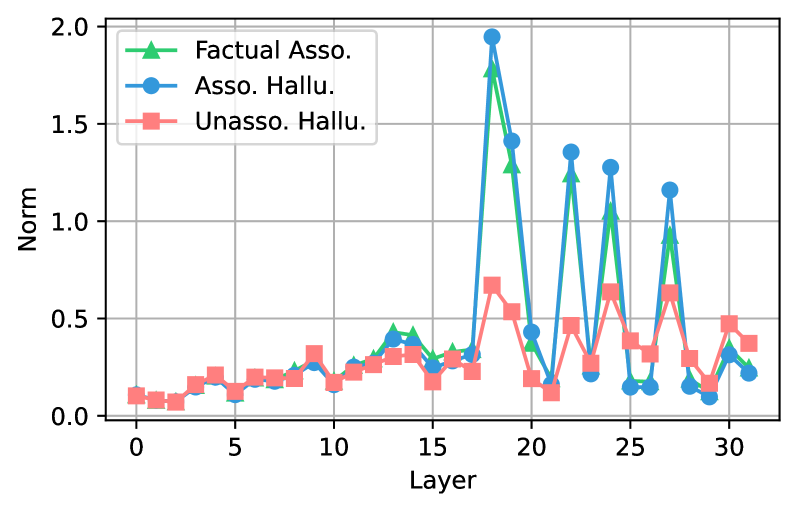
This image is a line chart plotting the "Norm" (y-axis) against "Layer" (x-axis) for three distinct data series. The chart visualizes how the magnitude (norm) of three different phenomena—Factual Association, Associated Hallucination, and Unassociated Hallucination—changes across the layers of a system, likely a neural network model. The data shows significant volatility and synchronized spikes in the later layers.
### Components/Axes
* **Chart Type:** Line chart with markers.
* **X-Axis:**
* **Label:** "Layer"
* **Scale:** Linear, ranging from 0 to 30.
* **Major Ticks:** 0, 5, 10, 15, 20, 25, 30.
* **Y-Axis:**
* **Label:** "Norm"
* **Scale:** Linear, ranging from 0.0 to 2.0.
* **Major Ticks:** 0.0, 0.5, 1.0, 1.5, 2.0.
* **Legend:** Located in the top-left corner of the plot area.
1. **Factual Asso.** - Represented by a green line with upward-pointing triangle markers (▲).
2. **Asso. Hallu.** - Represented by a blue line with circle markers (●).
3. **Unasso. Hallu.** - Represented by a red/salmon line with square markers (■).
* **Grid:** A light gray grid is present for both x and y axes.
### Detailed Analysis
The analysis is segmented by data series, with trends described before key data points.
**1. Factual Asso. (Green line, ▲)**
* **Trend:** The line remains relatively low and stable (norm < 0.5) from layer 0 to approximately layer 17. It then exhibits extreme volatility, with sharp, high-magnitude spikes and drops in layers 18 through 30.
* **Key Data Points (Approximate):**
* Layers 0-17: Fluctuates between ~0.1 and ~0.45.
* Layer 18: **Major spike** to a norm of ~1.8.
* Layer 19: Drops to ~1.3.
* Layer 20: Sharp drop to ~0.2.
* Layer 22: Spike to ~1.25.
* Layer 24: Spike to ~1.0.
* Layer 27: Spike to ~0.9.
* Layer 30: Ends at ~0.25.
**2. Asso. Hallu. (Blue line, ●)**
* **Trend:** Follows a pattern highly correlated with "Factual Asso." but with generally higher peak magnitudes. It is low and stable in early layers, then shows even more pronounced spikes in the later layers, often exceeding the "Factual Asso." values at the same points.
* **Key Data Points (Approximate):**
* Layers 0-17: Fluctuates between ~0.1 and ~0.4, closely tracking the green line.
* Layer 18: **Highest peak on the chart** at a norm of ~1.95.
* Layer 19: Drops to ~1.4.
* Layer 20: Sharp drop to ~0.45.
* Layer 22: Spike to ~1.35.
* Layer 24: Spike to ~1.3.
* Layer 27: Spike to ~1.15.
* Layer 30: Ends at ~0.2.
**3. Unasso. Hallu. (Red/Salmon line, ■)**
* **Trend:** This series maintains a lower baseline norm compared to the other two throughout all layers. While it also shows increased volatility after layer 15, its spikes are significantly smaller in magnitude. It does not exhibit the same extreme peaks as the other series.
* **Key Data Points (Approximate):**
* Layers 0-17: Fluctuates between ~0.1 and ~0.35.
* Layer 18: Moderate spike to ~0.65.
* Layer 19: Drops to ~0.5.
* Layer 20: Drops to ~0.2.
* Layer 22: Spike to ~0.45.
* Layer 24: Spike to ~0.6.
* Layer 27: Spike to ~0.6.
* Layer 30: Ends at ~0.4.
### Key Observations
1. **Synchronized Volatility:** All three series transition from a stable, low-norm state to a highly volatile state at approximately the same point (around layer 17-18).
2. **Magnitude Hierarchy:** In the volatile region (layers 18-30), the hierarchy of norms is consistent: `Asso. Hallu.` (blue) ≥ `Factual Asso.` (green) > `Unasso. Hallu.` (red). The blue line's peaks are almost always the highest.
3. **Correlated Spikes:** The spikes for "Factual Asso." and "Asso. Hallu." are tightly synchronized in layer position (e.g., layers 18, 22, 24, 27), suggesting a common underlying cause or trigger at those specific layers.
4. **Lower Baseline for Unassociated Hallucination:** The "Unasso. Hallu." series, while volatile, operates on a different, lower scale, indicating this phenomenon is consistently less intense than the associated forms.
### Interpretation
This chart likely illustrates the internal dynamics of a large language model or similar neural network. The "Layer" axis corresponds to the depth of processing within the model.
* **What the data suggests:** The findings imply that the phenomena of "association" and "hallucination" (both associated and unassociated) are not constant but are activated or amplified in specific, deeper layers of the network (post layer 17). The strong correlation between "Factual Association" and "Associated Hallucination" spikes suggests they may share computational pathways or be two outcomes of the same underlying process. The fact that "Associated Hallucination" norms are often higher than "Factual Association" norms at peak points could indicate that the mechanism for generating plausible but incorrect associations (hallucinations) is more powerful or less constrained than the mechanism for retrieving factual associations in these critical layers.
* **How elements relate:** The x-axis (Layer) is the independent variable, representing the model's processing stage. The y-axis (Norm) is the dependent variable, measuring the strength or salience of the tracked phenomena. The legend defines the three distinct processes being measured. The synchronized spikes are the most critical relational feature, pointing to layer-specific computational events.
* **Notable anomalies:** The most significant anomaly is the dramatic phase shift in behavior at layer ~18. The system's state changes fundamentally at this depth. The consistent pattern where "Asso. Hallu." meets or exceeds "Factual Asso." during spikes is also noteworthy, as it quantitatively demonstrates a potential vulnerability where hallucinatory associations can overpower factual ones at specific points in the model's processing hierarchy.