## Multi-Line Chart: Accuracy of Four AI Models Across 35 Mathematics Topics
### Overview
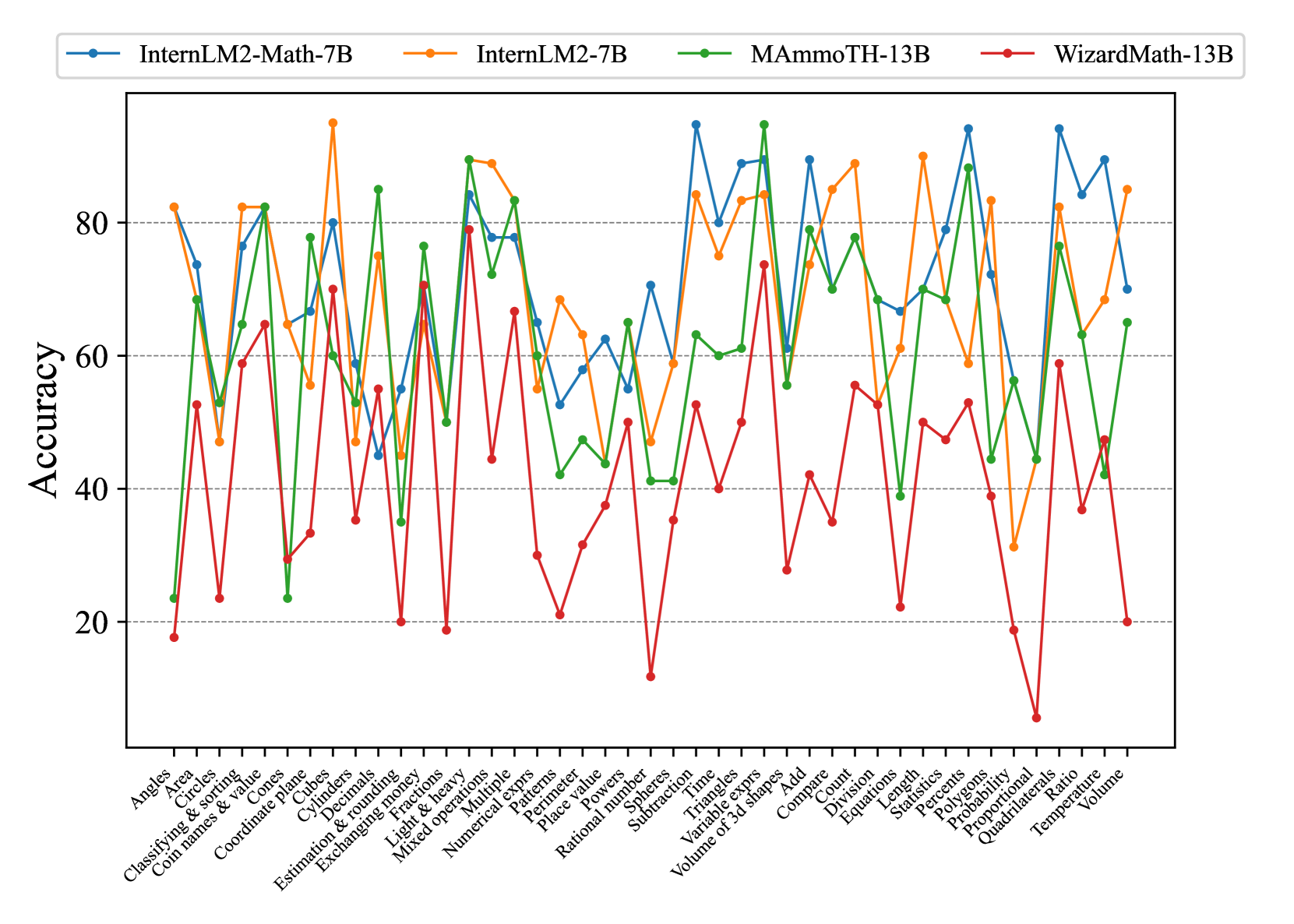
This image is a multi-line chart comparing the performance (accuracy) of four different AI models across a wide range of discrete mathematics topics. The chart visualizes how each model's accuracy fluctuates significantly depending on the specific mathematical concept being tested.
### Components/Axes
* **Chart Type:** Multi-line chart with markers.
* **Y-Axis:**
* **Label:** "Accuracy"
* **Scale:** Linear, ranging from 0 to 100 (implied percentage).
* **Major Gridlines:** Horizontal dashed lines at 20, 40, 60, and 80.
* **X-Axis:**
* **Label:** None explicit. Contains 35 categorical labels for mathematics topics.
* **Categories (from left to right):** Angles, Area, Circles, Classifying & sorting, Coin names & value, Cones, Coordinate plane, Cubes, Cylinders, Decimals, Estimation & rounding, Exchanging money, Fractions, Light & heavy, Mixed operations, Multiple, Numerical exprs, Patterns, Perimeter, Place value, Powers, Rational number, Spheres, Subtraction, Time, Triangles, Variable exprs, Volume of 3d shapes, Add, Compare, Count, Division, Equations, Length, Statistics, Percents, Polygons, Probability, Proportional, Quadrilaterals, Ratio, Temperature, Volume.
* **Legend:**
* **Position:** Top center, above the plot area.
* **Series:**
1. **InternLM2-Math-7B:** Blue line with circular markers.
2. **InternLM2-7B:** Orange line with circular markers.
3. **MAmmoTH-13B:** Green line with circular markers.
4. **WizardMath-13B:** Red line with circular markers.
### Detailed Analysis
The chart shows high variability in model performance across topics. Below is an approximate data extraction for each model across all 35 topics. Values are estimated from the chart's position relative to the gridlines.
**Trend Verification & Data Points (Approximate Accuracy %):**
| Topic | InternLM2-Math-7B (Blue) | InternLM2-7B (Orange) | MAmmoTH-13B (Green) | WizardMath-13B (Red) |
| :--- | :--- | :--- | :--- | :--- |
| **Angles** | ~82 | ~82 | ~23 | ~18 |
| **Area** | ~74 | ~47 | ~68 | ~53 |
| **Circles** | ~53 | ~53 | ~53 | ~23 |
| **Classifying & sorting** | ~77 | ~82 | ~65 | ~59 |
| **Coin names & value** | ~82 | ~82 | ~82 | ~65 |
| **Cones** | ~65 | ~65 | ~23 | ~29 |
| **Coordinate plane** | ~67 | ~56 | ~78 | ~33 |
| **Cubes** | ~80 | ~94 | ~60 | ~70 |
| **Cylinders** | ~59 | ~47 | ~53 | ~35 |
| **Decimals** | ~45 | ~75 | ~35 | ~55 |
| **Estimation & rounding** | ~55 | ~45 | ~50 | ~20 |
| **Exchanging money** | ~70 | ~65 | ~77 | ~19 |
| **Fractions** | ~84 | ~89 | ~89 | ~79 |
| **Light & heavy** | ~78 | ~89 | ~72 | ~44 |
| **Mixed operations** | ~78 | ~83 | ~83 | ~67 |
| **Multiple** | ~65 | ~55 | ~60 | ~30 |
| **Numerical exprs** | ~53 | ~68 | ~42 | ~21 |
| **Patterns** | ~58 | ~63 | ~47 | ~31 |
| **Perimeter** | ~62 | ~55 | ~44 | ~37 |
| **Place value** | ~55 | ~47 | ~65 | ~50 |
| **Powers** | ~70 | ~59 | ~41 | ~12 |
| **Rational number** | ~94 | ~84 | ~41 | ~35 |
| **Spheres** | ~80 | ~75 | ~63 | ~53 |
| **Subtraction** | ~88 | ~83 | ~60 | ~40 |
| **Time** | ~89 | ~84 | ~61 | ~50 |
| **Triangles** | ~61 | ~56 | ~56 | ~28 |
| **Variable exprs** | ~89 | ~74 | ~79 | ~42 |
| **Volume of 3d shapes** | ~70 | ~84 | ~70 | ~35 |
| **Add** | ~67 | ~89 | ~68 | ~56 |
| **Compare** | ~79 | ~84 | ~78 | ~53 |
| **Count** | ~69 | ~61 | ~39 | ~22 |
| **Division** | ~70 | ~90 | ~70 | ~50 |
| **Equations** | ~79 | ~59 | ~69 | ~48 |
| **Length** | ~94 | ~83 | ~88 | ~53 |
| **Statistics** | ~72 | ~31 | ~44 | ~39 |
| **Percents** | ~56 | ~45 | ~45 | ~19 |
| **Polygons** | ~94 | ~82 | ~77 | ~59 |
| **Probability** | ~84 | ~63 | ~63 | ~37 |
| **Proportional** | ~89 | ~69 | ~42 | ~47 |
| **Quadrilaterals** | ~70 | ~85 | ~65 | ~20 |
| **Ratio** | (Data point not clearly visible) | (Data point not clearly visible) | (Data point not clearly visible) | (Data point not clearly visible) |
| **Temperature** | (Data point not clearly visible) | (Data point not clearly visible) | (Data point not clearly visible) | (Data point not clearly visible) |
| **Volume** | (Data point not clearly visible) | (Data point not clearly visible) | (Data point not clearly visible) | (Data point not clearly visible) |
*Note: The last three topics (Ratio, Temperature, Volume) have data points that are obscured or not clearly plotted in the provided image.*
### Key Observations
1. **High Variability:** All models show dramatic swings in accuracy (often >40 percentage points) between different topics. No model is consistently superior.
2. **Model Strengths:**
* **InternLM2-Math-7B (Blue):** Often achieves the highest peaks (e.g., Rational number, Length, Polygons ~94%). It shows particular strength in more abstract or advanced topics.
* **InternLM2-7B (Orange):** Frequently competes for the top spot and shows very high accuracy in foundational arithmetic topics (e.g., Cubes, Fractions, Add, Division).
* **MAmmoTH-13B (Green):** Generally performs in the middle of the pack but has notable peaks in geometry (Fractions, Mixed operations) and specific topics like "Variable exprs".
* **WizardMath-13B (Red):** Consistently performs at the lowest accuracy level across nearly all topics, with its lowest point at "Powers" (~12%).
3. **Topic Difficulty:** Some topics appear universally challenging (e.g., "Powers", "Numerical exprs", "Patterns") where all models score below 70%. Others like "Fractions" and "Mixed operations" see high scores from multiple models.
4. **Outliers:** The "Rational number" topic shows a massive performance gap, with InternLM2-Math-7B scoring ~94% while WizardMath-13B scores ~35%.
### Interpretation
This chart is a comparative benchmark revealing the specialized nature of these AI models. The data suggests that:
* **Model Architecture & Training Matters:** The "InternLM2-Math-7B" variant, presumably fine-tuned for mathematics, frequently outperforms its base "InternLM2-7B" counterpart, especially on more complex topics. This demonstrates the effectiveness of domain-specific training.
* **No Universal Solver:** The extreme variability indicates that these models have not achieved a generalized mathematical reasoning ability. Their performance is highly dependent on the specific format and concept of the problem, akin to a student who excels in geometry but struggles with algebra.
* **WizardMath-13B's Underperformance:** The consistently lower scores of WizardMath-13B suggest its training or architecture may be less effective for this broad set of topics compared to the other models evaluated, or it may be optimized for a different type of mathematical problem (e.g., competition math) not well-represented here.
* **Benchmark Utility:** For a user or developer, this chart is crucial for model selection. If one needs a model for geometry problems, "InternLM2-7B" or "MAmmoTH-13B" might be preferred. For advanced topics like "Rational number" or "Polygons", "InternLM2-Math-7B" is the clear choice. The chart argues against using a single model for all mathematical tasks without understanding its specific strengths and weaknesses.