## Data Table: Operation Latencies
### Overview
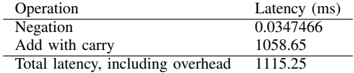
The image displays a simple two-column data table presenting the latency measurements for specific computational operations, along with a total latency figure that includes overhead.
### Components/Axes
The table consists of two columns:
1. **Operation**: Lists the names of the computational operations.
2. **Latency (ms)**: Lists the corresponding time measurements in milliseconds (ms).
### Detailed Analysis
The table contains three rows of data:
| Operation | Latency (ms) |
| :--- | :--- |
| Negation | 0.0347466 |
| Add with carry | 1058.65 |
| **Total latency, including overhead** | **1115.25** |
### Key Observations
1. There is a massive disparity in latency between the two listed operations. "Add with carry" (1058.65 ms) is approximately 30,470 times slower than "Negation" (0.0347466 ms).
2. The "Total latency, including overhead" (1115.25 ms) is greater than the sum of the two individual operation latencies (0.0347466 + 1058.65 ≈ 1058.6847 ms). The difference of approximately 56.5653 ms represents the unlisted "overhead" component.
### Interpretation
This table likely comes from a performance analysis or benchmarking report for a computing system, possibly at a low level (e.g., CPU instruction timing, cryptographic operation, or a specific algorithm's step).
* **What the data suggests**: The "Negation" operation is extremely fast, typical of a simple bitwise or arithmetic NOT operation. The "Add with carry" operation is orders of magnitude slower, suggesting it is either a more complex operation (like a multi-precision integer addition used in cryptography or big number arithmetic) or is being executed in a significantly less optimized context or on a different type of hardware accelerator.
* **How elements relate**: The total latency provides a holistic view of a process that includes these two operations plus additional setup, teardown, or communication overhead. The overhead itself (≈56.6 ms) is substantial—over 1,600 times slower than the Negation operation—indicating that system or process setup costs can dominate the total time for tasks involving very fast primitive operations.
* **Notable anomalies**: The primary anomaly is the extreme performance gap between the two operations. This could indicate a benchmark designed to highlight the cost of a specific, complex operation ("Add with carry") against a trivial one, or it could reflect the performance profile of a system where certain operations are hardware-accelerated while others are not. The explicit listing of "overhead" is also notable, as it is often omitted in simpler benchmarks.