\n
## Diagram: Digit to Matrix Mapping
### Overview
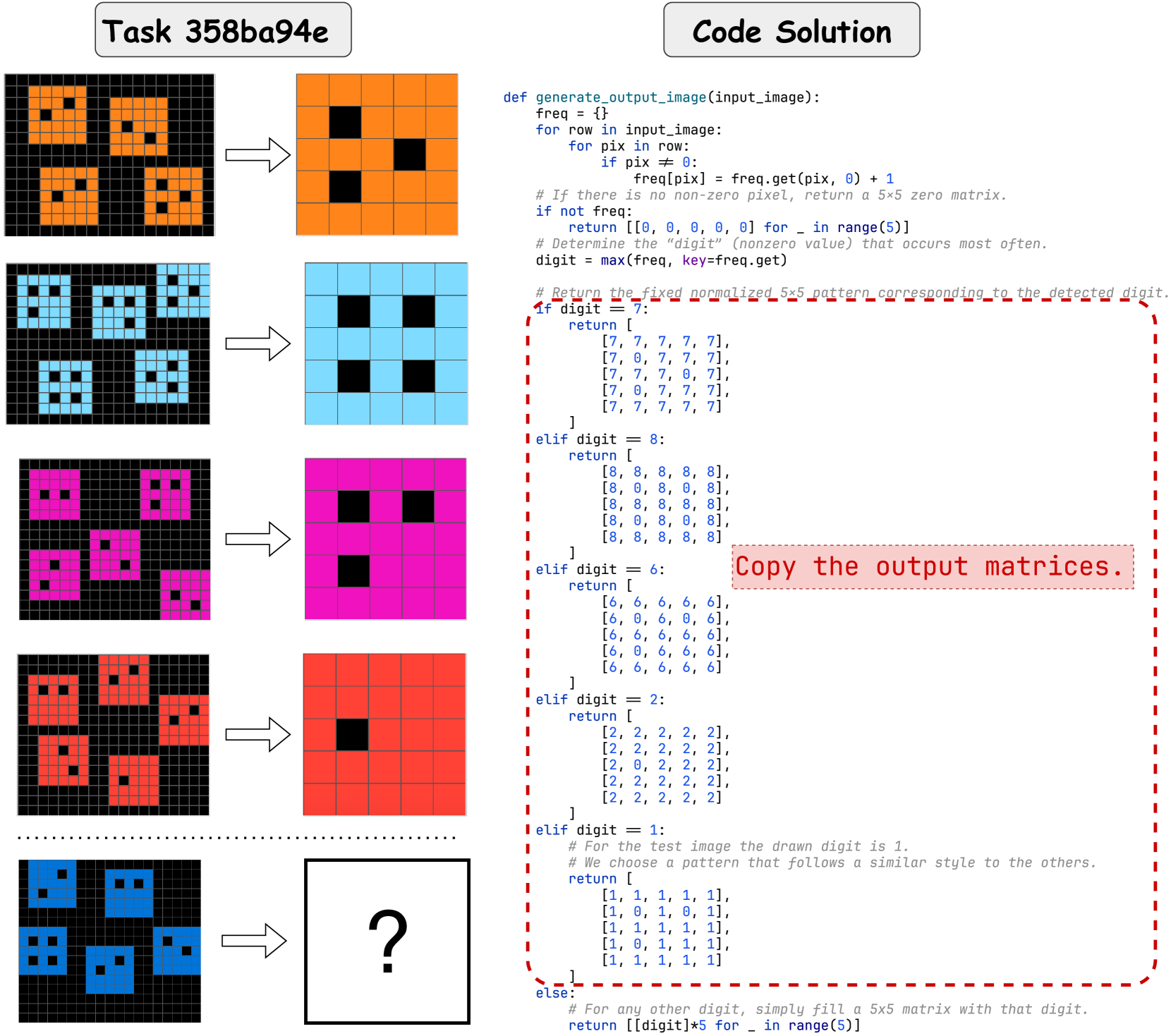
The image presents a diagram illustrating a function `generate_output_image` that maps digits (0-9) to 5x5 matrices represented by numerical values. The diagram shows example matrices for digits 7, 8, 6, 2, 1, and a placeholder for other digits. Arrows point from the digit representations (visualized as 5x5 pixel grids) to the corresponding code block defining the matrix. A text annotation "Copy the output matrices." is present on the right side of the diagram. A question mark is present next to the matrix for digit 1.
### Components/Axes
The diagram consists of the following components:
* **Code Block:** A Python code snippet defining the `generate_output_image` function.
* **Digit Representations:** 5x5 pixel grids visually representing the digits 7, 8, 6, 2, and 1.
* **Arrows:** Arrows connecting each digit representation to its corresponding matrix definition in the code.
* **Annotation:** "Copy the output matrices."
* **Question Mark:** A question mark next to the matrix for digit 1.
### Detailed Analysis or Content Details
The code snippet defines a function `generate_output_image(input_image)` that appears to convert an input image (presumably representing a digit) into a 5x5 matrix of numerical values. The function calculates the frequency of each pixel value (presumably 0 or 1) and determines the most frequent digit. It then returns a predefined 5x5 matrix corresponding to that digit.
Here's a breakdown of the matrices defined for each digit:
* **Digit 7:**
```
[
[7, 7, 7, 7, 7],
[7, 0, 0, 0, 7],
[7, 0, 7, 0, 7],
[7, 0, 0, 0, 7],
[7, 7, 7, 7, 7]
]
```
* **Digit 8:**
```
[
[8, 8, 8, 8, 8],
[8, 0, 0, 0, 8],
[8, 0, 8, 0, 8],
[8, 0, 0, 0, 8],
[8, 8, 8, 8, 8]
]
```
* **Digit 6:**
```
[
[6, 6, 6, 6, 6],
[6, 0, 0, 0, 6],
[6, 0, 6, 0, 6],
[6, 0, 0, 0, 6],
[6, 6, 6, 6, 6]
]
```
* **Digit 2:**
```
[
[2, 2, 2, 2, 2],
[2, 0, 0, 0, 2],
[2, 2, 2, 2, 2],
[2, 0, 0, 0, 2],
[2, 2, 2, 2, 2]
]
```
* **Digit 1:**
```
[
[1, 1, 1, 1, 1],
[1, 0, 0, 0, 1],
[1, 0, 0, 0, 1],
[1, 0, 0, 0, 1],
[1, 1, 1, 1, 1]
]
```
* **Other Digits (0, 3, 4, 5, 9):**
The code returns a 5x5 matrix filled with the digit's value. For example, if the digit is 5, it returns a matrix filled with 5s.
### Key Observations
* The matrices for digits 7, 8, 6, and 2 share a similar structure: a border of the digit's value and zeros inside.
* The matrix for digit 1 is also similar, but with a slightly different arrangement of zeros.
* The question mark next to the digit 1 matrix suggests a potential issue or uncertainty with its definition.
* The annotation "Copy the output matrices." indicates that these matrices are intended to be used elsewhere.
### Interpretation
The diagram demonstrates a method for converting handwritten digit images into a numerical representation suitable for machine learning or other computational tasks. The function `generate_output_image` essentially performs a simplified form of feature extraction, representing each digit as a 5x5 matrix of values. The use of predefined matrices for each digit suggests a rule-based approach, rather than a learned model. The question mark next to the digit 1 matrix could indicate that the predefined matrix does not accurately represent the digit, or that there is a need for further refinement. The annotation suggests that these matrices are used as input for another process. The code snippet is a simplified example, and a real-world implementation would likely involve more sophisticated image processing techniques. The function appears to be designed to handle binary images (pixels with values 0 or 1). The frequency calculation and digit determination step suggest that the input image is analyzed to identify the most prominent digit.