## Diagram: Multimodal Data Processing
### Overview
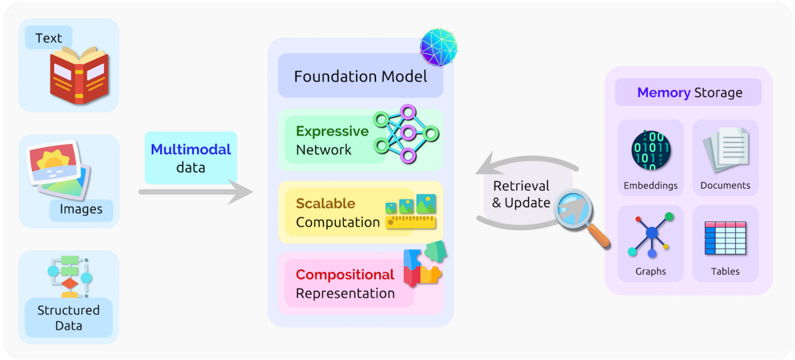
The image is a diagram illustrating the flow of multimodal data through a foundation model and its subsequent storage and retrieval. It depicts how different data types (text, images, structured data) are processed and stored for later use.
### Components/Axes
* **Input Data (Left)**:
* Text (represented by an open book icon)
* Images (represented by a stack of photos)
* Structured Data (represented by a flowchart icon)
* **Multimodal Data Processing**:
* "Multimodal data" label with a rightward-pointing arrow indicating the flow of data.
* **Foundation Model (Center)**:
* Foundation Model (top)
* Expressive Network (second from top)
* Scalable Computation (second from bottom)
* Compositional Representation (bottom)
* **Retrieval & Update**:
* "Retrieval & Update" label with a curved arrow pointing back from Memory Storage to the Foundation Model. A magnifying glass icon is present.
* **Memory Storage (Right)**:
* Memory Storage (top)
* Embeddings (represented by a binary code icon)
* Documents (represented by a stack of papers icon)
* Graphs (represented by a network graph icon)
* Tables (represented by a spreadsheet icon)
### Detailed Analysis or Content Details
1. **Input Data**: The diagram begins with three types of input data:
* **Text**: Represented by an open book.
* **Images**: Represented by a stack of photos.
* **Structured Data**: Represented by a flowchart.
2. **Multimodal Data**: These data types are combined into "Multimodal data," indicated by a blue box and an arrow pointing to the right.
3. **Foundation Model**: The multimodal data is then processed by a "Foundation Model," which consists of the following layers:
* **Expressive Network**: Represented by a network diagram.
* **Scalable Computation**: Represented by bar graphs and a ruler.
* **Compositional Representation**: Represented by interlocking blocks.
4. **Memory Storage**: The processed data is stored in "Memory Storage," which includes:
* **Embeddings**: Represented by a binary code icon.
* The binary code is "00", "01011", "101".
* **Documents**: Represented by a stack of papers.
* **Graphs**: Represented by a network graph.
* **Tables**: Represented by a spreadsheet.
5. **Retrieval & Update**: A "Retrieval & Update" process, indicated by a curved arrow and a magnifying glass, allows data to be retrieved from "Memory Storage" and fed back into the "Foundation Model."
### Key Observations
* The diagram illustrates a closed-loop system where multimodal data is processed, stored, and retrieved for continuous learning or updating.
* The "Foundation Model" is central to the process, suggesting its role in understanding and representing the multimodal data.
* The "Memory Storage" component highlights the importance of storing different data representations (embeddings, documents, graphs, tables).
### Interpretation
The diagram depicts a system for processing and managing multimodal data using a foundation model. The model likely learns from various data types, creating representations that are stored and can be retrieved for further processing or updating the model. The closed-loop nature of the system suggests a continuous learning process, where the model improves its understanding of the data over time. The different storage types indicate that the system can handle various forms of data representation, allowing for flexible and efficient data management.