\n
## Diagram: Foundation Model Architecture
### Overview
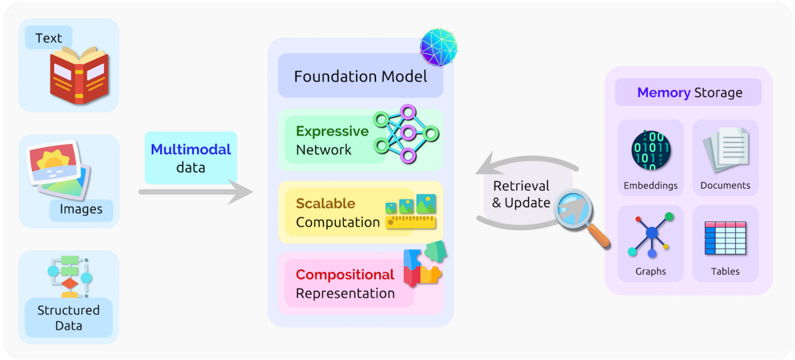
The image is a diagram illustrating the architecture of a Foundation Model, showcasing the flow of multimodal data through the model and into memory storage. It depicts the key components of the model and how they interact. The diagram uses icons and text labels to represent different data types and processes.
### Components/Axes
The diagram consists of three main sections: Input Data, Foundation Model, and Memory Storage.
* **Input Data:** Includes icons representing Text (open book), Images (picture frame with a sunburst), and Structured Data (database icon). These are collectively labeled "Multimodal data".
* **Foundation Model:** A rectangular block divided into three layers:
* "Expressive Network" (light blue) with an icon of interconnected nodes.
* "Scalable Computation" (yellow) with an icon of stacked blocks.
* "Compositional Representation" (pink) with an icon of various shapes.
* **Memory Storage:** A rectangular block labeled "Memory Storage" containing icons for:
* Embeddings (binary code)
* Documents (document icon)
* Graphs (network diagram)
* Tables (grid icon)
* **Flow:** Arrows indicate the flow of "Multimodal data" into the "Foundation Model" and then to "Retrieval & Update" (magnifying glass icon) which connects to "Memory Storage".
* **Global Icon:** A globe icon is positioned above the "Foundation Model", suggesting a broad scope or global knowledge.
### Detailed Analysis or Content Details
The diagram illustrates a process flow:
1. **Input:** Multimodal data (text, images, structured data) is fed into the Foundation Model.
2. **Processing:** The Foundation Model processes the data through three layers:
* **Expressive Network:** Likely handles complex relationships and patterns.
* **Scalable Computation:** Suggests efficient processing of large datasets.
* **Compositional Representation:** Implies the model breaks down data into meaningful components.
3. **Output:** The processed data is then sent to a "Retrieval & Update" process.
4. **Storage:** Finally, the data is stored in "Memory Storage" in various formats: embeddings, documents, graphs, and tables.
The diagram does not contain numerical data or specific values. It is a conceptual representation of a system architecture.
### Key Observations
The diagram emphasizes the model's ability to handle diverse data types ("Multimodal data") and its capacity for storing information in multiple formats. The layered structure of the Foundation Model suggests a hierarchical processing approach. The "Retrieval & Update" component indicates the model is not static and can be updated with new information.
### Interpretation
This diagram represents a modern approach to AI model design, focusing on versatility and scalability. The use of "Foundation Model" suggests a pre-trained model capable of adapting to various downstream tasks. The multimodal input capability is a key feature, allowing the model to learn from different data sources. The memory storage component highlights the importance of retaining and organizing knowledge for future use. The diagram suggests a system designed for continuous learning and improvement, as indicated by the "Retrieval & Update" process. The globe icon implies the model's knowledge base is extensive and potentially global in scope. The diagram is a high-level overview and does not delve into the specific algorithms or techniques used within each component.