## Diagram: Multimodal Data Processing Pipeline
### Overview
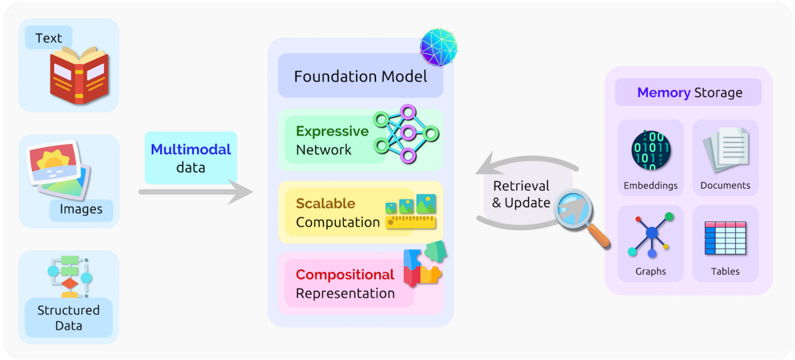
The diagram illustrates a technical architecture for processing multimodal data through a foundation model and storing results in a memory system. It emphasizes modular components, scalability, and bidirectional data flow between processing and storage.
### Components/Axes
1. **Left Inputs (Multimodal Data Sources):**
- **Text** (icon: open book)
- **Images** (icon: stacked photos)
- **Structured Data** (icon: flowchart with nodes)
- All inputs feed into a central **Multimodal Data** aggregation node.
2. **Central Foundation Model:**
- **Expressive Network** (green box, icon: interconnected nodes)
- **Scalable Computation** (yellow box, icon: calculator and graph)
- **Compositional Representation** (pink box, icon: puzzle pieces)
- These components are color-coded and spatially stacked vertically.
3. **Right Output (Memory Storage):**
- **Embeddings** (icon: binary code sphere)
- **Documents** (icon: paper stack)
- **Graphs** (icon: molecular structure)
- **Tables** (icon: spreadsheet grid)
- Connected via a bidirectional arrow labeled **"Retrieval & Update"** to the foundation model.
4. **Legend/Color Coding:**
- Green: Expressive Network
- Yellow: Scalable Computation
- Pink: Compositional Representation
### Detailed Analysis
- **Input Flow:** Multimodal data (text, images, structured data) is aggregated and processed sequentially through the foundation model’s three components.
- **Foundation Model Workflow:**
- **Expressive Network** (green) likely handles feature extraction or pattern recognition.
- **Scalable Computation** (yellow) suggests optimization for resource efficiency.
- **Compositional Representation** (pink) implies modular data structuring.
- **Memory Storage:** Outputs are stored as embeddings, documents, graphs, and tables, enabling retrieval and iterative updates.
### Key Observations
- The bidirectional arrow between the foundation model and memory storage indicates dynamic interaction, allowing the system to refine outputs based on stored data.
- No numerical values or quantitative metrics are present; the diagram focuses on architectural relationships.
- Color coding is consistent: green, yellow, and pink boxes align with their respective component labels.
### Interpretation
This pipeline represents a system designed for end-to-end multimodal data processing. The foundation model acts as a transformer, converting raw inputs into structured, scalable representations. The memory storage component ensures data persistence and accessibility, enabling iterative improvements. The absence of numerical data suggests the diagram prioritizes conceptual clarity over performance metrics. The bidirectional flow highlights adaptability, critical for applications like AI-driven analytics or real-time decision systems.