TECHNICAL ASSET FINGERPRINT
e0ad19f743596d84ef1a2237
Click to view fullscreen
Press ESC or click to close
FOUND IN PAPERS
EXPERT: gemini-2.0-flash VERSION 1
RUNTIME: nugit/gemini/gemini-2.0-flash
INTEL_VERIFIED
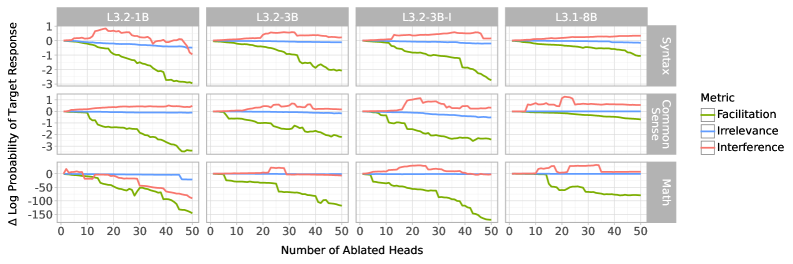
## Chart Type: Ablation Study Line Plots
### Overview
The image presents a series of line plots illustrating the impact of ablating (removing) heads from different language models on various metrics. The plots are arranged in a grid, with columns representing different model architectures (L3.2-1B, L3.2-3B, L3.2-3B-I, L3.1-8B) and rows representing different evaluation metrics (Syntax, Common Sense, Math). Each plot shows how the change in log probability of the target response (Δ Log Probability of Target Response) varies as the number of ablated heads increases. The lines represent Facilitation, Irrelevance, and Interference.
### Components/Axes
* **X-axis:** Number of Ablated Heads (ranging from 0 to 50)
* **Y-axis:** Δ Log Probability of Target Response. The scale varies by row:
* Syntax: -3 to 1
* Common Sense: -3 to 1
* Math: -150 to 0
* **Plot Titles (Top Row):** L3.2-1B, L3.2-3B, L3.2-3B-I, L3.1-8B (representing different model architectures)
* **Row Titles (Right Side):** Syntax, Common Sense, Math (representing different evaluation metrics)
* **Legend (Right Side):**
* Green: Facilitation
* Blue: Irrelevance
* Red: Interference
### Detailed Analysis
**Model L3.2-1B**
* **Syntax:**
* Facilitation (Green): Starts near 0, decreases to approximately -2.5 by 50 ablated heads.
* Irrelevance (Blue): Starts near 0, remains relatively flat, ending near 0.
* Interference (Red): Starts near 0, increases to approximately 1 by 10 ablated heads, then decreases to approximately 0 by 50 ablated heads.
* **Common Sense:**
* Facilitation (Green): Starts near 0, decreases to approximately -3 by 50 ablated heads.
* Irrelevance (Blue): Starts near 0, remains relatively flat, ending near 0.
* Interference (Red): Starts near 0, remains relatively flat, ending near 0.
* **Math:**
* Facilitation (Green): Starts near 0, decreases sharply to approximately -150 by 50 ablated heads.
* Irrelevance (Blue): Starts near 0, decreases to approximately -50 by 50 ablated heads.
* Interference (Red): Starts near 0, decreases to approximately -100 by 50 ablated heads.
**Model L3.2-3B**
* **Syntax:**
* Facilitation (Green): Starts near 0, decreases to approximately -1 by 50 ablated heads.
* Irrelevance (Blue): Starts near 0, remains relatively flat, ending near 0.
* Interference (Red): Starts near 0, remains relatively flat, ending near 0.
* **Common Sense:**
* Facilitation (Green): Starts near 0, decreases to approximately -1 by 50 ablated heads.
* Irrelevance (Blue): Starts near 0, remains relatively flat, ending near 0.
* Interference (Red): Starts near 0, remains relatively flat, ending near 0.
* **Math:**
* Facilitation (Green): Starts near 0, decreases to approximately -60 by 50 ablated heads.
* Irrelevance (Blue): Starts near 0, remains relatively flat, ending near 0.
* Interference (Red): Starts near 0, remains relatively flat, ending near 0.
**Model L3.2-3B-I**
* **Syntax:**
* Facilitation (Green): Starts near 0, decreases to approximately -1 by 50 ablated heads.
* Irrelevance (Blue): Starts near 0, remains relatively flat, ending near 0.
* Interference (Red): Starts near 0, remains relatively flat, ending near 0.
* **Common Sense:**
* Facilitation (Green): Starts near 0, decreases to approximately -1 by 50 ablated heads.
* Irrelevance (Blue): Starts near 0, remains relatively flat, ending near 0.
* Interference (Red): Starts near 0, remains relatively flat, ending near 0.
* **Math:**
* Facilitation (Green): Starts near 0, decreases to approximately -150 by 50 ablated heads.
* Irrelevance (Blue): Starts near 0, remains relatively flat, ending near 0.
* Interference (Red): Starts near 0, remains relatively flat, ending near 0.
**Model L3.1-8B**
* **Syntax:**
* Facilitation (Green): Starts near 0, decreases to approximately -0.5 by 50 ablated heads.
* Irrelevance (Blue): Starts near 0, remains relatively flat, ending near 0.
* Interference (Red): Starts near 0, remains relatively flat, ending near 0.
* **Common Sense:**
* Facilitation (Green): Starts near 0, decreases to approximately -0.5 by 50 ablated heads.
* Irrelevance (Blue): Starts near 0, remains relatively flat, ending near 0.
* Interference (Red): Starts near 0, remains relatively flat, ending near 0.
* **Math:**
* Facilitation (Green): Starts near 0, decreases to approximately -60 by 50 ablated heads.
* Irrelevance (Blue): Starts near 0, remains relatively flat, ending near 0.
* Interference (Red): Starts near 0, remains relatively flat, ending near 0.
### Key Observations
* **Facilitation:** The "Facilitation" metric (green line) consistently decreases as more heads are ablated, indicating that removing heads generally hinders the model's ability to perform the tasks. The most significant decrease is observed in the "Math" metric for model L3.2-1B and L3.2-3B-I.
* **Irrelevance:** The "Irrelevance" metric (blue line) generally remains flat, suggesting that ablating heads does not significantly impact the irrelevance of the model's responses, except for model L3.2-1B on the Math metric.
* **Interference:** The "Interference" metric (red line) generally remains flat, suggesting that ablating heads does not significantly impact the interference of the model's responses, except for model L3.2-1B on the Math metric.
* **Model Sensitivity:** Model L3.2-1B appears to be the most sensitive to head ablation, particularly in the "Math" metric, where all three metrics show a substantial change.
* **Task Difficulty:** The "Math" metric shows the most significant changes in Δ Log Probability of Target Response, suggesting that this task is more reliant on specific heads within the model.
### Interpretation
The data suggests that ablating heads from language models generally reduces their performance, particularly in tasks requiring mathematical reasoning. The "Facilitation" metric's consistent decrease indicates that many heads contribute positively to the model's ability to generate correct responses. The relative stability of the "Irrelevance" and "Interference" metrics suggests that these aspects of the model's behavior are less dependent on individual heads.
The varying sensitivity of different models to head ablation may reflect differences in their architecture or training data. The significant impact of head ablation on the "Math" metric highlights the importance of specific heads for performing complex reasoning tasks.
The outlier behavior of model L3.2-1B on the Math metric warrants further investigation. It is possible that this model relies more heavily on a smaller subset of heads for mathematical reasoning, making it more vulnerable to head ablation.
DECODING INTELLIGENCE...