\n
## Chart: Ablation Study of Language Model Heads
### Overview
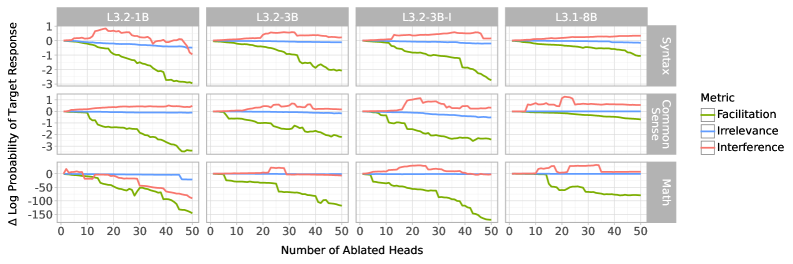
The image presents a 3x4 grid of line charts illustrating the impact of ablating (removing) heads from different language models on three different metrics: Syntax, Common Sense, and Match. The charts show the change in log probability of a target response as the number of ablated heads increases from 0 to 50. Each chart represents a specific language model configuration (L3.2-1B, L3.2-3B, L3.2-3B-I, L3.1-8B).
### Components/Axes
* **X-axis:** Number of Ablated Heads (ranging from 0 to 50, with markers at 0, 10, 20, 30, 40, and 50).
* **Y-axis:** Δ Log Probability of Target Response (ranging from approximately -100 to 1, with markers at -100, -80, -60, -40, -20, 0, and 1).
* **Rows:** Represent the evaluation metric: Syntax (top row), Common Sense (middle row), and Match (bottom row).
* **Columns:** Represent the language model configuration: L3.2-1B, L3.2-3B, L3.2-3B-I, and L3.1-8B.
* **Legend (top-right):**
* Facilitation (Blue line)
* Irrelevance (Yellow line)
* Interference (Red line)
### Detailed Analysis or Content Details
Each of the 12 sub-charts displays three lines representing the three metrics. I will analyze each row (metric) across all models, then summarize.
**Syntax (Top Row)**
* **L3.2-1B:** Facilitation line is relatively flat around 0.5. Irrelevance line starts around 0 and decreases to approximately -2. Interference line starts around 0.2 and decreases to approximately -1.5.
* **L3.2-3B:** Facilitation line is flat around 0.5. Irrelevance line starts around 0 and decreases to approximately -2.5. Interference line starts around 0.3 and decreases to approximately -2.
* **L3.2-3B-I:** Facilitation line is flat around 0.5. Irrelevance line starts around 0 and decreases to approximately -2. Interference line starts around 0.3 and decreases to approximately -1.5.
* **L3.1-8B:** Facilitation line is flat around 0.5. Irrelevance line starts around 0 and decreases to approximately -2. Interference line starts around 0.3 and decreases to approximately -1.5.
**Common Sense (Middle Row)**
* **L3.2-1B:** Facilitation line is flat around 0.5. Irrelevance line starts around 0 and decreases to approximately -3. Interference line starts around 0.2 and decreases to approximately -2.
* **L3.2-3B:** Facilitation line is flat around 0.5. Irrelevance line starts around 0 and decreases to approximately -4. Interference line starts around 0.3 and decreases to approximately -3.
* **L3.2-3B-I:** Facilitation line is flat around 0.5. Irrelevance line starts around 0 and decreases to approximately -3. Interference line starts around 0.3 and decreases to approximately -2.
* **L3.1-8B:** Facilitation line is flat around 0.5. Irrelevance line starts around 0 and decreases to approximately -3. Interference line starts around 0.3 and decreases to approximately -2.
**Match (Bottom Row)**
* **L3.2-1B:** Facilitation line is flat around 0.5. Irrelevance line starts around 0 and decreases to approximately -2. Interference line starts around 0.2 and decreases to approximately -1.5.
* **L3.2-3B:** Facilitation line is flat around 0.5. Irrelevance line starts around 0 and decreases to approximately -3. Interference line starts around 0.3 and decreases to approximately -2.
* **L3.2-3B-I:** Facilitation line is flat around 0.5. Irrelevance line starts around 0 and decreases to approximately -2. Interference line starts around 0.3 and decreases to approximately -1.5.
* **L3.1-8B:** Facilitation line is flat around 0.5. Irrelevance line starts around 0 and decreases to approximately -2. Interference line starts around 0.3 and decreases to approximately -1.5.
Across all models and metrics, the Facilitation line remains relatively stable. The Irrelevance and Interference lines generally decrease as the number of ablated heads increases, indicating a negative impact on these metrics.
### Key Observations
* The Facilitation metric is largely unaffected by head ablation across all models and metrics.
* The Irrelevance and Interference metrics consistently decrease with increasing head ablation, suggesting that removing heads leads to a reduction in these undesirable behaviors.
* The L3.2-3B model shows the most significant decrease in Irrelevance with head ablation, particularly in the Common Sense metric.
* The impact of head ablation appears to be relatively consistent across the L3.2-3B-I and L3.1-8B models.
### Interpretation
This chart demonstrates the impact of ablating heads in language models on different aspects of their performance. The consistent stability of the Facilitation metric suggests that the core ability of the model to generate relevant responses is not significantly affected by removing heads. However, the decrease in Irrelevance and Interference indicates that head ablation can reduce the tendency of the model to produce irrelevant or interfering outputs.
The fact that the L3.2-3B model shows the most pronounced effect on Irrelevance suggests that this model may be particularly sensitive to head ablation. This could be due to the specific architecture or training data used for this model.
The overall trend suggests that head ablation can be a useful technique for improving the quality of language model outputs by reducing undesirable behaviors. However, it is important to note that the optimal number of heads to ablate may vary depending on the specific model and task. The charts provide a visual representation of this trade-off, allowing researchers to assess the impact of head ablation on different metrics and choose the configuration that best suits their needs.