\n
## Bar Chart: Content vs. Function Word Ratio in MATH500 (R1-Qwen)
### Overview
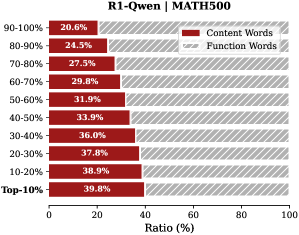
This is a horizontal bar chart displaying the ratio of content words to function words across different percentage ranges within a text corpus (MATH500) analyzed by R1-Qwen. The chart shows how the proportion of content words varies as you consider increasingly frequent words in the text.
### Components/Axes
* **Title:** R1-Qwen | MATH500
* **X-axis:** Ratio (%) - Scale ranges from 0 to 100.
* **Y-axis:** Percentage ranges of words, labeled as follows (from top to bottom):
* 90-100%
* 80-90%
* 70-80%
* 60-70%
* 50-60%
* 40-50%
* 30-40%
* 20-30%
* 10-20%
* Top 10%
* **Legend:**
* Content Words (Dark Red)
* Function Words (Light Gray)
### Detailed Analysis
The chart consists of horizontal bars representing the ratio of content words for each percentage range. The function word portion is represented by the remaining space to 100%.
Here's a breakdown of the data points, reading from top to bottom:
* **90-100%:** Content Words: 20.6%
* **80-90%:** Content Words: 24.5%
* **70-80%:** Content Words: 27.5%
* **60-70%:** Content Words: 29.8%
* **50-60%:** Content Words: 31.9%
* **40-50%:** Content Words: 33.9%
* **30-40%:** Content Words: 36.0%
* **20-30%:** Content Words: 37.8%
* **10-20%:** Content Words: 38.9%
* **Top 10%:** Content Words: 39.8%
The trend is clearly upward. As the percentage range decreases (i.e., considering more frequent words), the ratio of content words increases. The increase is not linear, but appears to be slowing down as you approach the top 10%.
### Key Observations
* The ratio of content words is lowest in the 90-100% range (20.6%) and highest in the top 10% range (39.8%).
* The difference between the lowest and highest content word ratios is 19.2%.
* The increase in content word ratio is most pronounced between the 90-100% and 20-30% ranges.
### Interpretation
This chart demonstrates that the most frequent words in the MATH500 corpus (as analyzed by R1-Qwen) tend to be function words (articles, prepositions, conjunctions, etc.), while less frequent words are more likely to be content words (nouns, verbs, adjectives, etc.). This is a common characteristic of natural language, where a small set of function words accounts for a large proportion of the total word count.
The increasing trend suggests that as you focus on the core vocabulary of the corpus, the proportion of meaningful content words increases. This could be useful for tasks like keyword extraction or topic modeling, where identifying the most important content words is crucial.
The slowing increase towards the top 10% might indicate that even the most frequent content words are still relatively rare compared to function words, or that the top 10% contains a mix of both content and function words. Further analysis would be needed to determine the exact composition of the top 10% of words.