## Bar Chart: R1-Qwen | MATH500
### Overview
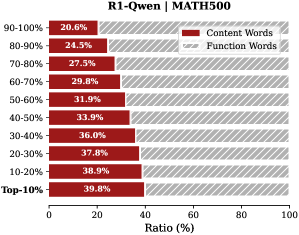
The chart compares the ratio of Content Words and Function Words across performance tiers (90-100% to Top-10%) for the R1-Qwen model on the MATH500 dataset. Content Words are represented by red bars, while Function Words use gray diagonal stripes. The x-axis shows percentages (0-100%), and the y-axis categorizes performance ranges.
### Components/Axes
- **X-Axis**: Ratio (%) (0 to 100, linear scale)
- **Y-Axis**: Performance tiers (90-100%, 80-90%, ..., Top-10%)
- **Legend**:
- Red: Content Words
- Gray (diagonal stripes): Function Words
- **Data Labels**: Percentages embedded in red bars (e.g., "20.6%", "39.8%")
### Detailed Analysis
1. **Content Words (Red Bars)**:
- **90-100%**: 20.6%
- **80-90%**: 24.5%
- **70-80%**: 27.5%
- **60-70%**: 29.8%
- **50-60%**: 31.9%
- **40-50%**: 33.9%
- **30-40%**: 36.0%
- **20-30%**: 37.8%
- **10-20%**: 38.9%
- **Top-10%**: 39.8%
2. **Function Words (Gray Bars)**:
- Calculated as 100% minus Content Words for each tier:
- **90-100%**: 79.4%
- **80-90%**: 75.5%
- **70-80%**: 72.5%
- **60-70%**: 70.2%
- **50-60%**: 68.1%
- **40-50%**: 66.1%
- **30-40%**: 64.0%
- **20-30%**: 62.2%
- **10-20%**: 61.1%
- **Top-10%**: 60.2%
### Key Observations
- **Inverse Relationship**: Content Words increase monotonically (20.6% → 39.8%) as performance tiers decrease, while Function Words decrease correspondingly (79.4% → 60.2%).
- **Steepest Gradient**: The largest shift occurs between 90-100% and 80-90% tiers (Content Words +3.9%, Function Words -3.9%).
- **Top-10% Dominance**: Content Words reach their peak (39.8%) in the highest-performing tier, suggesting a correlation between content-focused language and performance.
### Interpretation
The data implies that higher-performing tiers (e.g., Top-10%) rely more heavily on Content Words, which may reflect domain-specific knowledge or problem-solving relevance. Function Words dominate in lower tiers, potentially indicating generic or structural language use. This trend could highlight how R1-Qwen prioritizes substantive content over functional phrasing in high-stakes scenarios, aligning with its optimization for mathematical reasoning tasks. The consistent inverse relationship across all tiers suggests a systematic design choice favoring content density in high-performance outputs.