\n
## Diagram: Data Processing and Storage Flow
### Overview
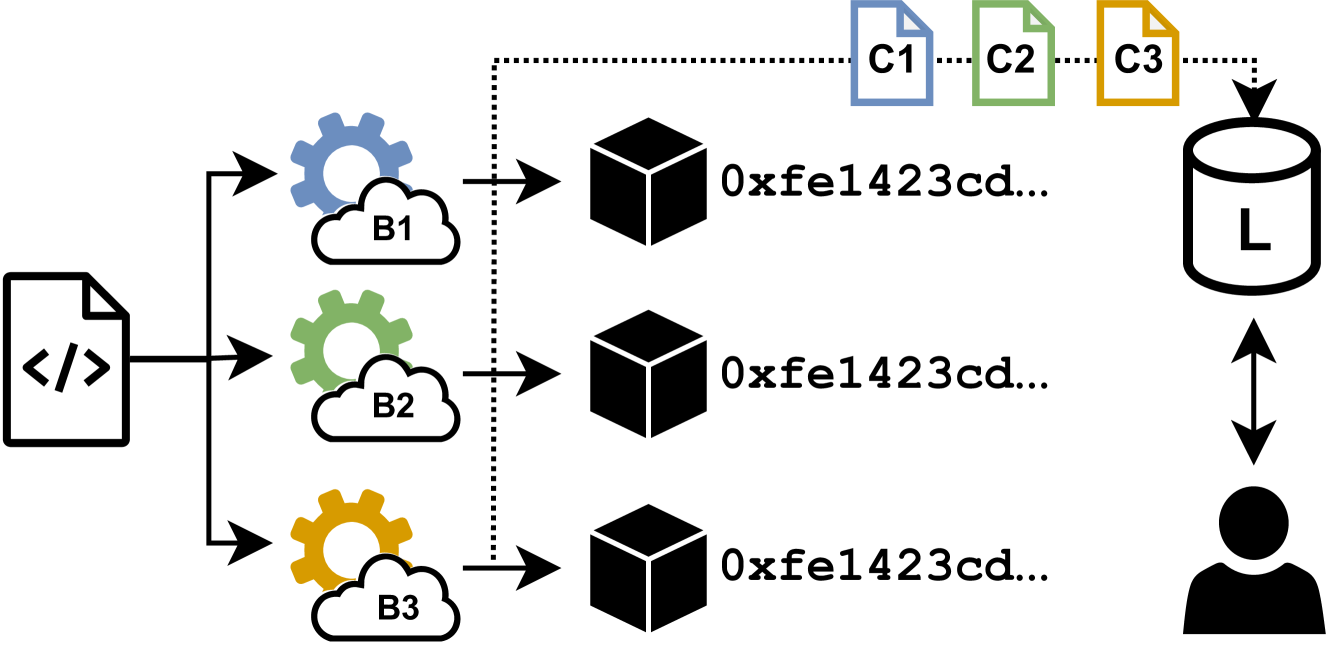
The image depicts a diagram illustrating a data processing and storage workflow. Data originates from a source represented by a file icon, is processed through three distinct stages (B1, B2, B3) involving cloud-like processing units, and ultimately stored in a database (L) accessible by a user. The diagram emphasizes a hashing or identification process, indicated by the hexadecimal strings "0xfe1423cd..." associated with each processed data block.
### Components/Axes
The diagram consists of the following components:
* **Source:** A file icon with `< />` inside, representing the initial data source.
* **Processing Stages:** Three cloud-shaped blocks labeled B1 (light blue), B2 (light green), and B3 (yellow). Each is preceded by a gear icon, suggesting a processing or transformation step.
* **Data Blocks:** Three cube-shaped blocks, each displaying the hexadecimal string "0xfe1423cd...". These represent the processed data.
* **Database:** A cylinder labeled "L", representing the final storage location.
* **User:** A silhouette of a head and shoulders, indicating a user interacting with the database.
* **Files:** Three file icons labeled C1 (blue), C2 (orange), and C3 (yellow) positioned above the database.
* **Arrows:** Black arrows indicating the flow of data between components.
* **Dotted Box:** A dotted rectangle encompassing the data blocks and files, suggesting a boundary or grouping.
### Detailed Analysis or Content Details
The diagram illustrates the following flow:
1. Data originates from the source file.
2. The data is processed by B1, resulting in a data block with the identifier "0xfe1423cd...".
3. The data is processed by B2, resulting in a data block with the identifier "0xfe1423cd...".
4. The data is processed by B3, resulting in a data block with the identifier "0xfe1423cd...".
5. The processed data blocks are stored in the database L.
6. Files C1, C2, and C3 are also associated with the database L.
7. The user interacts with the database L, with arrows indicating both input and output.
The hexadecimal string "0xfe1423cd..." appears to be a hash or unique identifier assigned to each processed data block. The three processing stages (B1, B2, B3) likely perform different transformations or operations on the data. The files C1, C2, and C3 may represent metadata or related files associated with the stored data.
### Key Observations
* All three data blocks have the same hexadecimal identifier ("0xfe1423cd..."). This suggests that despite being processed by different stages (B1, B2, B3), the resulting data is identical or equivalent in terms of its hash value. This could indicate a data validation or consistency check.
* The diagram emphasizes the transformation of data from a source file into a standardized format (represented by the hexadecimal identifier) before storage.
* The dotted box around the data blocks and files suggests a logical grouping or a specific storage area within the database.
### Interpretation
The diagram likely represents a data pipeline where raw data is processed through multiple stages, potentially involving cleaning, transformation, and validation, before being stored in a database. The consistent hash value across all processed data blocks suggests a robust data integrity mechanism. The presence of files C1, C2, and C3 indicates that the database stores not only the processed data but also associated metadata or supporting files. The user interaction with the database implies that the data is accessible and usable for various purposes.
The diagram could be illustrating a system for data archiving, data warehousing, or a secure data storage solution. The use of hashing suggests a focus on data security and integrity. The multiple processing stages (B1, B2, B3) could represent different levels of data processing or different data validation checks. The diagram is a high-level representation and does not provide details about the specific processing algorithms or data formats used.