## Diagram: Data Processing Pipeline with Cloud Servers and Database
### Overview
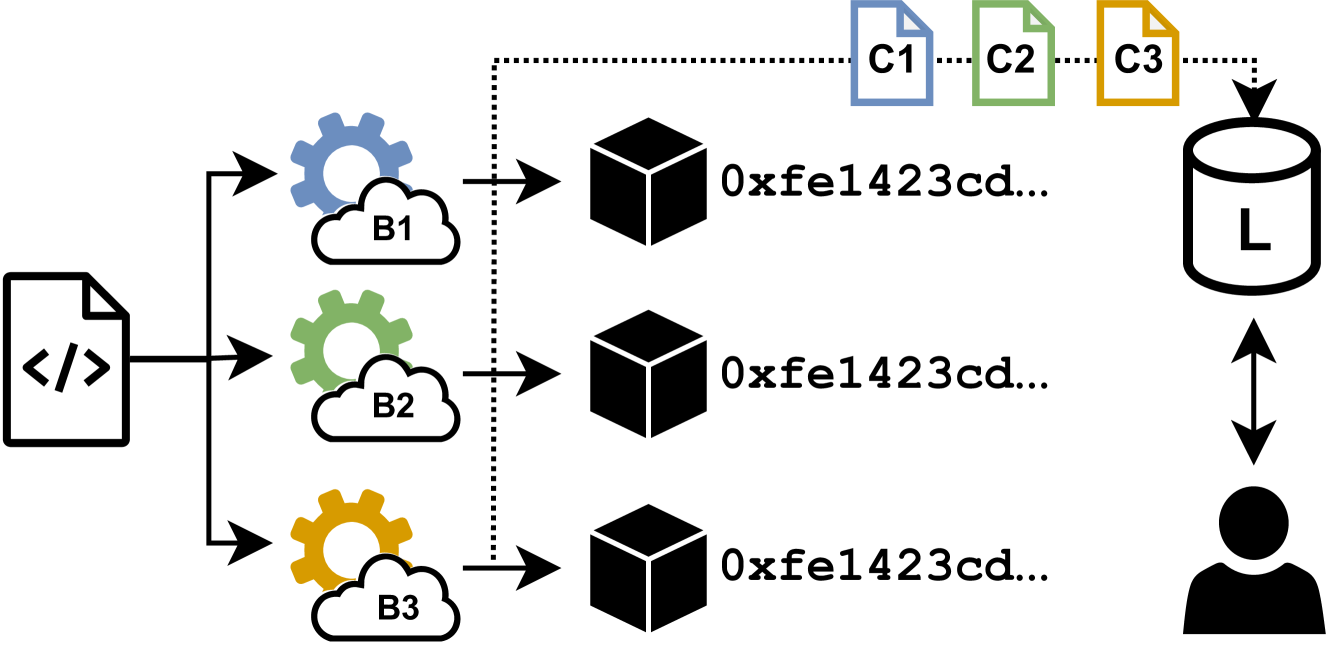
The diagram illustrates a multi-stage data processing workflow originating from a source document (`</>`), passing through three cloud servers (B1, B2, B3), generating identical hexadecimal outputs (`0xfe1423cd...`), and concluding with a database (`L`) and user interaction. Dotted lines connect three document-like elements (C1, C2, C3) to the hexadecimal outputs, suggesting auxiliary relationships.
### Components/Axes
- **Source Document**: Labeled `</>`, initiating the workflow.
- **Cloud Servers**:
- B1 (blue gear), B2 (green gear), B3 (yellow gear).
- **Hexadecimal Outputs**: Three identical strings (`0xfe1423cd...`) generated by each server.
- **Database**: Labeled `L`, receiving input from the hexadecimal outputs.
- **User**: Represented by a silhouette icon, connected bidirectionally to the database.
- **Auxiliary Documents**: C1 (blue), C2 (green), C3 (yellow), linked via dotted lines to the hexadecimal outputs.
### Detailed Analysis
- **Flow Direction**:
- The source document (`</>`) feeds into all three cloud servers (B1, B2, B3) via solid arrows.
- Each server produces the same hexadecimal output (`0xfe1423cd...`), which is then routed to the database (`L`).
- The database (`L`) has a bidirectional arrow to the user icon, implying data retrieval or user interaction.
- Dotted lines from C1, C2, C3 to the hexadecimal outputs suggest non-primary dependencies or secondary data paths.
- **Hexadecimal Output Consistency**:
- All three cloud servers generate identical outputs (`0xfe1423cd...`), which may indicate:
- A placeholder value for demonstration.
- A standardized output across servers (e.g., checksum, token, or identifier).
- A potential error or oversight in the diagram (if uniqueness was intended).
- **Color Coding**:
- Cloud servers use distinct gear colors (blue, green, yellow), possibly denoting:
- Different environments (e.g., development, testing, production).
- Resource allocation or priority levels.
- Functional roles (e.g., B1 for encryption, B2 for validation).
### Key Observations
1. **Repetitive Outputs**: The identical hexadecimal values across servers raise questions about the purpose of multiple servers if outputs are uniform.
2. **Dotted Line Relationships**: C1, C2, C3 are visually disconnected from the main workflow, suggesting auxiliary or optional data paths.
3. **User-Database Interaction**: The bidirectional arrow between `L` and the user implies real-time data access or feedback loops.
### Interpretation
This diagram likely represents a **distributed data processing system** where:
- The source document is processed in parallel by three cloud servers (B1–B3), possibly for redundancy, load balancing, or parallel computation.
- The consistent hexadecimal output (`0xfe1423cd...`) could represent a shared identifier, token, or checksum critical to the workflow.
- The database (`L`) acts as a central repository, while the user interacts with it, suggesting a client-server architecture.
- The dotted lines from C1–C3 to the hexadecimal outputs may indicate metadata, logging, or secondary data streams not central to the primary workflow.
**Uncertainties**:
- The purpose of C1–C3 remains unclear without additional context.
- The identical hexadecimal outputs may be intentional (e.g., a shared key) or an oversight.
- The color-coded gears lack explicit legends, leaving their significance open to interpretation.