\n
## Diagram: Samples of Characters, Training Equations, and Test Equations
### Overview
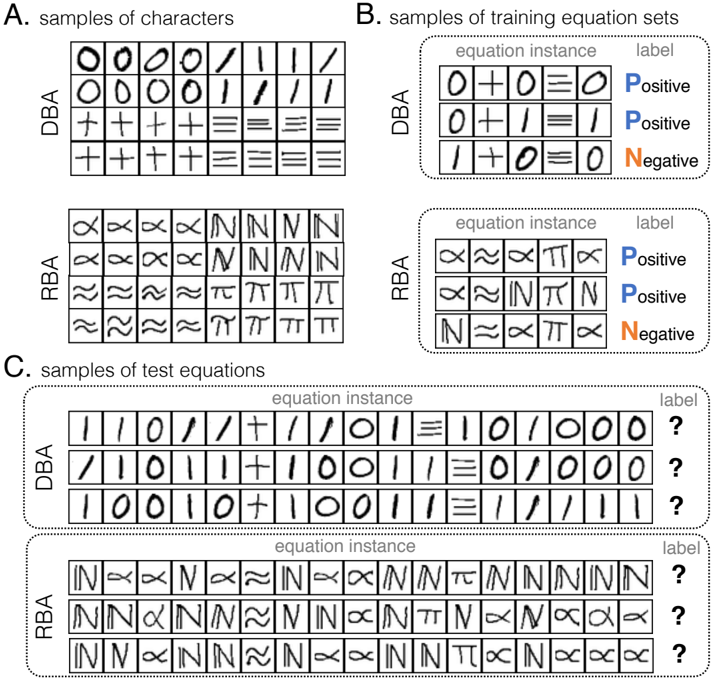
The image presents a diagram showcasing samples of characters, training equation sets with labels, and test equations without labels. The diagram is divided into three sections labeled A, B, and C, arranged in a 3x2 grid. Each section displays a set of equation instances organized by font type (DBA and RBA). The training set (B) includes labels indicating whether the equation instance is "Positive" or "Negative". The test set (C) lacks these labels, represented by question marks.
### Components/Axes
The diagram consists of three main sections:
* **A: samples of characters:** Displays individual characters used in the equations.
* **B: samples of training equation sets:** Shows equation instances with corresponding labels ("Positive" or "Negative").
* **C: samples of test equations:** Presents equation instances without labels.
Each section is further divided into two rows, representing the "DBA" and "RBA" fonts. The columns within each section represent individual equation instances.
The labels are color-coded:
* **Blue:** Positive
* **Red:** Negative
* **Black:** Question Mark (for unlabeled test equations)
### Detailed Analysis or Content Details
**Section A: Samples of Characters**
* **DBA (Top Row):** Displays characters including circles, plus signs, slashes, and vertical lines.
* **RBA (Bottom Row):** Displays characters including omega symbols, N symbols, and pi symbols.
**Section B: Samples of Training Equation Sets**
* **DBA (Top Row):**
* Equation Instance: `0 + 0 = 0` - Label: Positive (Blue)
* Equation Instance: `0 + / = /` - Label: Positive (Blue)
* Equation Instance: `/ + 0 = 0` - Label: Negative (Red)
* **RBA (Bottom Row):**
* Equation Instance: `∞ + ∞ = ∞` - Label: Positive (Blue)
* Equation Instance: `∞ + N = N` - Label: Positive (Blue)
* Equation Instance: `N = ∞ = ∞` - Label: Negative (Red)
**Section C: Samples of Test Equations**
* **DBA (Top Row):** Displays several equation instances with question mark labels.
* **RBA (Bottom Row):** Displays several equation instances with question mark labels.
### Key Observations
* The training set (B) provides labeled examples for the DBA and RBA fonts, allowing for a supervised learning approach.
* The test set (C) consists of unlabeled equation instances, presumably to evaluate the performance of a model trained on the training set.
* The characters used in the equations are distinct between the DBA and RBA fonts.
* The labels in the training set appear to be based on the overall structure or validity of the equation, rather than a simple arithmetic calculation.
### Interpretation
This diagram illustrates a dataset designed for a machine learning task, likely equation recognition or classification. The goal is to train a model to predict whether a given equation instance is "Positive" or "Negative" based on its visual representation. The use of two different fonts (DBA and RBA) suggests the model should be robust to variations in character style. The test set allows for evaluating the model's generalization ability on unseen data. The question marks in the test set indicate that the correct labels are unknown and will be predicted by the trained model. The diagram suggests a focus on the *form* of the equation rather than its mathematical correctness, as the labels are assigned based on visual patterns. The use of symbols like infinity and N suggests the equations may not be standard arithmetic but rather symbolic representations.