## Diagram: Symbolic Equation Samples for DBA and RBA Datasets
### Overview
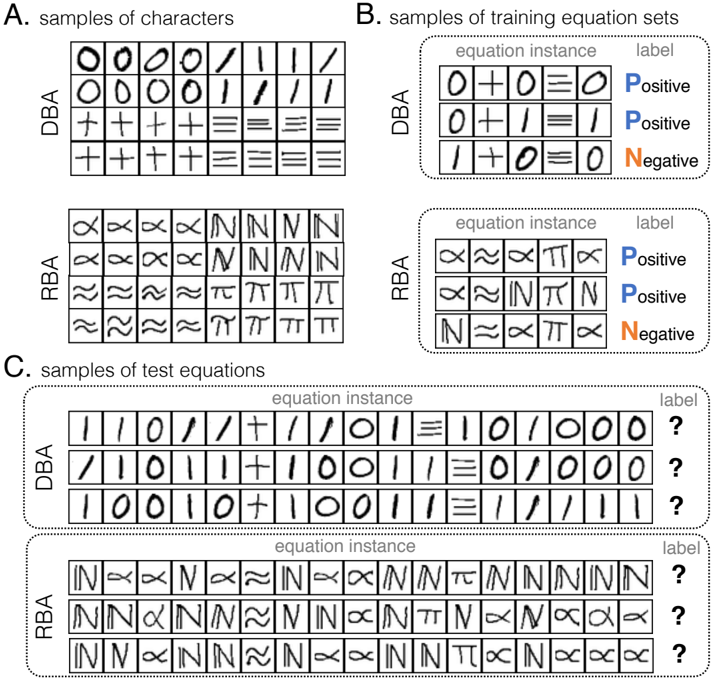
The image is a technical figure, likely from a research paper, illustrating samples from two symbolic datasets or methods labeled **DBA** and **RBA**. It is divided into three main panels (A, B, C) that show character samples, training equation sets with labels, and test equations with unknown labels. The content is primarily visual symbols and mathematical notation, with English text for labels and headers.
### Components/Axes
The figure is organized into three distinct panels:
* **Panel A (Top Left):** Titled "samples of characters". It displays two grids of handwritten-style symbols.
* **DBA Grid (Top):** A 4x8 grid containing four rows of symbols. The first two rows show variations of circles (`O`) and slashes (`/`). The third and fourth rows show variations of plus signs (`+`) and equals signs (`=`).
* **RBA Grid (Bottom):** A 4x8 grid containing four rows of more complex symbols. The first two rows show variations of the Greek letter alpha (`α`) and the letter `N`. The third and fourth rows show variations of the Greek letter pi (`π`) and a symbol resembling a cursive `T` or a variant of pi.
* **Panel B (Top Right):** Titled "samples of training equation sets". It shows two dotted-line boxes, each containing three example equations with labels.
* **DBA Box (Top):** Contains three equations using the simpler DBA symbols. Each equation is labeled as either "Positive" (in blue text) or "Negative" (in orange text).
* **RBA Box (Bottom):** Contains three equations using the more complex RBA symbols. Each equation is labeled as either "Positive" (blue) or "Negative" (orange).
* **Panel C (Bottom):** Titled "samples of test equations". It shows two larger dotted-line boxes, each containing three example equations with a question mark (`?`) in the label column.
* **DBA Box (Top):** Contains three longer equations composed of DBA symbols (slashes, circles, plus, equals).
* **RBA Box (Bottom):** Contains three longer equations composed of RBA symbols (N, alpha, pi, etc.).
### Detailed Analysis
**Panel A: Character Samples**
* **DBA Characters:** The symbol set appears to be: `O` (circle), `/` (slash), `+` (plus), `=` (equals). Each symbol is shown in multiple handwritten variations across its row.
* **RBA Characters:** The symbol set appears to be: `α` (alpha), `N` (letter N), `π` (pi), and a fourth symbol that looks like a cursive `T` or a pi variant (`𝜋` or `τ`). Each is shown in multiple handwritten variations.
**Panel B: Training Equation Sets**
* **DBA Training Examples:**
1. Equation: `O + O = O` | Label: **Positive** (Blue)
2. Equation: `O + / = /` | Label: **Positive** (Blue)
3. Equation: `/ + O = O` | Label: **Negative** (Orange)
* **RBA Training Examples:**
1. Equation: `α ≈ α π α` | Label: **Positive** (Blue) *(Note: The symbol between the alphas is an approximation sign `≈`)*.
2. Equation: `α ≈ N π N` | Label: **Positive** (Blue)
3. Equation: `N ≈ α π α` | Label: **Negative** (Orange)
**Panel C: Test Equations**
* **DBA Test Examples:** Three equations are shown. The structure is less clear than the training set, involving sequences like `| / O / / + / / O | = | O / O O O`. The label column contains only a question mark `?` for each.
* **RBA Test Examples:** Three equations are shown, involving sequences like `N α α N α ≈ N α N N π N N N N N`. The label column contains only a question mark `?` for each.
### Key Observations
1. **Dataset Dichotomy:** The figure clearly contrasts two distinct symbolic systems: **DBA** (simpler, arithmetic-like symbols) and **RBA** (more complex, Greek/alphabetic symbols).
2. **Learning Task:** Panel B defines a clear classification task for the training data. For DBA, the rule appears to be related to the commutative property of addition (e.g., `O + O = O` is Positive, but `/ + O = O` is Negative). For RBA, the rule is less immediately obvious but involves the relationship between symbols around an approximation sign (`≈`).
3. **Generalization Test:** Panel C presents the core challenge: applying the learned rule from the short training equations in Panel B to classify longer, more complex sequences of symbols in the test set. The question marks indicate these are unlabeled instances for prediction.
4. **Visual Complexity:** The RBA symbols are inherently more visually complex and varied than the DBA symbols, suggesting a potentially harder recognition or reasoning task.
### Interpretation
This figure illustrates the setup for a **symbolic reasoning or few-shot learning** experiment. The core idea is to test whether a model (likely a neural network) can learn an abstract rule or pattern from a very small set of labeled examples (Panel B) and then generalize that rule to correctly classify novel, more complex instances (Panel C).
* **DBA Task:** Likely tests basic arithmetic logic or set membership. The "Positive" examples might represent valid equations under a specific rule (e.g., identity element, where `O` acts like zero), while "Negative" examples violate it.
* **RBA Task:** Likely tests more abstract relational reasoning. The rule could involve pattern matching, sequence completion, or a logical relationship between the symbols surrounding the `≈` operator.
* **Significance:** The contrast between DBA and RBA allows researchers to evaluate a model's ability to learn different *types* of symbolic rules—one grounded in simple arithmetic, the other in more abstract, possibly linguistic or structural, relationships. The success of a model would be measured by its accuracy on the test equations in Panel C, demonstrating its capacity for **systematic generalization** from sparse data. The handwritten style of the symbols adds a layer of perceptual noise, testing robustness beyond clean, typed input.