## Diagram: Symbolic Equation Classification System
### Overview
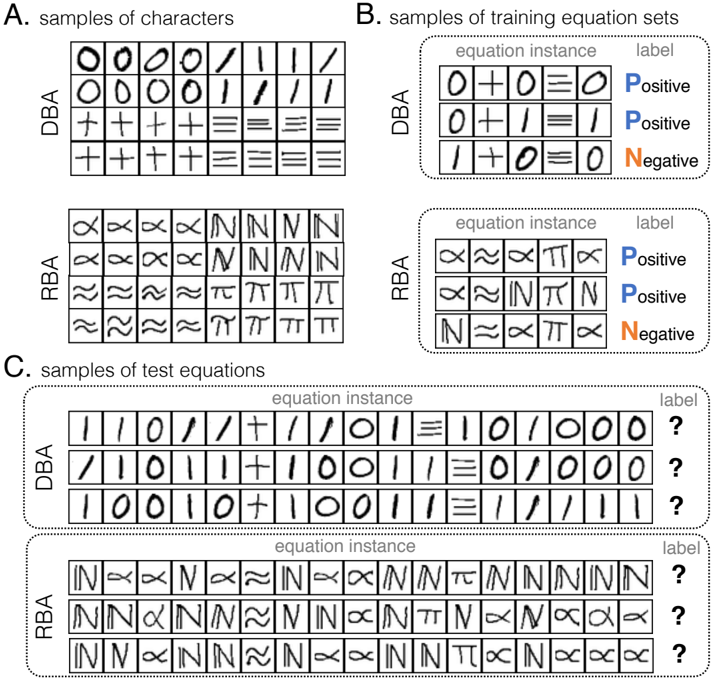
The image depicts a structured system for symbolic equation classification, divided into three sections:
- **A. Samples of characters**: Displays character sets for two models (DBA and RBA) using symbolic representations.
- **B. Samples of training equation sets**: Shows labeled equation instances (Positive/Negative) for DBA and RBA.
- **C. Samples of test equations**: Presents unlabeled equation instances (marked with "?") for DBA and RBA.
### Components/Axes
1. **Section A: Samples of characters**
- **DBA**: Grid of 5 rows × 5 columns of symbols (e.g., `O`, `/`, `+`, `I`, `//`).
- **RBA**: Grid of 5 rows × 5 columns of complex symbols (e.g., `R`, `Z`, `N`, `X`, `T`).
- **Labels**: No explicit axis titles, but rows/columns are implicitly structured as character samples.
2. **Section B: Samples of training equation sets**
- **DBA**:
- Equation instances:
- `0+0=0` (Positive)
- `0+0=1` (Negative)
- `1+0=1` (Negative)
- **RBA**:
- Equation instances:
- `R+R=R` (Positive)
- `R+R=Z` (Negative)
- `Z+R=Z` (Negative)
- **Labels**: "equation instance" (x-axis) and "label" (y-axis, with "Positive" and "Negative" as categories).
3. **Section C: Samples of test equations**
- **DBA**:
- Equation instances with "?" (unlabeled):
- `1/1=0`
- `1/1=1`
- `1/1=0`
- **RBA**:
- Equation instances with "?" (unlabeled):
- `N+N=N`
- `N+R=N`
- `R+N=R`
- **Labels**: "equation instance" (x-axis) and "label" (y-axis, with "?" indicating missing labels).
### Detailed Analysis
- **Section A**:
- DBA uses simpler symbols (e.g., `O`, `/`, `+`), while RBA employs more complex, abstract symbols (e.g., `R`, `Z`, `N`).
- Both grids are 5×5, suggesting a fixed-size input for character-based models.
- **Section B**:
- DBA equations involve arithmetic operations (e.g., `+`, `/`) with binary outcomes (0/1).
- RBA equations use symbolic operations (e.g., `+`, `R`, `Z`) with similar binary outcomes.
- Labels are explicitly marked as "Positive" (blue) or "Negative" (red), indicating a binary classification task.
- **Section C**:
- Test equations mirror the structure of training equations but lack labels, requiring classification.
- DBA test cases involve division (`/`), while RBA test cases use symbolic operations (`+`, `N`, `R`).
### Key Observations
1. **Symbolic vs. Arithmetic**: DBA focuses on arithmetic operations (e.g., `+`, `/`), while RBA uses abstract symbols (e.g., `R`, `Z`, `N`).
2. **Labeling Consistency**: Positive labels correspond to "correct" equations (e.g., `0+0=0`), while Negative labels indicate "incorrect" or "non-standard" results (e.g., `0+0=1`).
3. **Test Equation Ambiguity**: Test cases in C are unlabeled, suggesting a need for model inference or validation.
4. **Grid Structure**: Both DBA and RBA use 5×5 grids, implying a standardized input format for character-based models.
### Interpretation
This system appears to be a **symbolic equation classifier** for machine learning, where:
- **DBA** and **RBA** represent different models or datasets, with DBA focusing on arithmetic and RBA on abstract symbolic operations.
- **Training data (B)** provides labeled examples to train the model, while **test data (C)** evaluates its performance on unseen equations.
- The use of "?" in test equations highlights the challenge of generalization, as the model must infer labels based on learned patterns.
- The distinction between DBA and RBA suggests a comparison of approaches: DBA for numerical reasoning and RBA for symbolic logic.
**Note**: No numerical trends or quantitative data are present; the analysis is based on symbolic structure and labeling conventions.