## Line Chart: Accuracy Comparison Across Iterations
### Overview
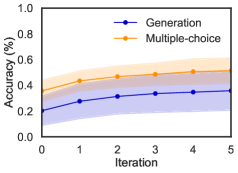
The chart compares the accuracy trends of two methods ("Generation" and "Multiple-choice") across 5 iterations. Accuracy is measured on a percentage scale (0-100%), with shaded regions indicating confidence intervals or error margins. Both methods show improvement over iterations, but "Multiple-choice" consistently outperforms "Generation".
### Components/Axes
- **X-axis (Horizontal)**: Labeled "Iteration", with markers at 0, 1, 2, 3, 4, 5.
- **Y-axis (Vertical)**: Labeled "Accuracy (%)", scaled from 0.0 to 1.0 (0% to 100%).
- **Legend**: Located in the top-right corner, with:
- **Blue line/dots**: "Generation"
- **Orange line/dots**: "Multiple-choice"
- **Shaded Regions**: Gray bands around each line represent uncertainty/error margins.
### Detailed Analysis
1. **Generation (Blue)**:
- **Iteration 0**: ~0.2% accuracy.
- **Iteration 1**: ~0.25%.
- **Iteration 2**: ~0.3%.
- **Iteration 3**: ~0.32%.
- **Iteration 4**: ~0.33%.
- **Iteration 5**: ~0.35%.
- **Trend**: Gradual upward slope, plateauing after iteration 3. Shaded region narrows slightly over time, indicating reduced uncertainty.
2. **Multiple-choice (Orange)**:
- **Iteration 0**: ~0.35% accuracy.
- **Iteration 1**: ~0.4%.
- **Iteration 2**: ~0.45%.
- **Iteration 3**: ~0.47%.
- **Iteration 4**: ~0.48%.
- **Iteration 5**: ~0.5%.
- **Trend**: Steady upward trajectory. Shaded region remains wider than "Generation", suggesting higher variability.
### Key Observations
- **Performance Gap**: "Multiple-choice" maintains ~0.1–0.15% higher accuracy than "Generation" across all iterations.
- **Uncertainty**: The orange shaded region (Multiple-choice) is consistently broader, implying less confidence in its measurements.
- **Convergence**: Both methods show diminishing returns after iteration 3, with accuracy gains slowing.
### Interpretation
The data suggests that "Multiple-choice" methods yield higher accuracy but with greater variability, while "Generation" offers more stable (narrower confidence intervals) but lower performance. The widening gap between the two methods over iterations implies that "Multiple-choice" may scale better for complex tasks, though its reliability is less certain. The plateauing trends indicate potential limits to improvement for both approaches beyond 5 iterations.