## Diagram: Sailboat Rigging and Structure
### Overview
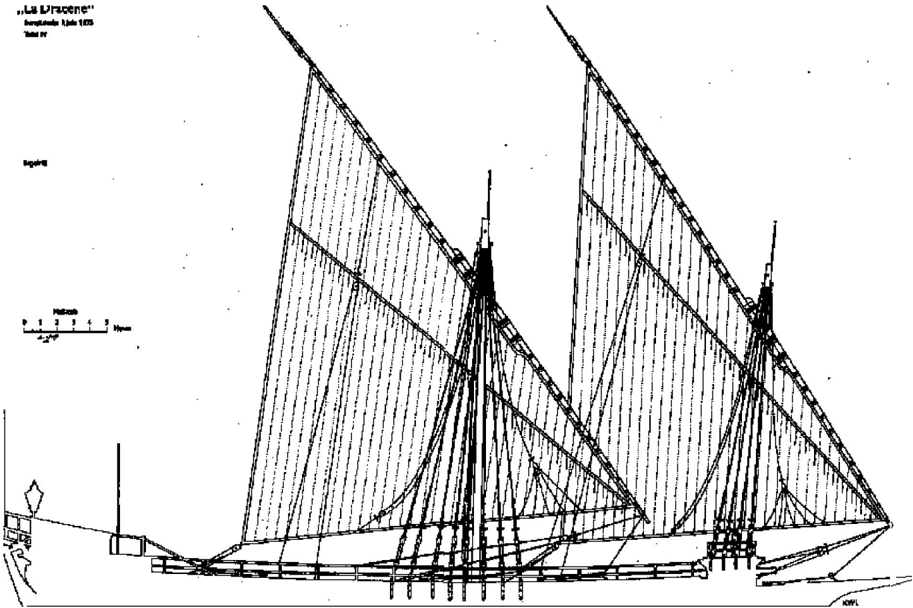
The image is a black-and-white technical diagram of a sailboat, labeled "La Dracene" with the author "Sauvageau, 1 juin 1803" and "Tome 1" (Volume 1). It depicts the hull, masts, sails, rigging, and deck in a simplified, schematic style. The diagram includes a scale (0–5 meters) and labels for key components.
### Components/Axes
- **Labels**:
- "La Dracene" (top-left corner, likely the vessel's name).
- "Sauvageau, 1 juin 1803" (author and date, in French).
- "Tome 1" (Volume 1, in French).
- "Spar" (horizontal support for the mast).
- "Mast" (vertical structure for sails).
- "Hull" (main body of the boat).
- "Sail" (triangular fabric for propulsion).
- "Rigging" (network of lines and pulleys).
- "Deck" (flat surface of the boat).
- **Scale**: A linear scale labeled "Mètre" (meter) from 0 to 5, positioned near the bottom-left.
- **Legend**: No explicit legend, but labels are directly embedded in the diagram.
### Detailed Analysis
- **Hull**: A long, rectangular shape with a small cabin at the bow (front).
- **Masts**: Two vertical masts, one larger (main mast) and one smaller (foremast), connected by rigging.
- **Sails**: Two triangular sails, one on each mast, with lines and pulleys (rigging) extending from the masts to the deck.
- **Rigging**: A complex network of lines and pulleys, including a "Spar" (horizontal support) and "Mast" (vertical structure).
- **Deck**: A flat surface with a small cabin and a mast at the stern (rear).
- **Scale**: The 0–5 meter scale is positioned near the bottom-left, but no specific measurements are labeled on the diagram.
### Key Observations
- The diagram emphasizes the **rigging system**, with lines and pulleys connecting the masts to the deck.
- The **sails** are triangular, typical of traditional sailing vessels.
- The **hull** and **deck** are simplified, with no detailed features beyond the cabin and mast.
- The **scale** (0–5 meters) is present but not used to label specific dimensions.
### Interpretation
This diagram appears to be a **technical illustration** of a historical sailboat, likely from the early 19th century (as indicated by the date "1 juin 1803"). The focus on **rigging and sail structure** suggests it was created for educational or archival purposes, possibly to document the design of "La Dracene." The absence of a bowsprit (a horizontal spar at the bow) may indicate a specific design choice for stability or maneuverability. The diagram’s simplicity prioritizes clarity over realism, making it useful for understanding the basic mechanics of a sailing vessel. The French text ("Sauvageau, 1 juin 1803") and "Tome 1" imply it is part of a larger collection or publication, possibly a technical manual or historical record.
**Note**: The image contains no numerical data or trends, as it is a schematic diagram rather than a chart. All textual information has been transcribed, with French terms translated for clarity.