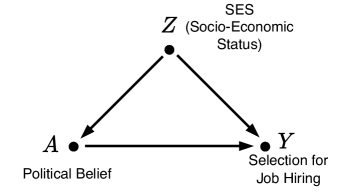
## Diagram: Cyclical Relationship Between Political Belief, Job Hiring, and Socio-Economic Status (SES)
### Overview
The diagram illustrates a cyclical relationship among three interconnected factors: **Political Belief (A)**, **Selection for Job Hiring (Y)**, and **SES (Socio-Economic Status) (Z)**. Arrows indicate directional influence, forming a closed loop: A → Y → Z → A.
### Components/Axes
- **Nodes**:
- **A**: Political Belief
- **Y**: Selection for Job Hiring
- **Z**: SES (Socio-Economic Status)
- **Arrows**:
- A → Y: Political Belief influences Selection for Job Hiring.
- Y → Z: Selection for Job Hiring affects SES.
- Z → A: SES reinforces or modifies Political Belief.
### Detailed Analysis
- **Labels**: All nodes are explicitly labeled with their respective concepts.
- **Flow Direction**:
- Political Belief (A) directly impacts Job Hiring (Y).
- Job Hiring (Y) determines or correlates with SES (Z).
- SES (Z) feeds back into Political Belief (A), completing the cycle.
- **No Numerical Data**: The diagram lacks quantitative values, scales, or legends. It focuses on conceptual relationships rather than measurable trends.
### Key Observations
1. **Cyclical Dependency**: The system is self-reinforcing, with no clear starting or ending point.
2. **Bidirectional Influence**: While arrows suggest unidirectional flow, the loop implies mutual reinforcement (e.g., SES may shape Political Belief, which then affects Job Hiring).
3. **No Outliers**: All components are equally weighted in the cycle, with no emphasis on dominance or hierarchy.
### Interpretation
This diagram suggests a **systemic feedback loop** where socio-economic factors, political beliefs, and employment opportunities are interdependent. For example:
- Political beliefs (e.g., support for labor rights) might influence hiring practices (Y), which in turn affect an individual’s SES (Z).
- Higher SES (Z) could then enable access to education or networks that reinforce or shift Political Belief (A), perpetuating the cycle.
- The absence of numerical data limits causal strength assessment but highlights the **theoretical interconnectedness** of these factors in shaping social outcomes.
This model aligns with sociological theories of structural mobility, where individual agency (Political Belief) and structural barriers (Job Hiring, SES) co-evolve. Further analysis would require empirical data to quantify the strength and directionality of these relationships.