## Directed Acyclic Graph (DAG): Causal Model of SES, Political Belief, and Job Hiring
### Overview
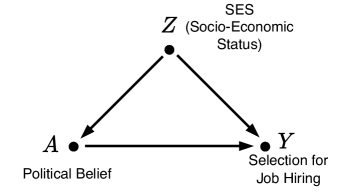
The image displays a simple directed acyclic graph (DAG), a type of diagram used in statistics, causal inference, and social sciences to represent hypothesized causal relationships between variables. The diagram consists of three nodes (variables) connected by three directed arrows (causal paths), forming a triangular structure.
### Components/Axes
The diagram has three labeled nodes, each represented by a black dot with text labels:
1. **Node A (Bottom-Left):**
* **Label:** `A`
* **Description:** `Political Belief`
* **Position:** Bottom-left corner of the triangular layout.
2. **Node Z (Top-Center):**
* **Label:** `Z`
* **Description:** `SES (Socio-Economic Status)`
* **Position:** Top-center, forming the apex of the triangle.
3. **Node Y (Bottom-Right):**
* **Label:** `Y`
* **Description:** `Selection for Job Hiring`
* **Position:** Bottom-right corner.
**Directed Arrows (Causal Paths):**
* An arrow originates from **Z** and points to **A**.
* An arrow originates from **Z** and points to **Y**.
* An arrow originates from **A** and points to **Y**.
### Detailed Analysis
The diagram explicitly defines the following causal relationships:
1. **Z → A:** Socio-Economic Status (SES) is modeled as a cause of Political Belief.
2. **Z → Y:** Socio-Economic Status (SES) is modeled as a direct cause of Selection for Job Hiring.
3. **A → Y:** Political Belief is modeled as a cause of Selection for Job Hiring.
This structure implies that **Z (SES)** is a common cause (a confounder) for both **A (Political Belief)** and **Y (Job Hiring)**. The path **Z → A → Y** represents an *indirect effect* of SES on job hiring that is mediated through political belief.
### Key Observations
* **No Reverse Causality:** All arrows are unidirectional. The model does not allow for feedback loops (e.g., job hiring outcome affecting political belief or SES).
* **No Direct Link from A to Z:** The model assumes political belief does not influence one's socio-economic status.
* **Complete Mediation Assumption:** The model suggests that the *only* way political belief (A) affects job hiring (Y) is directly (A → Y). It does not account for political belief potentially influencing SES, which in turn influences hiring.
* **Visual Clarity:** The triangular layout cleanly separates the three variables and makes the two distinct pathways from Z to Y (one direct, one indirect via A) immediately apparent.
### Interpretation
This diagram is a formal representation of a causal hypothesis, likely used to frame a research question or analysis in social science, economics, or public policy. It suggests that when studying the effect of political belief on job hiring outcomes, one must account for socio-economic status as a confounding variable. SES influences both the belief itself and the hiring outcome independently.
The model implies that any observed correlation between political belief and hiring success could be partially or wholly due to the underlying influence of SES, rather than being a direct causal relationship. To isolate the true effect of political belief (A → Y), a researcher would need to "control for" or adjust for the variable Z (SES) in their analysis. This is a classic setup for discussing selection bias or confounding in observational studies.