\n
## 3D Surface Plot: Free Energy Landscape
### Overview
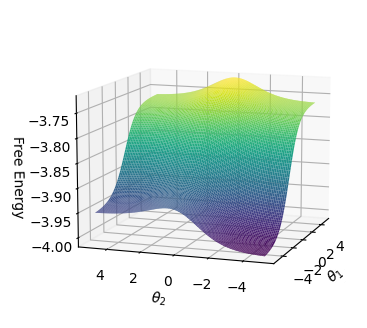
The image displays a three-dimensional surface plot visualizing "Free Energy" as a function of two parameters, θ₁ and θ₂. The plot is rendered in a perspective view, showing a continuous, curved surface that represents the relationship between the three variables. The surface is colored with a gradient that maps to the Free Energy value.
### Components/Axes
* **Vertical Axis (Z-axis):**
* **Label:** "Free Energy"
* **Scale:** Linear, ranging from approximately **-4.00** at the bottom to **-3.75** at the top.
* **Markers:** Major ticks are visible at -4.00, -3.95, -3.90, -3.85, -3.80, and -3.75.
* **Horizontal Axis 1 (X-axis, front-right):**
* **Label:** "θ₁" (Theta subscript 1)
* **Scale:** Linear, ranging from **-4** to **4**.
* **Markers:** Major ticks at -4, -2, 0, 2, 4.
* **Horizontal Axis 2 (Y-axis, front-left):**
* **Label:** "θ₂" (Theta subscript 2)
* **Scale:** Linear, ranging from **-4** to **4**.
* **Markers:** Major ticks at -4, -2, 0, 2, 4.
* **Color Mapping (Implicit Legend):**
* The surface color corresponds directly to the Free Energy (Z) value.
* **Dark Purple/Blue:** Represents the lowest Free Energy values (near **-4.00**).
* **Teal/Green:** Represents mid-range Free Energy values (around **-3.90**).
* **Yellow:** Represents the highest Free Energy values (near **-3.75**).
### Detailed Analysis
The surface forms a smooth, continuous landscape with a distinct topological feature.
* **Global Minimum:** The lowest point on the surface (deepest purple) is located at the coordinate **(θ₁ ≈ 0, θ₂ ≈ 0)**. The Free Energy at this point is approximately **-4.00**.
* **General Trend:** Moving away from the origin (0,0) in any direction along the θ₁-θ₂ plane generally results in an increase in Free Energy. The surface slopes upward from the central minimum.
* **Asymmetry and Ridge:** The increase is not uniform. There is a pronounced ridge or saddle point running diagonally. The surface rises more steeply towards the positive θ₁, positive θ₂ quadrant (back corner) and the negative θ₁, negative θ₂ quadrant (front corner), reaching its highest values (yellow) in these regions. The rise is more gradual along the anti-diagonal (positive θ₁, negative θ₂ and negative θ₁, positive θ₂).
* **Spatial Grounding:** The highest point (yellow) appears to be near **(θ₁ ≈ 4, θ₂ ≈ 4)** and **(θ₁ ≈ -4, θ₂ ≈ -4)**, with Free Energy values approaching **-3.75**. The lowest point is clearly at the center of the grid.
### Key Observations
1. **Single Well Potential:** The landscape depicts a single, broad energy well centered at the origin, suggesting a stable equilibrium point at (0,0).
2. **Anisotropic Curvature:** The "walls" of the well are not symmetrical. The curvature is tighter (steeper slope) along the θ₁ = θ₂ diagonal compared to the θ₁ = -θ₂ diagonal.
3. **No Local Minima:** Within the plotted range, there are no other local minima or maxima besides the global minimum at the center. The surface is smooth and convex in the region shown.
### Interpretation
This plot likely represents an **energy landscape or cost function** from fields like statistical mechanics, optimization theory, or machine learning.
* **What it demonstrates:** The function has a clear, unique minimum at θ₁ = 0, θ₂ = 0. This is the optimal state where the system's "Free Energy" (or cost, error) is minimized. Any deviation from these parameter values increases the energy/cost.
* **Relationship between elements:** The two parameters θ₁ and θ₂ are coupled. Changing one affects the Free Energy, and the effect depends on the value of the other parameter, as shown by the curved, non-planar surface. The diagonal ridge indicates that certain combinations of parameters (e.g., both large and positive) are particularly "costly."
* **Potential Context:** In an optimization context, this would be a straightforward landscape to minimize using gradient-based methods, as there are no deceptive local minima. In a physical context, it could represent the free energy of a system as a function of two order parameters, with (0,0) being the stable phase. The asymmetry suggests the system's response to perturbations is direction-dependent.