## Flowchart: System-to-Executable Compilation Process
### Overview
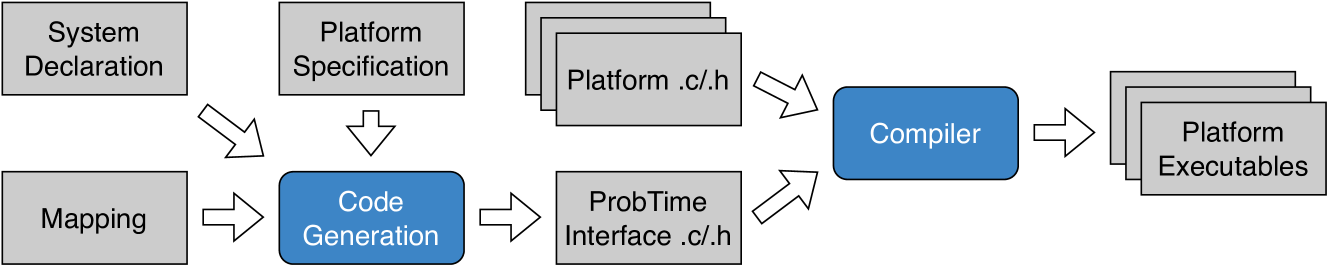
This flowchart illustrates a multi-stage compilation process transforming system declarations into platform executables. The process involves system specification, code generation, compilation, and final executable production, with explicit dependencies between components.
### Components/Axes
1. **System Declaration** (Top-left)
- Initial input specification
2. **Platform Specification** (Top-center)
- Configuration parameters
3. **Platform .c/.h** (Top-right)
- Core platform implementation
4. **ProbTime Interface .c/.h** (Bottom-right)
- Probabilistic timing interface
5. **Mapping** (Bottom-left)
- System-to-platform translation
6. **Code Generation** (Central blue node)
- Intermediate code production
7. **Compiler** (Central blue node)
- Code optimization and compilation
8. **Platform Executables** (Far right)
- Final output products
### Detailed Analysis
- **System Declaration** → **Platform Specification**: System requirements feed into platform configuration
- **Platform Specification** ↓ **Mapping**: Configuration enables system-to-platform translation
- **Mapping** → **Code Generation**: Translated specifications generate intermediate code
- **Code Generation** → **ProbTime Interface .c/.h**: Timing constraints are encoded
- **Platform .c/.h** and **ProbTime Interface .c/.h** → **Compiler**: Dual input compilation
- **Compiler** → **Platform Executables**: Optimized binaries are produced
### Key Observations
1. **Dual Input Compilation**: Both platform implementation and timing interfaces are required for compilation
2. **Sequential Dependency Chain**: Each stage depends on prior outputs
3. **Color Coding**: Blue nodes (Code Generation, Compiler) highlight critical transformation stages
4. **Bidirectional Flow**: Arrows show both vertical and horizontal dependencies
### Interpretation
This diagram represents a typical embedded systems development pipeline where:
- System-level abstractions (declarations/specifications) must be translated into concrete implementations (code generation)
- Timing constraints (ProbTime Interface) are critical for real-time systems
- The compiler acts as a convergence point requiring both platform implementation and timing information
- The final executables represent the physical manifestation of initial system requirements
The blue coloring of Code Generation and Compiler nodes suggests these are the most computationally intensive stages. The absence of error handling paths implies this represents an idealized, linear workflow.