\n
## Diagram: Conceptual Mapping
### Overview
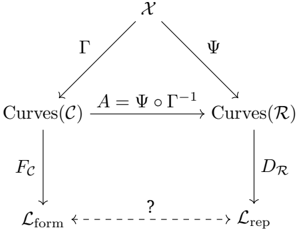
The image presents a diagram illustrating a conceptual mapping between different spaces or sets, likely within a mathematical or geometric context. It depicts a series of transformations and relationships between these spaces, represented by labeled nodes and arrows. The diagram appears to be a commutative diagram, suggesting that different paths between points yield the same result.
### Components/Axes
The diagram consists of the following components:
* **Nodes:** χ (Chi), Γ (Gamma), Ψ (Psi), Curves(C), Curves(R), 𝓛form (L-form), 𝓛rep (L-rep).
* **Transformations/Mappings:** Γ (from χ to Curves(C)), Ψ (from χ to Curves(R)), A = Ψ ∘ Γ⁻¹ (from Curves(C) to Curves(R)), F<sub>C</sub> (from Curves(C) to 𝓛form), D<sub>R</sub> (from Curves(R) to 𝓛rep).
* **Question Mark:** A dashed arrow with a question mark indicates an unknown or unproven relationship between 𝓛form and 𝓛rep.
* **Arrows:** Solid arrows represent defined transformations, while the dashed arrow represents a potential or unconfirmed relationship.
### Detailed Analysis or Content Details
The diagram shows the following relationships:
1. χ maps to Curves(C) via Γ.
2. χ maps to Curves(R) via Ψ.
3. Curves(C) maps to Curves(R) via A, defined as the composition of Ψ and the inverse of Γ (Ψ ∘ Γ⁻¹).
4. Curves(C) maps to 𝓛form via F<sub>C</sub>.
5. Curves(R) maps to 𝓛rep via D<sub>R</sub>.
6. There is a potential, but unconfirmed, relationship between 𝓛form and 𝓛rep, indicated by the dashed arrow and question mark.
The notation "∘" represents function composition. Γ⁻¹ denotes the inverse of the transformation Γ.
### Key Observations
The central element is the mapping A = Ψ ∘ Γ⁻¹, which connects Curves(C) and Curves(R). The diagram suggests that the composition of Ψ and the inverse of Γ provides a transformation between these two spaces. The question mark highlights a gap in the understanding of the relationship between 𝓛form and 𝓛rep. The diagram is structured in a way that suggests a commutative property, where following different paths between nodes should yield the same result.
### Interpretation
This diagram likely represents a conceptual framework for relating different representations or spaces within a mathematical or geometric problem. χ could represent an initial space or set of data. Γ and Ψ are transformations that map this space to different curve spaces, Curves(C) and Curves(R), respectively. The mapping A represents a transformation between these curve spaces. F<sub>C</sub> and D<sub>R</sub> then map these curves to final forms, 𝓛form and 𝓛rep.
The question mark indicates that the relationship between the final forms (𝓛form and 𝓛rep) is not yet established or understood. The diagram could be used to explore the conditions under which these final forms are equivalent or related. The overall structure suggests a process of transforming data through a series of mappings to arrive at different representations, and the diagram is used to visualize and analyze these relationships. The diagram is a visual representation of a mathematical argument, and the goal is likely to prove or disprove the existence of the dashed arrow relationship.