## Diagram: Transformation and Relationship Between Curve Sets and Representations
### Overview
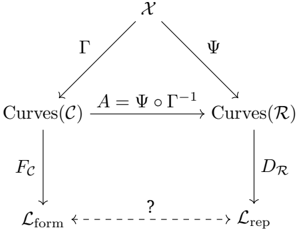
The diagram illustrates a conceptual framework involving transformations between curve sets (Curves(C) and Curves(R)) and their associated representations (L_form and L_rep). It includes mappings, function compositions, and an unresolved relationship denoted by a question mark.
### Components/Axes
- **Top Layer**:
- **X**: A central node splitting into two paths.
- **Γ (Gamma)**: Arrow from X to Curves(C), labeled as a function mapping.
- **Ψ (Psi)**: Arrow from X to Curves(R), labeled as a function mapping.
- **Middle Layer**:
- **A = Ψ ∘ Γ⁻¹**: Transformation between Curves(C) and Curves(R), indicating a composition of Ψ and the inverse of Γ.
- **Bottom Layer**:
- **FC**: Arrow from Curves(C) to L_form (form representation).
- **DR**: Arrow from Curves(R) to L_rep (representation).
- **Question Mark (?)**: Dashed bidirectional arrow between L_form and L_rep, indicating an unresolved or unknown relationship.
### Detailed Analysis
1. **Top Layer**:
- **X** acts as a source node, branching into two distinct mappings:
- **Γ**: Maps X to Curves(C), suggesting a transformation or encoding process for curve set C.
- **Ψ**: Maps X to Curves(R), indicating a separate transformation for curve set R.
- **Curves(C)** and **Curves(R)** are intermediate sets derived from X via Γ and Ψ, respectively.
2. **Middle Layer**:
- **A = Ψ ∘ Γ⁻¹** defines a bidirectional or composite transformation between Curves(C) and Curves(R). This implies that Curves(R) can be derived from Curves(C) via the inverse of Γ followed by Ψ, or vice versa.
3. **Bottom Layer**:
- **FC** and **DR** represent mappings from curve sets to their respective representations:
- **FC**: Maps Curves(C) to L_form (form representation).
- **DR**: Maps Curves(R) to L_rep (representation).
- The **question mark (?)**, placed between L_form and L_rep, highlights an unresolved relationship or dependency between these two representations. This could imply uncertainty about how form and representation layers interact or whether they are equivalent, complementary, or independent.
### Key Observations
- The diagram emphasizes **transformations** (Γ, Ψ, A) as core mechanisms linking abstract sets (X, Curves(C), Curves(R)) to concrete representations (L_form, L_rep).
- The **question mark** is the only ambiguous element, suggesting a gap in understanding or a research question about the relationship between L_form and L_rep.
- No numerical data or trends are present; the focus is on structural relationships and mappings.
### Interpretation
This diagram likely represents a theoretical framework in a domain such as computational geometry, machine learning (e.g., curve representation learning), or mathematical modeling. Key insights include:
1. **Transformation Hierarchy**: X is the foundational entity, with Γ and Ψ acting as specialized transformations for curve sets C and R.
2. **Compositional Relationship**: The transformation A bridges C and R, implying interoperability or equivalence under specific conditions.
3. **Representation Ambiguity**: The unresolved link between L_form and L_rep raises questions about how form and representation are related. For example:
- Are they dual perspectives of the same underlying structure?
- Is there a missing function or constraint connecting them?
- Do they operate in separate domains (e.g., geometric vs. algebraic representations)?
The diagram underscores the importance of clarifying the relationship between form and representation in the context of curve transformations. The question mark serves as a focal point for further investigation, potentially guiding future work to resolve this ambiguity.