## Diagram: Symbolic Generation and LLM Interaction
### Overview
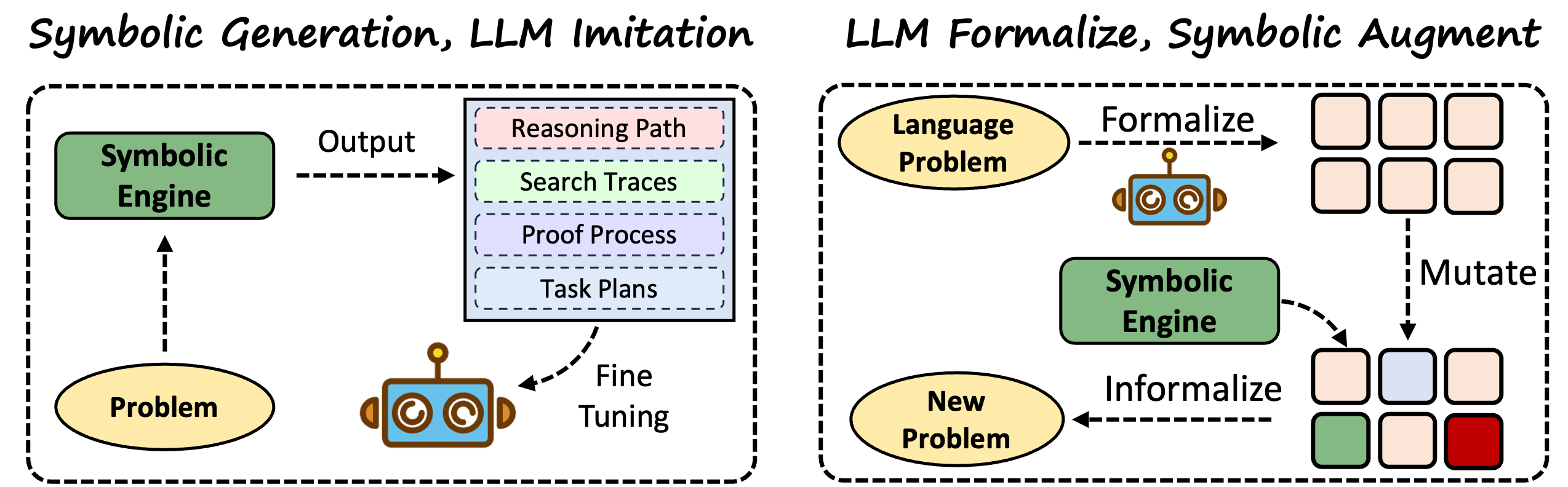
The image presents a diagram illustrating two distinct processes: "Symbolic Generation, LLM Imitation" and "LLM Formalize, Symbolic Augment." Each process involves a symbolic engine, a language model (LLM), and the interaction between them. The diagram uses arrows to indicate the flow of information and processes.
### Components/Axes
**Left Side: Symbolic Generation, LLM Imitation**
* **Symbolic Engine:** A green rounded rectangle labeled "Symbolic Engine."
* **Problem:** A yellow oval labeled "Problem."
* **Output:** An arrow labeled "Output" pointing from the Symbolic Engine to a box containing:
* **Reasoning Path:** A light pink rounded rectangle labeled "Reasoning Path."
* **Search Traces:** A light green rounded rectangle labeled "Search Traces."
* **Proof Process:** A light purple rounded rectangle labeled "Proof Process."
* **Task Plans:** A light blue rounded rectangle labeled "Task Plans."
* **Fine Tuning:** An arrow labeled "Fine Tuning" pointing from a blue robot-like figure to the Symbolic Engine.
**Right Side: LLM Formalize, Symbolic Augment**
* **Language Problem:** A yellow oval labeled "Language Problem."
* **Formalize:** An arrow labeled "Formalize" pointing from the Language Problem to a blue robot-like figure.
* **Symbolic Engine:** A green rounded rectangle labeled "Symbolic Engine."
* **New Problem:** A yellow oval labeled "New Problem."
* **Informalize:** An arrow labeled "Informalize" pointing from the Symbolic Engine to the New Problem.
* **Mutate:** An arrow labeled "Mutate" pointing from a set of six light orange squares to a set of nine squares, where one is light blue, one is green, and one is red.
### Detailed Analysis
**Left Side: Symbolic Generation, LLM Imitation**
1. A "Problem" is fed into the "Symbolic Engine."
2. The "Symbolic Engine" generates an "Output" consisting of "Reasoning Path," "Search Traces," "Proof Process," and "Task Plans."
3. A robot-like figure performs "Fine Tuning" on the "Symbolic Engine."
**Right Side: LLM Formalize, Symbolic Augment**
1. A "Language Problem" is "Formalized" by a robot-like figure.
2. The formalized problem is then processed by a set of six light orange squares.
3. These squares are "Mutated" into a set of nine squares, with one light blue, one green, and one red.
4. The "Symbolic Engine" then "Informalizes" the mutated output into a "New Problem."
### Key Observations
* The diagram illustrates two complementary processes involving symbolic engines and language models.
* The left side focuses on generating symbolic representations from a problem, while the right side focuses on formalizing language problems and augmenting them with symbolic reasoning.
* The robot-like figure appears to represent the LLM component, performing tasks like fine-tuning and formalization.
* The "Mutate" step on the right side suggests a transformation or evolution of the problem representation.
### Interpretation
The diagram suggests a framework for combining the strengths of symbolic reasoning and language models. The "Symbolic Generation, LLM Imitation" process leverages the symbolic engine's ability to generate structured representations, while the LLM is used for fine-tuning. The "LLM Formalize, Symbolic Augment" process uses the LLM to formalize language problems, which are then augmented with symbolic reasoning through mutation and informalization. This approach could be used to solve complex problems that require both structured reasoning and natural language understanding. The mutation step is interesting, as it suggests a way to explore different problem representations and potentially discover novel solutions. The use of color-coding in the mutated squares (light blue, green, red) could represent different aspects or properties of the problem.