## Diagram: Foundation Model Training and Adaptation
### Overview
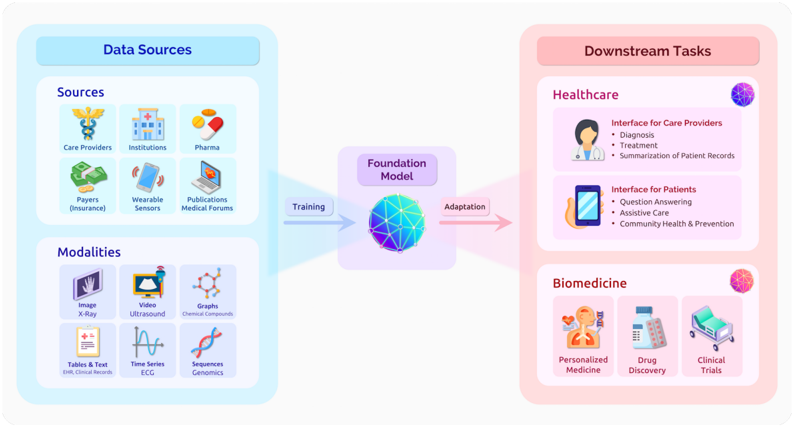
The image is a diagram illustrating the training and adaptation of a foundation model using various data sources and modalities for downstream tasks in healthcare and biomedicine. The diagram is divided into three main sections: Data Sources (left), Foundation Model (center), and Downstream Tasks (right).
### Components/Axes
**Data Sources (Left Section):**
* **Title:** Data Sources
* **Sources:**
* Care Providers (icon: caduceus)
* Institutions (icon: hospital building)
* Pharma (icon: pills)
* Payers (Insurance) (icon: stack of money)
* Wearable Sensors (icon: smartphone)
* Publications Medical Forums (icon: laptop)
* **Modalities:**
* Image X-Ray (icon: X-ray image)
* Video Ultrasound (icon: ultrasound machine)
* Graphs Chemical Compounds (icon: molecular structure)
* Tables & Text EHR, Clinical Records (icon: clipboard)
* Time Series ECG (icon: ECG graph)
* Sequences Genomics (icon: DNA strand)
**Foundation Model (Center Section):**
* **Title:** Foundation Model
* **Process:**
* Training (arrow pointing from Data Sources to Foundation Model)
* Adaptation (arrow pointing from Foundation Model to Downstream Tasks)
* **Model Representation:** A multi-faceted, spherical object representing the foundation model.
**Downstream Tasks (Right Section):**
* **Title:** Downstream Tasks
* **Healthcare:**
* Interface for Care Providers
* Diagnosis
* Treatment
* Summarization of Patient Records
* Interface for Patients
* Question Answering
* Assistive Care
* Community Health & Prevention
* **Biomedicine:**
* Personalized Medicine (icon: human body with internal organs)
* Drug Discovery (icon: pills and vial)
* Clinical Trials (icon: hospital bed)
### Detailed Analysis or ### Content Details
The diagram illustrates a workflow where diverse data sources and modalities are used to train a foundation model. This model is then adapted for specific downstream tasks in healthcare and biomedicine.
* **Data Sources:** The data sources include information from care providers, institutions, pharmaceutical companies, payers (insurance), wearable sensors, and publications/medical forums.
* **Modalities:** The modalities encompass various data types such as images (X-rays), videos (ultrasound), graphs (chemical compounds), tables and text (EHR, clinical records), time series (ECG), and sequences (genomics).
* **Foundation Model:** The foundation model acts as a central hub, receiving input from the data sources through a "Training" process and then being adapted for specific applications.
* **Downstream Tasks:** The downstream tasks are categorized into Healthcare and Biomedicine. Healthcare applications include interfaces for care providers (diagnosis, treatment, summarization of patient records) and interfaces for patients (question answering, assistive care, community health & prevention). Biomedicine applications include personalized medicine, drug discovery, and clinical trials.
### Key Observations
* The diagram emphasizes the integration of diverse data types and sources for training a foundation model.
* The foundation model serves as a bridge between data input and specific applications in healthcare and biomedicine.
* The downstream tasks are divided into two main categories: Healthcare and Biomedicine, each with specific applications.
### Interpretation
The diagram illustrates the application of foundation models in healthcare and biomedicine. It highlights the importance of diverse data sources and modalities in training these models. The foundation model approach allows for the development of versatile tools that can be adapted for a wide range of downstream tasks, from assisting healthcare providers and patients to advancing personalized medicine and drug discovery. The diagram suggests a comprehensive approach to leveraging data for improving healthcare outcomes and advancing biomedical research.