TECHNICAL ASSET FINGERPRINT
e18fbef19456ed88a427b85a
Click to view fullscreen
Press ESC or click to close
FOUND IN PAPERS
EXPERT: gemini-2.5-flash-lite-free VERSION 1
RUNTIME: google-free/gemini-2.5-flash-lite
INTEL_VERIFIED
## Venn Diagrams: Daily Screen Usage, Impact of Long Screen Time, Strategies to Balance, and Effect After Balance
### Overview
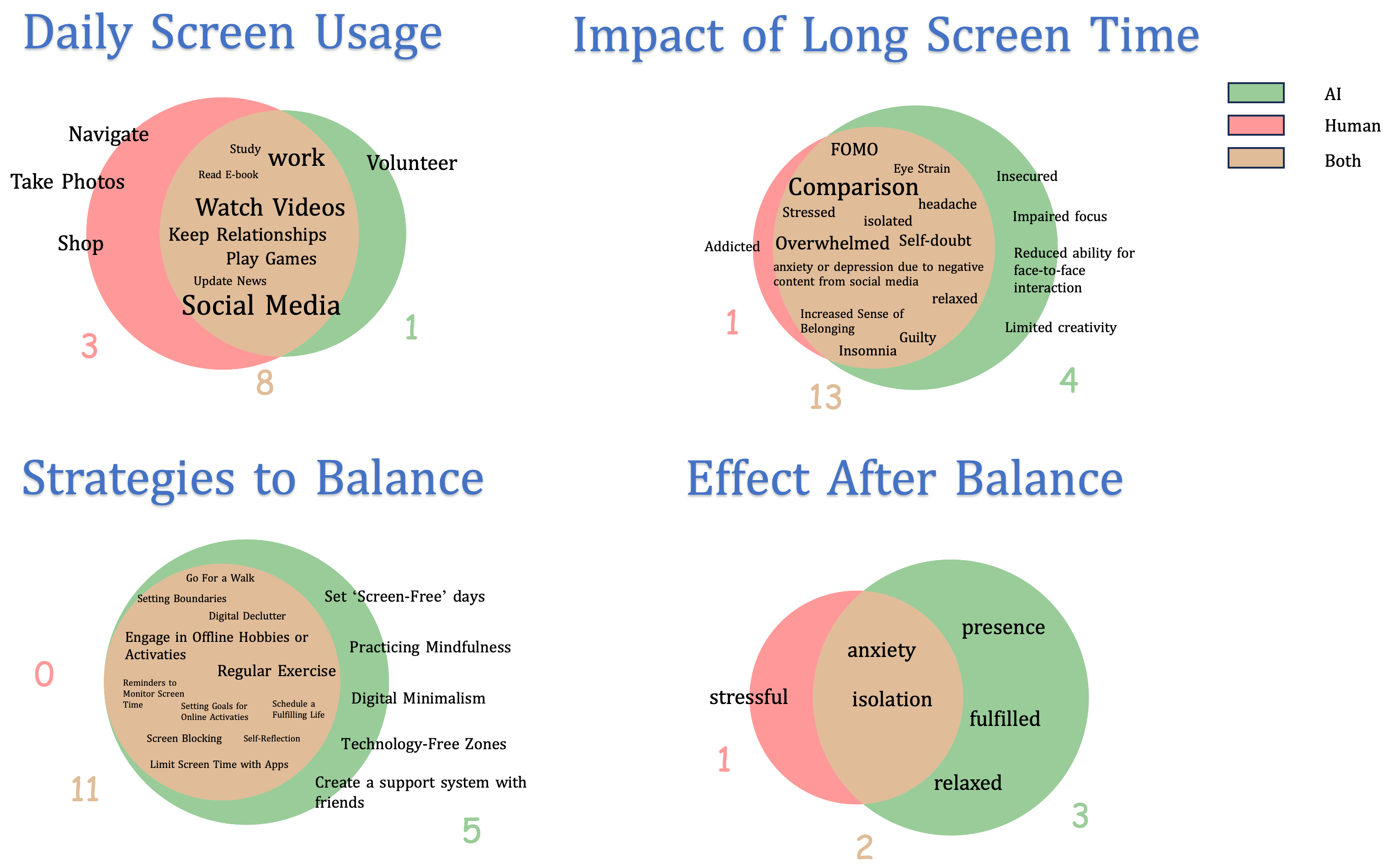
This image presents four Venn diagrams, each illustrating different aspects related to screen time. The top row displays "Daily Screen Usage" and "Impact of Long Screen Time," while the bottom row shows "Strategies to Balance" and "Effect After Balance." Each diagram uses colored circles to represent categories and lists various activities, impacts, or strategies within these categories and their intersections. A legend in the top right corner associates colors (green, pink, beige) with "AI," "Human," and "Both," respectively, though this legend appears to be relevant only to the "Impact of Long Screen Time" diagram. Numerical values are present outside and within the circles, likely representing counts or proportions.
### Components/Axes
**General Legend (Top Right):**
* **Green Square:** AI
* **Pink Square:** Human
* **Beige Square:** Both
**Diagram 1: Daily Screen Usage**
* **Title:** Daily Screen Usage
* **Circles:**
* **Pink Circle (Left):** Represents activities primarily associated with "Human" (based on legend, though not explicitly stated for this diagram). Contains labels: "Navigate," "Take Photos," "Shop," "Social Media."
* **Green Circle (Right):** Represents activities primarily associated with "AI" (based on legend, though not explicitly stated for this diagram). Contains labels: "Volunteer," "Work."
* **Beige Overlap (Center):** Represents activities associated with "Both" (based on legend, though not explicitly stated for this diagram). Contains labels: "Study," "Read E-book," "Watch Videos," "Keep Relationships," "Play Games," "Update News."
* **External Numbers:**
* "3" (bottom-left, pink): Likely represents items exclusively in the pink circle.
* "1" (bottom-right, green): Likely represents items exclusively in the green circle.
* "8" (bottom-center, beige): Likely represents items exclusively in the beige overlap.
**Diagram 2: Impact of Long Screen Time**
* **Title:** Impact of Long Screen Time
* **Circles:**
* **Pink Circle (Left):** Labeled "Human" in the legend. Contains labels: "Addicted," "Stressed," "Comparison," "FOMO," "anxiety or depression due to negative content from social media," "Increased Sense of Belonging," "Insomnia."
* **Green Circle (Right):** Labeled "AI" in the legend. Contains labels: "Insecure," "Impaired focus," "Reduced ability for face-to-face interaction," "Limited creativity."
* **Beige Overlap (Center):** Labeled "Both" in the legend. Contains labels: "Overwhelmed," "Self-doubt," "relaxed," "Guilty."
* **External Numbers:**
* "1" (bottom-left, pink): Likely represents items exclusively in the pink circle.
* "4" (bottom-right, green): Likely represents items exclusively in the green circle.
* "13" (bottom-center, beige): Likely represents items exclusively in the beige overlap.
**Diagram 3: Strategies to Balance**
* **Title:** Strategies to Balance
* **Circles:**
* **Pink Circle (Left):** Contains labels: "Go For a Walk," "Setting Boundaries," "Digital Declutter," "Engage in Offline Hobbies or Activates," "Reminders to Monitor Screen Time," "Screen Blocking," "Limit Screen Time with Apps."
* **Green Circle (Right):** Contains labels: "Set 'Screen-Free' days," "Practicing Mindfulness," "Digital Minimalism," "Technology-Free Zones," "Create a support system with friends."
* **Beige Overlap (Center):** Contains labels: "Regular Exercise," "Setting Goals for Online Activates," "Schedule a Fulfilling Life," "Self-Reflection."
* **External Numbers:**
* "0" (left, pink): Likely represents items exclusively in the pink circle.
* "5" (bottom-right, green): Likely represents items exclusively in the green circle.
* "11" (bottom-left, beige): Likely represents items exclusively in the beige overlap.
**Diagram 4: Effect After Balance**
* **Title:** Effect After Balance
* **Circles:**
* **Pink Circle (Left):** Contains labels: "stressful."
* **Green Circle (Right):** Contains labels: "presence," "fulfilled," "relaxed."
* **Beige Overlap (Center):** Contains labels: "anxiety," "isolation."
* **External Numbers:**
* "1" (bottom-left, pink): Likely represents items exclusively in the pink circle.
* "3" (bottom-right, green): Likely represents items exclusively in the green circle.
* "2" (bottom-center, beige): Likely represents items exclusively in the beige overlap.
### Detailed Analysis or Content Details
**Daily Screen Usage:**
* **Pink (Human-centric):** Navigate, Take Photos, Shop, Social Media. External count: 3.
* **Green (AI-centric):** Volunteer, Work. External count: 1.
* **Beige (Both):** Study, Read E-book, Watch Videos, Keep Relationships, Play Games, Update News. External count: 8.
**Impact of Long Screen Time:**
* **Pink (Human):** Addicted, Stressed, Comparison, FOMO, anxiety or depression due to negative content from social media, Increased Sense of Belonging, Insomnia. External count: 1.
* **Green (AI):** Insecure, Impaired focus, Reduced ability for face-to-face interaction, Limited creativity. External count: 4.
* **Beige (Both):** Overwhelmed, Self-doubt, relaxed, Guilty. External count: 13.
**Strategies to Balance:**
* **Pink (Exclusive):** Go For a Walk, Setting Boundaries, Digital Declutter, Engage in Offline Hobbies or Activates, Reminders to Monitor Screen Time, Screen Blocking, Limit Screen Time with Apps. External count: 0.
* **Green (Exclusive):** Set 'Screen-Free' days, Practicing Mindfulness, Digital Minimalism, Technology-Free Zones, Create a support system with friends. External count: 5.
* **Beige (Overlap):** Regular Exercise, Setting Goals for Online Activates, Schedule a Fulfilling Life, Self-Reflection. External count: 11.
**Effect After Balance:**
* **Pink (Exclusive):** stressful. External count: 1.
* **Green (Exclusive):** presence, fulfilled, relaxed. External count: 3.
* **Beige (Overlap):** anxiety, isolation. External count: 2.
### Key Observations
* **Daily Screen Usage:** "Social Media" is a prominent activity in the "Both" category, suggesting it's a common activity for both human and AI-related contexts (or perhaps a broad category encompassing both). "Work" and "Volunteer" are categorized as "AI" activities, which is an unusual categorization for "Volunteer." "Study" and "Read E-book" are also in the "Both" category.
* **Impact of Long Screen Time:** The "Both" category has the highest count (13), indicating that "Overwhelmed," "Self-doubt," "relaxed," and "Guilty" are common impacts experienced by both humans and AI (or in both contexts). Negative impacts like "anxiety or depression" and "Insomnia" are listed under the "Human" category. "Reduced ability for face-to-face interaction" and "Limited creativity" are listed under the "AI" category, which is a peculiar attribution for AI.
* **Strategies to Balance:** The "Overlap" category for strategies (11) is the largest, suggesting that activities like "Regular Exercise," "Setting Goals," "Schedule a Fulfilling Life," and "Self-Reflection" are considered multifaceted or beneficial across different aspects of balance. The "Human" exclusive strategies (0) are notably absent in this count, implying all listed strategies are either shared or have some overlap.
* **Effect After Balance:** The "Overlap" category for effects after balance (2) is the smallest, with "anxiety" and "isolation." The "AI" exclusive effects (3) are "presence," "fulfilled," and "relaxed," which are generally positive outcomes. The "Human" exclusive effect (1) is "stressful."
### Interpretation
The collection of Venn diagrams provides a conceptual framework for understanding screen time, its impacts, and strategies for balance.
1. **Daily Screen Usage:** This diagram suggests a categorization of daily activities based on their perceived association with human or AI contexts. The significant overlap in the "Both" category for activities like "Study," "Watch Videos," and "Social Media" highlights their ubiquity. The categorization of "Volunteer" and "Work" under "AI" is a notable point of interpretation, potentially reflecting a perspective on how these activities are facilitated or perceived in an increasingly automated or digitally-driven world, or it might be a misapplication of the legend.
2. **Impact of Long Screen Time:** This diagram illustrates the negative consequences of excessive screen time, with a strong emphasis on psychological and emotional impacts. The high count in the "Both" category for "Overwhelmed" and "Self-doubt" suggests these are widespread issues. The attribution of impacts like "Insecure," "Impaired focus," and "Limited creativity" to "AI" is highly unconventional and warrants further investigation into the intended meaning. It's possible "AI" here refers to the digital environment or systems rather than artificial intelligence itself, or it represents a novel perspective on how AI systems might be affected by or contribute to these issues. The legend's explicit labeling of colors to "AI" and "Human" makes this interpretation critical.
3. **Strategies to Balance:** This diagram outlines various approaches to mitigate the negative effects of screen time. The large overlap in strategies suggests that many effective methods are multifaceted and contribute to overall well-being. The absence of any "Human" exclusive strategies (count of 0) implies that all listed strategies are either shared or have some degree of overlap, reinforcing the idea of holistic approaches to balance.
4. **Effect After Balance:** This diagram contrasts the outcomes of balancing screen time. The positive outcomes like "presence," "fulfilled," and "relaxed" are associated with the "AI" category, while "stressful" is linked to "Human." The overlap of "anxiety" and "isolation" suggests these are common challenges that can arise even when attempting balance, or perhaps are residual effects. The interpretation of "AI" here is again crucial; if it refers to the digital environment, then positive states are associated with it, while "stressful" is a human-specific outcome. If "AI" refers to artificial intelligence, this implies AI systems can achieve states of "presence" and "fulfillment" after balance, which is a speculative interpretation.
**Overall Interpretation:** The diagrams collectively suggest a complex relationship between humans and technology, particularly concerning screen time. There's an acknowledgment of both the utility and the detrimental impacts of screen usage. The "Impact of Long Screen Time" diagram, in particular, presents some unconventional attributions to "AI," which might indicate a specific theoretical model or a metaphorical use of the term. The "Strategies to Balance" and "Effect After Balance" diagrams offer a more conventional view, emphasizing holistic approaches and the pursuit of positive states like presence and fulfillment. The numerical values, while not providing precise data points, offer a relative sense of the prevalence of different categories within each diagram. The consistent use of Venn diagrams implies a focus on overlapping and distinct elements within each thematic area.
DECODING INTELLIGENCE...